
Afghanistan-Pakistan Conflict Puts Russia at Center of Regional Diplomacy
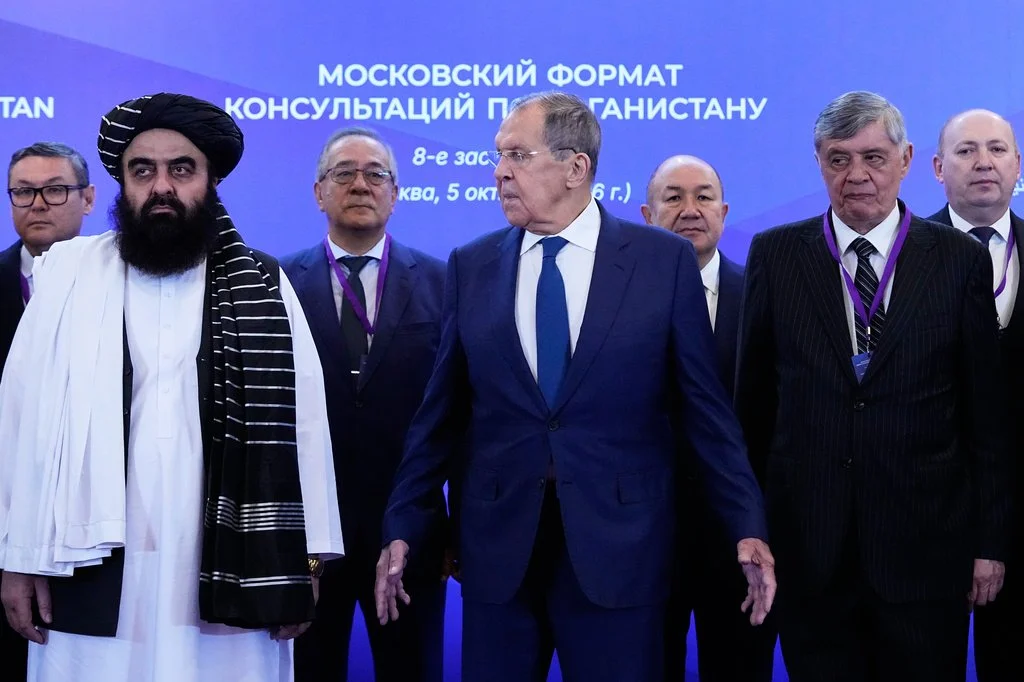
Front, from left, Afghanistan's Foreign Minister Amir Khan Muttaqi, Russian Foreign Minister Sergey Lavrov and Russian Presidential Envoy to Afghanistan Zamir Kabulov pose for a photo ahead of the Moscow format consultations on Afghanistan in Moscow, Monday, Oct. 5, 2026. (AP Photo/Alexander Zemlianichenko). Photo: AP Photo
Russia offered to mediate between Afghanistan and Pakistan after their dispute over militant activity prevented regional powers from issuing a joint statement at talks in Moscow on October 5th, 2026. The outcome underscored the difficulty of erasing tensions between two countries as they continue to exchange accusations over militant activity and cross-border attacks.
The Moscow meeting brought together representatives from Afghanistan and Pakistan alongside Russia and other regional powers seeking to address cross-border militancy and instability. Known as the Moscow Format, the Russia-hosted consultations is a regional diplomatic platform addressing Afghanistan’s political, security and humanitarian conditions since 2017.
Pakistan has repeatedly accused the Taliban government of allowing the Pakistani Taliban, formally known as Tehrik-e-Taliban Pakistan (TTP), to use Afghan territory to organize attacks across the border. The Pakistani Taliban is distinct from Afghanistan’s governing Taliban but shares ideological and historical ties with it. The group seeks to overthrow Pakistan’s government and impose its interpretation of Islamic law. Kabul has denied providing TTP a safe haven alongside Pakistan’s accusations.
The meeting was held amid escalating tensions between Afghanistan and Pakistan over such violence. Pakistan’s special representative for Afghanistan, Mohammad Sadiq, argued that terrorism originating from Afghan territory remained central to the dispute, accusing the Taliban government of supporting militant groups. Afghanistan’s delegation objected to what it considered an excessive focus on Afghanistan in connection to terrorism, according to Zamir Kabulov, Russia’s special representative for Afghanistan. The disagreement prevented participants from issuing a joint statement.
Afghanistan’s Taliban government has denied that it permits militants to use the country as a base for attacks on Pakistan. It has also accused Pakistan of violating Afghan sovereignty through cross-border military operations. The competing claims have strained relations between neighboring countries, which share a border of more than 1,600 miles.
Tensions persisted ahead of the Moscow meeting. Pakistan accused militant groups of meeting in the southern Afghan city of Kandahar to coordinate attacks, an allegation the Taliban denied. Pakistan did not publicly provide evidence supporting that specific claim.
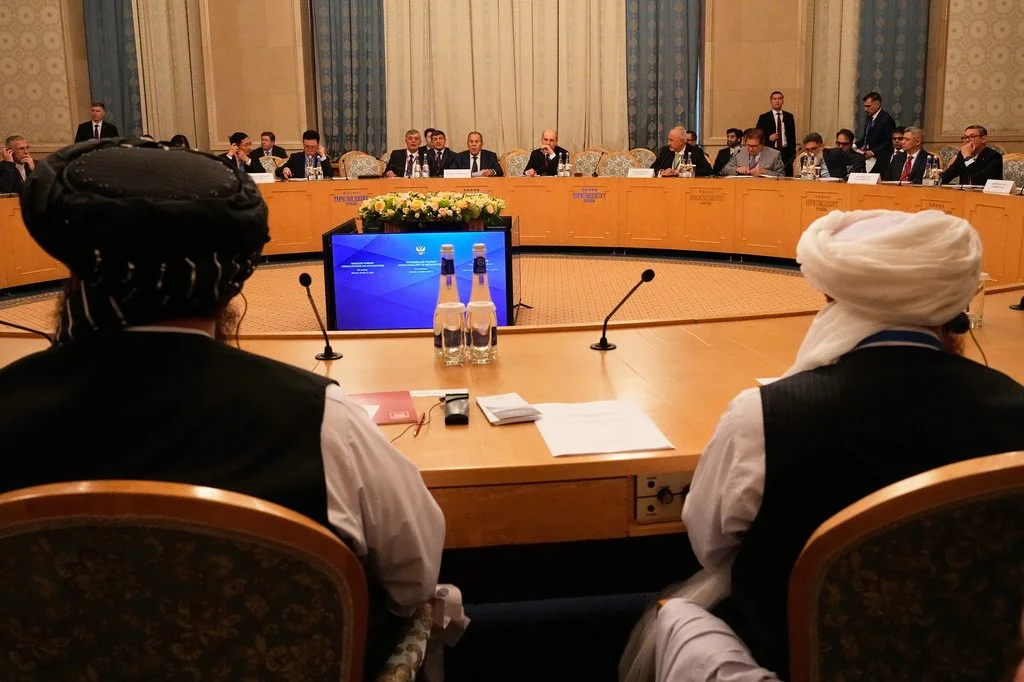
Russian Foreign Minister Sergey Lavrov, center, speaks during the Moscow format consultations on Afghanistan in Moscow, Monday, Oct. 5, 2026. (AP Photo/Alexander Zemlianichenko). Photo: AP Photo
Russia’s envoy for Afghanistan, Kabulov said Russia was prepared to assist Afghanistan and Pakistan in resolving their dispute, “Russia stands ready to help end this conflict using all possible means and acting independently or together with other partners if both parties ask for it.” The offer came as Russia continued hosting regional consultations on Afghanistan involving neighboring countries and other regional governments.
Russia became the first country to formally recognize the Taliban government in July 2025. The Taliban returned to power in August 2021 following the withdrawal of United States and allied forces, but most governments have not granted it formal recognition. International concerns have included the Taliban’s restrictions. Specifically, entities like TTP and Islamic State Khorasan Province (IS-K, also known as ISIL-K), on women and girls, its human-rights record and allegations that militant organizations continue to operate from Afghan territory.
The presence of several regional powers at the October meeting demonstrated that Afghanistan-Pakistan tensions extend beyond their shared border. China’s economic ties with Pakistan include the China-Pakistan Economic Corridor (CPEC), a flagship of Beijing’s Belt and Road Initiative. Projects listed by the CPEC Secretariat include upgrades to the Karakoram Highway and other road infrastructure. In Afghanistan, China and the Afghan government have identified the Aynak copper-mine and Amu Darya basin oil projects as potential areas for investment, although a 2024 bilateral statement described progress on both as slow.
Despite their participation, the delegates were unable to agree on a common description of the principal security issue. Russian envoy Zamir Kabulov said the Afghan and Pakistani delegations “didn’t see eye to eye” while drafting the joint statement. The absence of a joint statement limited the meeting’s immediate diplomatic outcome and demonstrated how disagreement over responsibility for militant violence continues to obstruct negotiations.
Pakistan continued raising the issue internationally after the talks. On October 7th, 2026, Prime Minister Shehbaz Sharif discussed militant groups operating from Afghanistan during a meeting with United Nations Secretary-General António Guterres. Pakistan reiterated its position that the Taliban government must prevent Afghan territory from being used to organize attacks.
The Moscow meeting expanded regional discussion of the dispute but produced no agreement between Afghanistan and Pakistan. Russia’s offer to mediate created another possible diplomatic channel, although it depended on both governments accepting outside assistance. The failed statements showed that regional powers could bring the parties together but could not resolve their disagreements over militant activity and responsibility for cross-border violence.