
Gen-Z is Reshaping South Asia’s Political Landscape
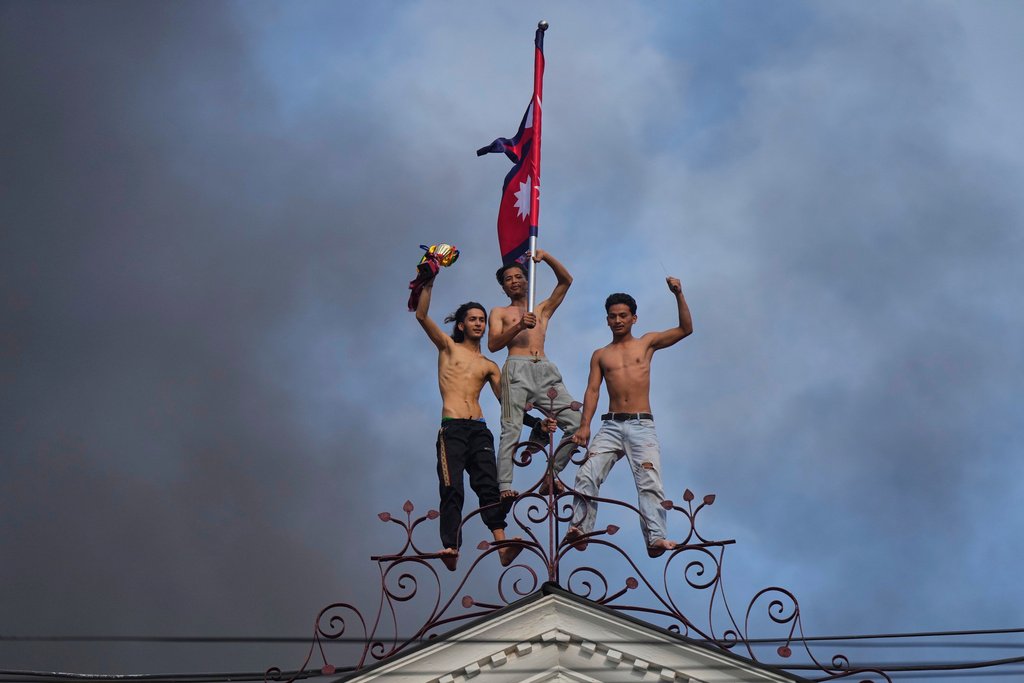
Protesters celebrate standing at the top of the Singha Durbar, the seat of Nepal's government's various ministries and offices, after it was set on fire during a protest against social media ban and corruption in Kathmandu, Nepal, Tuesday, Sept. 9, 2025. (AP Photo/Niranjan Shrestha, File)
On March 8, 2026, Nepalis voted in the country’s first parliamentary election since Gen Z protesters toppled its government six months earlier. The early results were surprising: the Rastriya Swatantra party, also known as the National Independent party, formed just four years ago and led by ex-rapper Balendra Shah, swept 103 out of 165 directly elected seats, with leads in 21 more. The country’s two long-dominant parties, the Nepali Congress and the Communist Party of Nepal, were defeated. “People’s ballot revolt; shift in political paradigm,” declared the Annapurna Post.
Nepal’s election didn’t occur in a vacuum. It is the third country in three years to see youth-led revolts topple its government, part of a broader wave of generational revolts sweeping across South Asia since 2022. Gen Z has decided, in country after country, that waiting for change from within with broken systems is no longer an option.
The first revolt started in Sri Lanka in 2022. Faced with economic collapse, with 12-hour power blackouts, fuel shortages, and inflation above 50 percent, young Sri Lankans set up a protest camp outside the Presidential Secretariat in Colombo. In mid-July, President Gotabaya Rajapaksa, whose family had governed the country for 15 of the previous 18 years, fled. Two years later, Bangladesh followed. What began as a student campaign against discriminatory job quotas became a broader uprising against Prime Minister Sheikh Hasina’s 15-year rule. After security forces killed hundreds of protesters, Hasina fled by helicopter on Aug. 5, 2024.
Then came Nepal. In September 2025, the government banned major social media platforms. Thousands of young Nepalis, many still in school uniforms, poured into the streets when security forces opened fire and killed more than 70 protestors. The government’s legitimacy collapsed. Prime Minister K.P. Sharma Oli resigned days later.
“It’s certainly very striking. There’s this kind of new politics of instability,” said Paul Staniland, a political science professor at the University of Chicago who studies South Asia. He noted that in each case, the governments shared a common weakness. Their institutions were hollowed out by personalism and patronage, with little legitimacy left when anger amongst Gen Z boiled over.
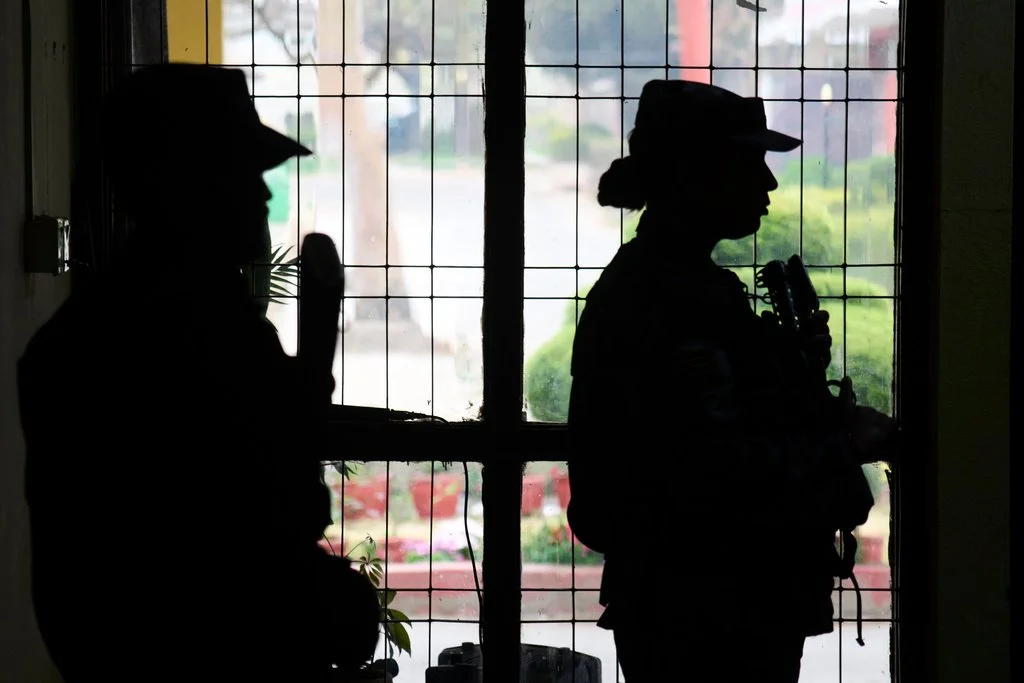
Police stand guard at the door as vote counting takes place at a counting center for the parliamentary election in Lalitpur, Nepal, Sunday, March 8, 2026. (AP Photo/Niranjan Shrestha)
Nearly 50 percent of people in Nepal, Bangladesh, and Sri Lanka are under 28. Many members of Gen Z have lived through two economic recessions and a pandemic that improved their digital organizing skills while shrinking their economic opportunities. When they emerged to find their governments led by men in the 70s (Oli was 73, Hasina was 76, Rajapaksa was 74), they felt disconnected from their political leaders. “The dissonance was too high,” said Meenakshi Ganguly of Human Rights Watch.
But toppling governments has proven easier than replacing them. In Bangladesh, the National Citizen Party, founded by protest leaders, won only six of the 30 seats it contested. The winner was the Bangladesh National Party (BNP), the party that the revolution sought to dismantle. Gen Z got fair elections in their revolution, but still got crushed at the ballot box. Nepal’s RSP may yet prove to be the exception. But Staniland cautions that a decentralized protest movement, especially without a developed governing platform, faces obstacles in rebuilding damaged state institutions. This is true especially when patronage networks and entrenched parties, along with their supporters, do not simply disappear after one bad election.
The upheavals have unsettled regional geopolitics too. Oli has been tilting Nepal towards Beijing, and that agenda stalled the moment he resigned. Hasina's leaving ended Bangladesh’s careful balance between India and China. Sri Lanka’s new president has adopted a genuinely nonaligned foreign policy, seeking ties with as many partners as possible while the country gets out of its debt crisis. The lesson for India and China is clear: regional influence does not translate into control, and these smaller ‘swing’ states can shift alliances faster than either power can respond.
The young people who are marching across the region have already done something previous generations could not: they proved that entrenched power, no matter how long it has held, is not permanent. Whether they can build something long-lasting in its place is the harder question, and the one Nepal’s newly elected parliament will soon have to answer.