
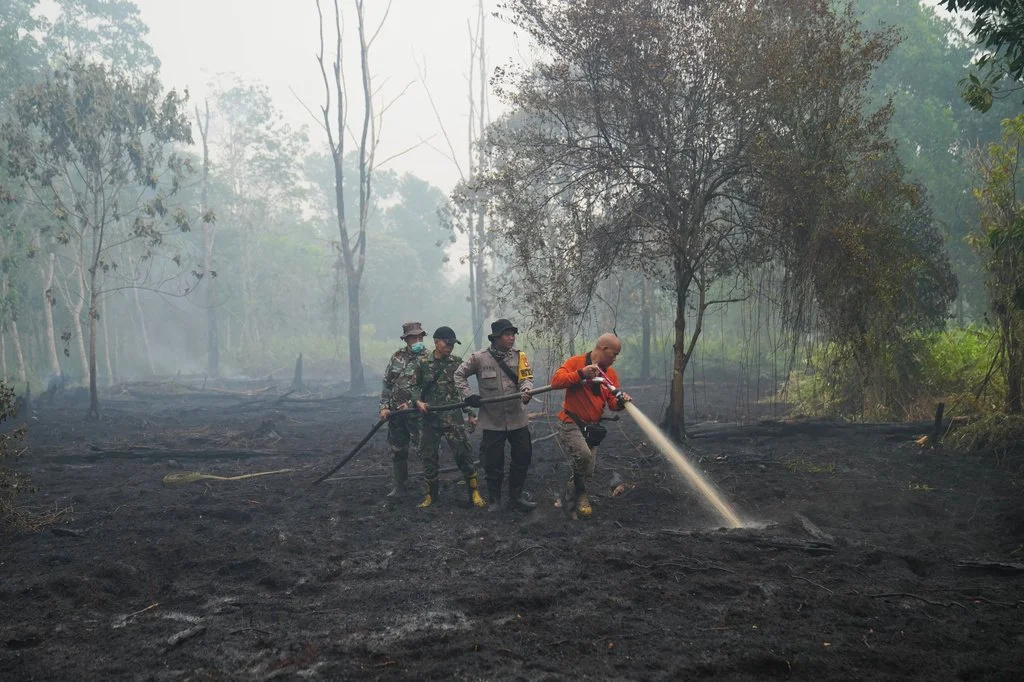
Firefighters spray water to put out wildfires burning through peatland forest in Kubu Raya, West Kalimantan, Indonesia, Saturday, Sept. 12, 2026. (AP Photo/Tatan Syuflana)
Indonesia approved foreign assistance to fight forest and land fires that have spread across Southeast Asia on October 15, Foreign Minister Arrmanatha Nasir said President Prabowo Subianto authorized the move. On October 9, Malaysia had already closed schools in several states, including Johor, Malacca, Negeri Sembilan and Selangor on the Malaysian peninsula, as well as the country's capital Kuala Lumpur and Putrajaya. Government monitoring showed unhealthy air quality in 37 areas that morning. In Singapore, the one-hour concentration of PM2.5 reached 284 micrograms per cubic meter on October 14, entering the National Environment Agency’s “very high” band for the first time during the current haze period.
Indonesia’s Health Ministry recorded 283,270 cases of illness associated with the fires across seven provinces. The World Health Organization says that wildfire smoke can trigger asthma attacks, breathing difficulties and heart-related problems, posing greater risks for children, older adults, and people with heart or lung conditions. Children are particularly vulnerable because their lungs aren't fully developed and they breathe in more air relative to their body weight than adults.
Within Indonesia, fires have reached residential areas. In the Bangka Belitung province, a fire that began on October 10 destroyed 305 houses and forced around 500 people to leave the area. Residents who could no longer live in their houses could only take rest in a school and a mosque.
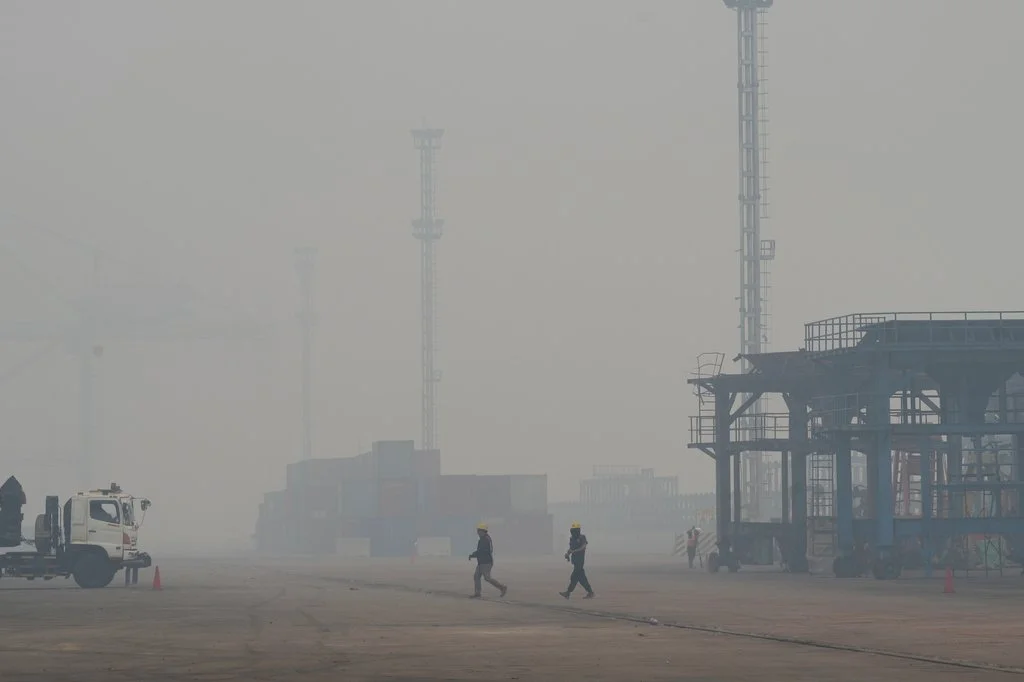
Dock workers walk amid the thick haze from forest fires at Kijing Port in Mempawah, West Kalimantan, Indonesia, Thursday, Sept. 10, 2026. (AP Photo/Tatan Syuflana)
Dry conditions linked to El Niño and damages to Indonesia’s peatlands have helped the fires spread. Logging, drainage, and land clearing could leave peat soils more exposed to fire. Peat can continue smoldering underground, making fires more difficult to go out. Repeated burning reduces biodiversity and damages the land's fertility, while existing peatlands are thawed, releasing more greenhouse gases. UNEP therefore identifies restoring moisture to degraded peatlands as an important part of preventing future fires.
Indonesia has now mobilized around 60,000 personnel across six provinces to stop the fire. Aircraft have been used for water bombing and cloud seeding and authorities have restricted burning to clear farmland. A total of 223 individuals and nine companies could face action over their involvement in starting fires.
The approval of foreign assistance follows offers from Malaysia and Singapore. Nasir did not specify which countries’ assistance would be accepted or what form it might take. On October 15, Malaysia’s Foreign Minister Mohamad Hasan stated that his government had no plans to send a note or take action against Indonesia over the haze. “We need to safeguard the close relationship between the two countries,” he said, citing the New Straits Times.
Malaysia has also called for a coordinated regional response. Mohamad said poor visibility, difficult access, and unsuitable conditions for cloud seeding had complicated the efforts for stopping the fire. Foreign ministers from the Association of Southeast Asian Nations will discuss the haze in November, according to the Philippines, this year’s ASEAN chair. An effective regional collaboration could bring an end to this haze and reduce the risks of prolonged disruptions to people's residues, health and normal life.