
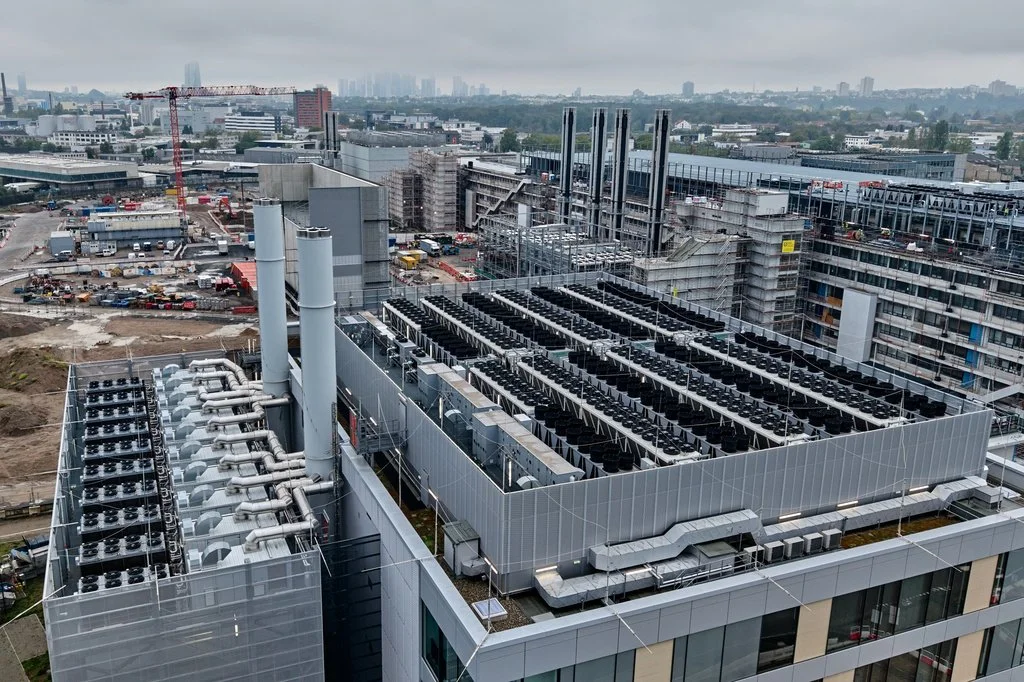
An AI data center under construction in Frankfurt, Germany, Monday, Sep. 14, 2026. (AP Photo/Michael Probst)
On Oct. 6, the Finnish Supervisory Agency (LVV) ordered Google to suspend the construction of two data centers in Finland. The LVV gave Tuike Finland, the company working on behalf of Google in the centers’ construction, until Oct. 23 to halt any actions that would “significantly alter the environment”. This prohibition includes activities such as the clearing of trees and the construction of new roads.
The restrictions come in response to reports that Tuike Finland had been clearing forests in the Finnish municipalities of Muhos and Kajaani without completing a mandatory environmental impact assessment. Hanna Halmeenpaa, the chair of the board of the Finnish Association for Nature Conservation, told Agence France-Presse that “nature sites which should be preserved” had been destroyed. Satellite images show rapid deforestation in Muhos during the project’s construction. Halmeenpaa estimated the logged area to be approximately the same size as 420 football fields. Tuike Finland is reported to have removed more than 500 hectares of forest between the two sites. However, Finnish law requires that projects permanently changing the land-use of 200 hectares of forest or more undergo an environmental impact assessment.
Google acknowledges that it may have failed to meet internal sustainability markers, but denies illegal activity. Google spokesperson Sondre Ronander told the media: “We understand the concerns and have fallen short of our own high standards in this instance,” announcing the company’s intent to fully comply with the LVV’s orders. However, Ronander also defended the actions in Muhos and Kajaani, stating that “we acted in good faith under the Forestry Act.” In addition, Google emphasized its plans to mitigate the projects’ impact through measures such as planting 130 hectares of trees in Muhos.
Finnish authorities’ decision comes while foreign investment in technology such as data centers within the country is ramping up. Finland attracts data centers due to its cool climate and consistent access to a reliable power grid. The two projects suspended by the LVV are part of a €13 billion investment into Finnish AI infrastructure that was announced by Google on Sep. 9, the company’s single largest in Europe. When Google made the announcement, many Finnish officials responded positively, with Finland’s Prime Minister Petteri Orpo calling the plan “a clear testament to [Finland’s] strengths.” However, Muhos residents had concerns, with one local farmer expressing worries about the project’s energy demands in the small town of only 8,800 residents.

Finland's Prime Minister Petteri Orpo speaks with the media as he arrives for the EU summit at the European Council building in Brussels, Thursday, Oct. 15, 2026. (AP Photo/Harry Nakos)
It is uncertain what will come next for Google’s Finnish projects or whether construction will be permitted to resume. When asked about the situation, Sari Multala, Finland’s Minister of the Environment and Climate, said that the data center industry has a responsibility to prove that projects can be managed in a lawful and responsible manner. Multala stated that the failure to conduct the proper environmental assessments means that the construction of the centers is likely to be delayed. The case exemplifies the question many countries have been forced to reckon with during the AI boom: how should a nation embrace investment in AI and the financial gains that accompany it while also protecting the natural environment?