
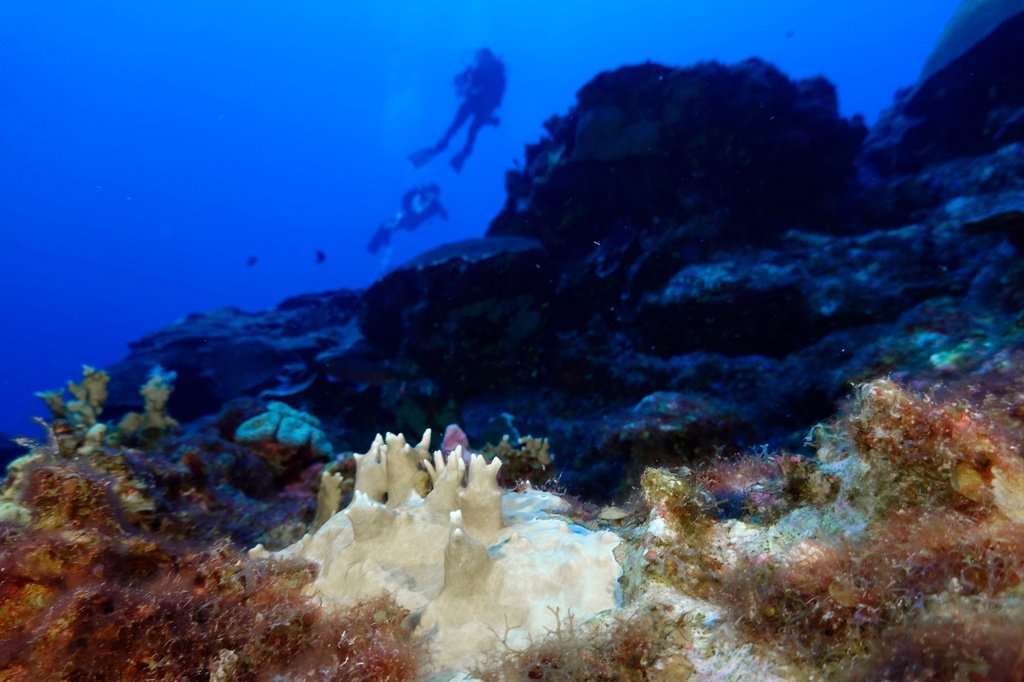
Bleached coral is visible at the Flower Garden Banks National Marine Sanctuary, off the coast of Galveston, Texas, in the Gulf of Mexico, Saturday, Sept. 16, 2023. (AP Photo/LM Otero)
On Oct. 22, the International Union for Conservation of Nature (IUCN) announced that, according to its Red List of Ecosystems assessment, almost all of the world’s coral reef ecosystems are at risk of collapsing by 2075. Under the assessment, collapse is defined as the loss or near loss of all living corals. The data include reefs in 10 different world regions, spanning five continents.
The IUCN’s Red List of Ecosystems is an analytical tool used to measure the health of ecosystems throughout the world. The tool uses scientific data to classify ecosystems based on their relative risk of collapse in order to guide the development of conservation strategies. In the case of coral reefs, five criteria were used to assess ecosystem health. The criteria were the amount of living reef that has already been lost; the reef’s size; the extent to which the reef is impacted by bleaching; the health of coral, algae, and fish populations; and quantitative modeling results that attempted to calculate the chance of collapse. Through this methodology, 96 percent of the world’s coral reefs were found to be critically endangered.
According to the IUCN, global warming is considered the most significant threat to coral reef ecosystems. Increasing temperatures are incredibly dangerous for coral reefs, as they place them under thermal stress that is known to cause coral bleaching and stimulate the spread of infectious diseases from coral to coral. If temperatures continue to rise, a significant loss in coral is expected to occur globally. Additional threats identified by the assessment include overfishing, overtourism, industrialization, and aquaculture.
“The risk is real and very concerning,” said Dr. Mishal Gudka, the scientific lead for the Red List of Ecosystems Coral Reef Assessment. “We stand to lose one of the most valuable ecosystems we have - the impacts of which will affect millions of people around the world.” Coral reefs are incredibly valuable, especially for coastal communities. They provide food, stimulate tourism and recreation industries, and can be important catalysts for medical research. The National Oceanic and Atmospheric Administration’s assessment of coral reefs’ impact expands on Dr. Gudka’s research, estimating that one billion people worldwide benefit from coral reefs in some way. Their collapse has the potential to generate economic and social devastation that is felt across the globe.
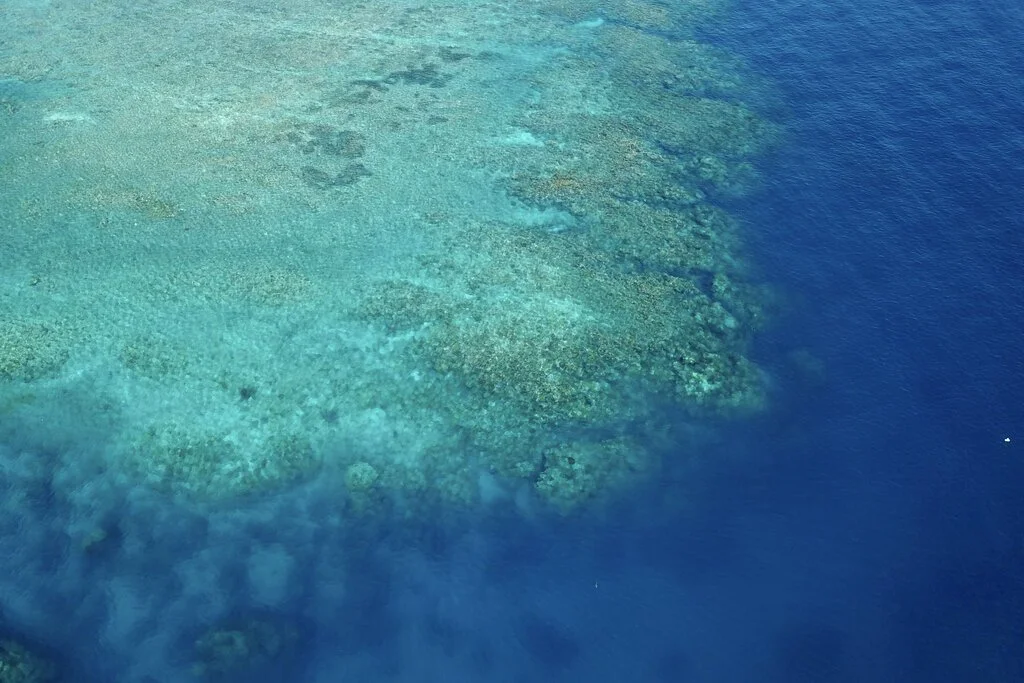
Corals on the Great Barrier Reef (the world’s largest coral reef) are visible below the waves above Moore Reef in Gunggandji Sea Country off the coast of Queensland in eastern Australia on Monday, Nov. 14, 2022. (AP Photo/Sam McNeil)
Despite the alarming nature of the IUCN’s findings, there is still hope for the future of coral reefs. The Red List of Ecosystems’ methodology takes future climate projections into account, assuming global temperatures will warm by approximately 2.7 degrees Celsius by 2100. When these predictions are excluded and ecosystems’ statuses are calculated using observed historical data alone, only 24 percent of coral reefs meet the criteria for the Critically Endangered classification. This gap highlights the importance of future conservation efforts. Dr. Gudka describes the data as “a wake-up call rather than a cause for despair.” It is not too late to save many of the world’s coral reefs, but change cannot happen without climate action.
Coral reefs will not be able to be saved without significant international cooperation. Reefs can be found within the borders of over 100 countries. The primary engine for international collaboration on the topic of reef conservation is the International Coral Reef Initiative (ICRI). Founded by Australia, France, Japan, Jamaica, the Philippines, Sweden, the United Kingdom, and the United States in 1994, the ICRI now has over 100 members. The ICRI monitors ecosystem health in addition to raising global awareness and promoting conservation. However, the organization’s decisions are non-binding for member states, raising concerns that it may not be sufficient to protect these essential ecosystems. To guarantee a positive future for coral reefs, decisive action on the international scale is necessary.