
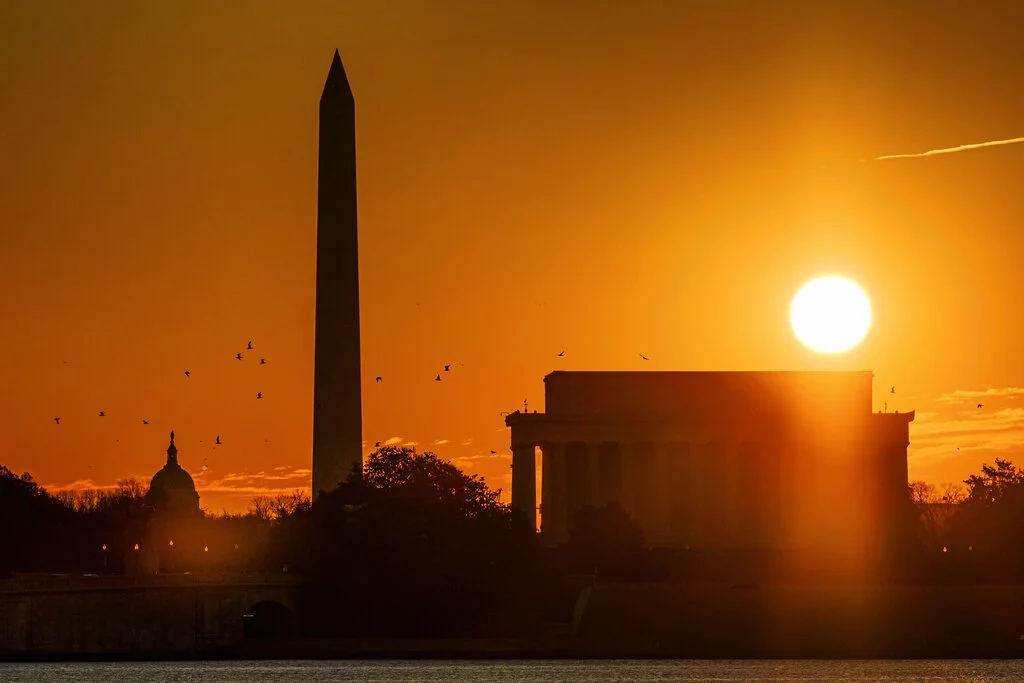
The sun rises above the Lincoln Memorial with the Washington Monument and the U.S. Capitol building in the background Saturday morning, March 13, 2021 in Washington. Sunrise soon will be an hour later in most places in the U.S. as daylight saving time takes effect. (AP Photo/J. David Ake)
The sun rises above the Lincoln Memorial with the Washington Monument and the U.S. Capitol building in the background Saturday morning, March 13, 2021 in Washington. Sunrise soon will be an hour later in most places in the U.S. as daylight saving time takes effect. (AP Photo/J. David Ake)
The end of daylight saving time is often associated with early sunsets and dark, depressing evenings. Every year, on the first Sunday of November, most Americans move their clocks back an hour, marking the transition back to standard time and shifting sunsets and sunrises an hour earlier. This measure has been criticized by many, with some arguing that the earlier sunset discourages after-work socialization and exercise while encouraging violent crime. On Nov. 4, President Donald Trump joined the chorus of critics, lamenting about the time change on social media with a post reading “It’s so dark outside, so early (Sunset was 5:06 P.M., and it was dark by 5:31 P.M. — Isn’t that ridiculous?)”.
President Trump’s disapproving attitude toward the time change is in line with recent legislative efforts to make daylight saving time a permanent facet of American life. In January 2025, Representative Vern Buchanan introduced the Sunshine Protection Act (H.R. 139), to the House of Representatives. This bill was intended to make daylight saving time permanent across the United States. In July 2026, the House of Representatives passed the Act. It is yet to face a vote in the Senate.
Under current American time law, states can choose to opt out of daylight saving time, remaining on standard time year-round. Only Hawaii and Arizona have decided to do so thus far. However, states do not have the right to choose to remain on daylight saving time. The power to make daylight saving time permanent belongs to Congress alone.
The Sunshine Protection Act is not the first time that Congress has tried to keep the clocks ahead. In 1974, the American government attempted to mitigate an energy crisis by adopting permanent daylight saving time. Behind the government’s plan was the idea that an extra hour of afternoon daylight would lead to less electricity use. While this idea was initially popular, earning an approval rating of over 80 percent, the change quickly lost popularity due to the fact that much of the country was undergoing daily morning commutes in the dark. The initiative ended up lasting less than a year before being reversed. Approval rates had plummeted to 42 percent in just a couple months. While Americans were initially excited about the idea of permanent daylight saving time, the change proved to be much less appealing in practice. Congress going ahead with the Sunshine Protection Act would mean ignoring historical evidence and repeating a mistake that has already been made.
The negative effects of permanent daylight saving time extend beyond public opinion. Scientists warn that making daylight saving time permanent comes with serious risks. For one, without the time change, American winters would involve noticeably later sunrises. If daylight saving time were made permanent, most states would see sunrises after 8:00 am throughout the winter months, from November through February. In addition, the costs of permanent daylight saving time would not be equally distributed across America. In some parts of the country, such as Juneau, Alaska, daylight would not begin until after 11:00 am. Since communities near the western end of a time zone already face significantly later sunrises and sunsets, shifting the clocks forward would delay already late winter sunsets. Northern states, which face the shortest winter days, would be especially affected.
It is estimated that delayed sunrises would result in American children making at least 2 billion additional trips to school in the dark. This change is incredibly consequential. Dark mornings are associated with a substantial increase in fatal car accidents involving school-aged pedestrians. With vehicular accidents already being a leading cause of death for Americans, the extra hour of afternoon sunlight is far from being worth the safety risk. There is also an aspect of inequity involved, as rural communities are more likely to face long commute times, meaning they will be disproportionately impacted by the dangers that late sunrises present.
In addition to the serious safety challenges presented by dark mornings, there are several health risks associated with making daylight saving time permanent. The human circadian rhythm relies heavily on morning light exposure, something that would be limited in many areas and lost altogether in others as a result of later sunrises. Exposure to sunlight in the morning is associated with increased sleep quality and even has the potential to lower cardiovascular risk.
Making the shift to permanent daylight saving time also has the potential to worsen the phenomenon scientists describe as “social jetlag”, a gap between the body’s natural waking time and the time required to wake up for societal obligations such as work or school. According to Ashley Nixon, a psychology professor at the University of Ottawa, morning light acts as a circadian rhythm reset, sending the body signals that it is time to wake up. With the dark mornings that would come with a winter on daylight saving time, this signal would disappear, leading many people to struggle to wake up in the mornings.
Permanent daylight saving time has been attempted in several countries and territories, often with little success. In Russia, for example, the clocks were switched to year-round summer time in 2011. While initially popular amongst Russians, the change lasted less than four years due to increased morning traffic accidents and discontentment among northern Russians, who were most impacted by the later sunrises. The country moved to permanent standard time in 2014, abandoning daylight saving time entirely. Similar to the US 1974 experiment, the case of Russia further suggests that those who experience permanent daylight saving time quickly find that earlier sunsets are preferable to later sunrises.
Despite scientific and historical evidence suggesting that permanent daylight saving time would be detrimental, President Trump continues to back the Sunshine Protection Act, with his Nov. 4 post announcing “I will keep fighting for this!”
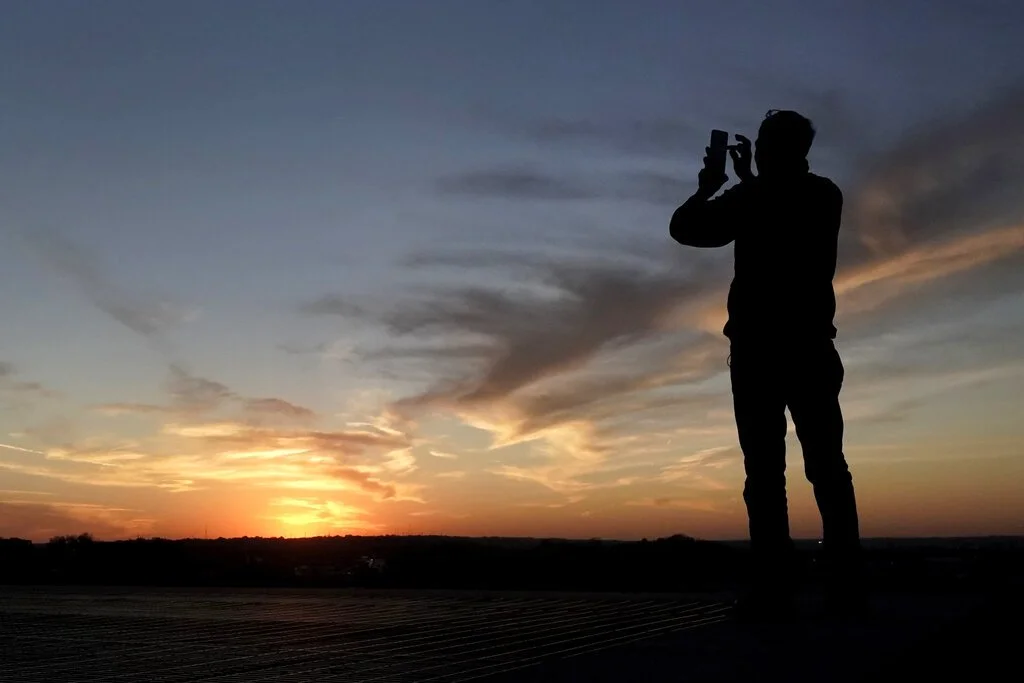
A man photographs the last sunset of daylight saving time, Saturday, Nov. 6, 2021, in Kansas City, Mo. The sun will soon set an hour earlier as people in most of the United States set their clocks back an hour to switch to standard time. (AP Photo/Charlie Reidel)
A man photographs the last sunset of daylight saving time, Saturday, Nov. 6, 2021, in Kansas City, Mo. The sun will soon set an hour earlier as people in most of the United States set their clocks back an hour to switch to standard time. (AP Photo/Charlie Reidel)
Proponents of permanent daylight saving time make an argument worth listening to. The extra hour of evening light provides more time for outdoor recreation, shopping, and dining out. This comes with several economic benefits, which is why recreational industries such as the golf industry have lobbied in favor of daylight saving time. Many people simply enjoy leaving work or school in the daylight, and the frustration that President Trump voiced on Nov. 4 is something that many Americans relate to each winter.
However, a preference for afternoon light cannot be allowed to dismiss legitimate risks to public health. While the frustration that comes along with 5:00 pm sunsets is valid, the Sunshine Protection Act threatens to trade an inconvenience for something much more dangerous. Despite what the act’s name may suggest, lawmakers cannot create additional sunlight. Any attempt to prolong afternoon daylight will inevitably result in the darker mornings that have been proven to put the health and safety of the American people at risk. The inconveniences of earlier sunsets and changing clocks back are worth enduring. America has already learned that a brighter afternoon is not worth a pitch-black morning, and Congress must be careful not to repeat historical mistakes.