
Scientists from Ohio State University (OSU) and other international collaborators estimate ancient ice in Tibet is approximately 128,000 years old, dating back to the ice age. Earth sciences professor Lonnie Thompson of OSU led the study, analyzing ice caps from the Guliya Plateau of northwestern Tibet. The team estimated this age by studying radioactive isotopes of elements such as beryllium and chlorine. These elemental isotopes have the same number of protons but differing numbers of neutrons, resulting in distinct atomic masses and radioactivities. Due to this radioactivity, these isotopes decay at predictable rates, thus allowing scientists to calculate the age based on the current amount of isotopes available in a sample and its rate of decay. Radiometric dating can also be used to identify events in Earth’s environmental history based on the chemical markers left behind.
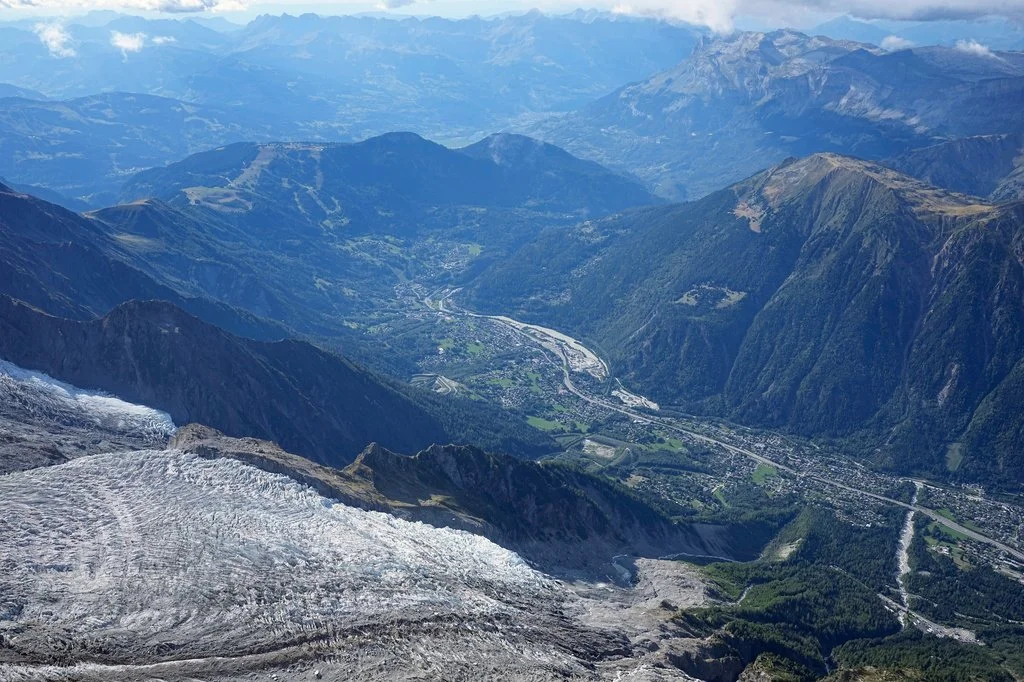
A glacier is seen from the Aiguille du Midi, in Chamonix, France, Saturday, Sept. 5, 2026. (AP Photo/Laurent Cipriani)
In this case, researchers used this method to detect signs of a specific event, namely the Laschamp geomagnetic excursion. The event occurred over 41,000 years ago, drastically disturbing Earth’s magnetic field. During this period, Earth’s magnetic field was dramatically weakened, and the north and south poles briefly swapped. Such an extreme event left chemical changes that the OSU team was able to detect when analyzing the radioactive isotopes. The researchers then examined a nearby Tibet cave deposit oxygen isotopes, allowing for comparative dating and a rough estimate of the 128,000-year-old ice.
This discovery yields valuable information about Earth’s climate history as previous research estimated ice in Guliya to be less than 12,000 years old, suggesting it only appeared within the current geological epoch, the Holocene. However, now scientists have evidence to believe that ice from the last ice age survived into the Holocene, providing clues about the climate conditions on Earth. These records permit scientists to build a timescale of the climate, including information about glaciation intensity, atmospheric chemistry, and ice loss over time in the region and beyond.
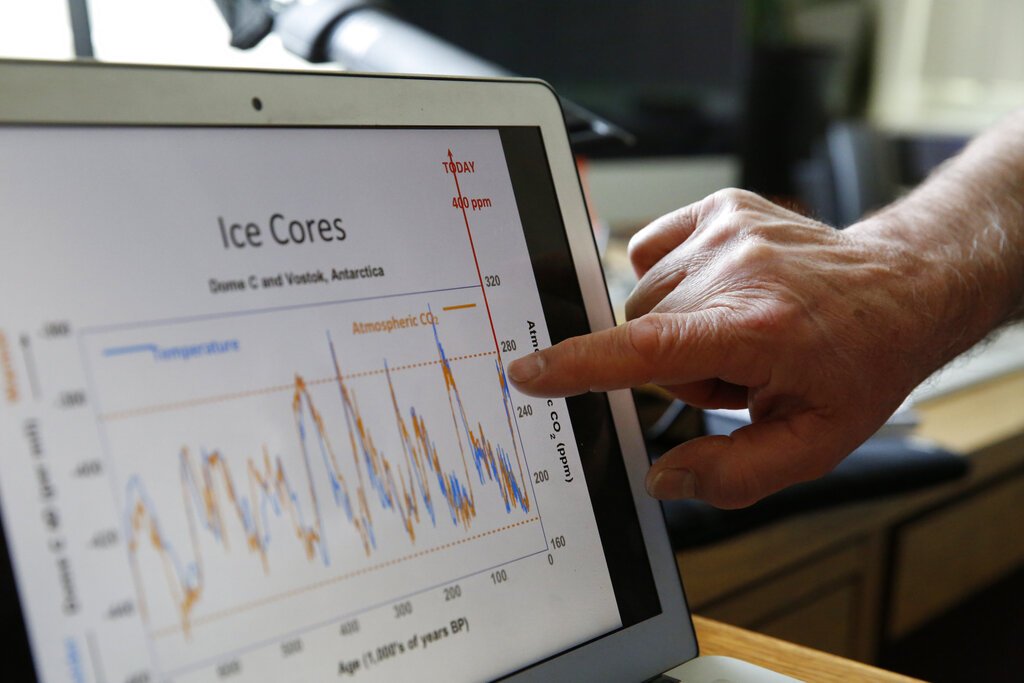
In this June 3, 2016 photo, Bruce Vaughn, who manages the INSTAAR Stable Isotope lab, refers to his laptop while discussing his data collection and analysis for climate change research, at the University of Colorado, in Boulder, Colo. Vaughn, who is one of many researchers who relies on ice core data, says of the ice cores: "It's as if we're standing on the ice sheet writing down the temperature for the last 800,000 years. It's that good." (AP Photo/Brennan Linsley)
Establishing a detailed climate timeline of Earth is extremely important for the future as well. This enables scientists to predict patterns in Earth’s climate and analyze the potential effects of climate change and global warming. This study employs paleoclimatology, and has allowed scientists to piece together important details about major climate events of the past. This field also utilizes other methods, such as lake and seafloor sediments, coral reefs, speleothems (stalactites and stalagmites), and even packrat urine which can crystallize various materials together for over 20,000 years.
Previous research has already built up some perspective of glacial cycles and atmospheric changes. Scientists now know from gas bubbles trapped in ice cores that atmospheric carbon dioxide levels before the Industrial Revolution were around 180 to 280 parts per million (ppm), but have recently surpassed 407 ppm, contributing to the greenhouse gas effect. Researchers have also determined that Earth has likely not been as warm as it is now in the past 5,000 years. However, there are limits to the information that can be gathered based on the time and region of the sample. So each new discovery, including 128,000-year-old ice, can offer significant insight into both the past and future as scientists continue to compare findings.