
Every winter, Delhi-NCR faces a familiar environmental crisis. The skies turn gray, visibility decreases, and air quality reaches hazardous levels. As Diwali approaches, firecrackers become the focus of public criticism, political debate, and judicial restrictions. Although they contribute to air pollution, holding one festival responsible for an issue that develops across several months oversimplifies the science behind Delhi's deteriorating air quality.
Diwali celebrations have become a larger part of India's wider debate about environmental responsibility. The use of firecrackers releases particulate matter and harmful gases into the atmosphere, contributing to an immediate deterioration in air quality. However, the timing of the festival also coincides with the beginning of Delhi's winter pollution season, when agricultural burning increases and atmospheric conditions become less favorable for the dispersal of pollutants.
The distinction is important because addressing air pollution requires understanding where it comes from and why it becomes concentrated over the region. Restricting firecrackers may reduce one source of emissions, but it cannot independently resolve a problem involving several sectors and neighboring states.
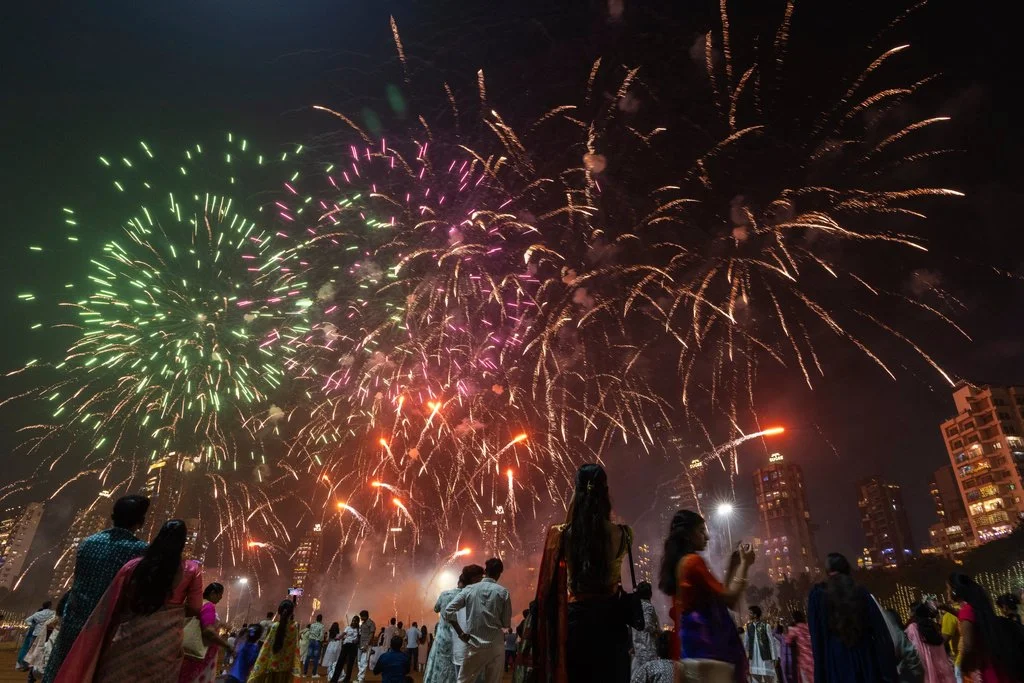
Fireworks light up the sky during the festival of lights Diwali in Mumbai, India, on Monday, Oct. 20, 2025. (AP Photo/Rafiq Maqbool)
The Contribution of Diwali Firecrackers
There is scientific evidence that firecrackers contribute to Delhi's pollution levels. Their combustion releases fine particulate matter, including PM2.5 and PM10, alongside sulfur dioxide, nitrogen oxides, and metal-containing particles. PM2.5 is particularly concerning because its small size allows it to penetrate deep into respiratory systems.
A 2018 study examined hourly PM2.5 measurements and used statistical methods to estimate the festival's contribution to pollution. The findings showed that Diwali caused a small but statistically significant increase in air pollution, although the impact varied across different locations in Delhi. The study also identified winter weather conditions, including low wind speeds and high relative humidity, as factors contributing to the region's higher pollution levels.
Recent research provides further evidence of the festival's environmental impact. A June 2026 study researched air quality across 14 cities using ground measurements, satellite observations, and meteorological data. The researchers found that Delhi's PM2.5 concentration increased by 19 percent during Diwali in 2024. This was a rise from a pre-festival level of approximately 185.49 micrograms per cubic meter to 220.64 micrograms per cubic meter on Nov. 1. The study also recorded increases in sulfur dioxide and nitrogen dioxide during the celebrations, pollutants associated with firecracker emissions.
These findings establish that fireworks have a measurable environmental impact. However, another detail in the study claimed that Delhi's PM2.5 concentration was already significantly elevated before Diwali. The researchers attributed the existing pollution to factors including vehicle emissions, industrial activity, and pollution transported from agricultural burning in Punjab and Haryana. This suggests that while firecrackers can intensify existing pollution, they do not explain why the region's air quality is already poor before the celebrations begin. The festival adds to an existing environmental burden rather than causing the entire crisis.
The Pollution That Exists Beyond Diwali
One of the most significant contributors to Delhi-NCR's winter pollution is biomass burning, particularly the burning of agricultural residue in neighboring states. After harvesting paddy crops, some farmers burn the remaining stubble to clear their fields before the next planting season. The smoke contains particulate matter and other pollutants that can travel across state boundaries and contribute to deteriorating air quality in Delhi. This is particularly relevant because the agricultural burning season coincides with the period immediately before and after Diwali. Consequently, the pollution measured during this period can reflect emissions from several sources operating simultaneously.
The scale of the wider crisis is illustrated by the Commission for Air Quality Management (CAQM) January 2026 report on the causes of worsening air quality in Delhi-NCR. The report brought together research from experts at Indian Institutes of Technology, academic institutions and other research organizations to examine the sources of pollution across the region.
According to the report, the estimated winter contributions to PM2.5 pollution were 27 percent from secondary particulate formation, 23 percent from transport, 20 percent from biomass burning, 15 percent from dust, and 9 percent from industries, including thermal power plants. Other sources accounted for the remaining 6 percent. These estimates cover the wider winter pollution phase, rather than pollution specifically measured during Diwali.
The figures demonstrate why attributing Delhi's winter pollution primarily to firecrackers is misleading. Transport, biomass burning, industrial activity, and dust collectively account for a substantial share of particulate pollution. Furthermore, the largest estimated contribution comes from secondary particulate formation, which occurs when gases released by different sources undergo chemical reactions in the atmosphere and form additional particles.
This process creates more complications. Pollution does not always remain in the form in which it was originally released. Emissions from vehicles, industries, power plants, and agricultural activities can interact in the atmosphere, creating particles that contribute to the overall PM2.5 concentration. Therefore, controlling individual sources is important, but understanding their combined effects is equally necessary.
Additionally, the World Bank's June 2026 report identifies fossil fuel combustion, biomass burning, crop residue, construction dust, and industrial activity as sources of PM2.5. It also estimates that more than half of India's PM2.5 forms secondarily through atmospheric reactions involving gases such as ammonia, sulfur dioxide, and nitrogen oxides. These pollutants can travel hundreds of kilometers across state boundaries. This is why Delhi's air pollution cannot be treated as an isolated city-level issue. Emissions originating outside the capital can affect its air quality, making cooperation between Delhi and neighboring states essential.
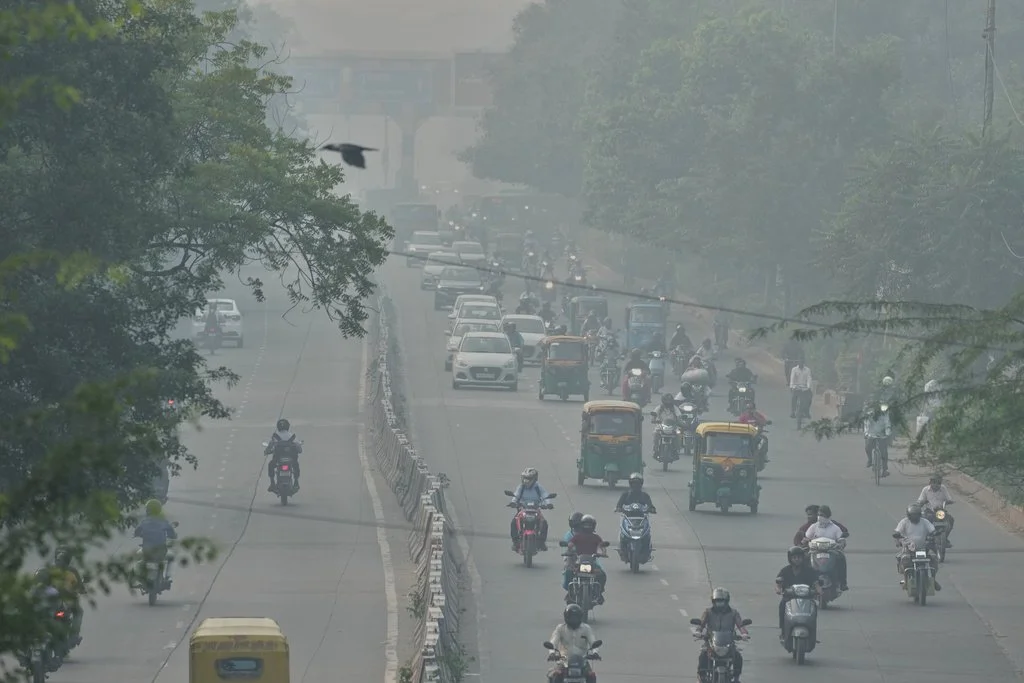
Commuters drive to work amidst morning smog a day after Diwali festival in New Delhi, India, Tuesday, Oct. 21, 2025. (AP Photo/Manish Swarup)
Why Winter Worsens the Situation
The sources of pollution explain what enters the atmosphere, but weather conditions help explain why it accumulates so severely during winter.
Delhi's pollution levels follow a recurring seasonal pattern. During the monsoon, stronger winds, higher atmospheric mixing, and rainfall help disperse and remove pollutants. As the monsoon ends, temperatures and wind speeds begin to decrease, while rainfall becomes less frequent. These changes reduce the atmosphere's ability to clear accumulated pollution.
Low wind speeds and a reduced planetary boundary layer are major reasons for the seasonal deterioration in air quality. The planetary boundary layer is the lowest part of the atmosphere, where pollutants released at the surface mix with the surrounding air. When this layer becomes shallow, there is less atmospheric space for pollutants to disperse.
Temperature inversions can make the situation worse. Under normal conditions, warmer air near the surface rises and helps distribute pollutants vertically. During an inversion, a layer of warmer air sits above cooler air near the ground, restricting this movement and trapping pollutants closer to where people live and breathe.
The result is an accumulation of emissions from vehicles, industries, agricultural fires, construction activity and other sources. Even when the amount of pollution being released does not increase significantly, unfavorable weather conditions can cause concentrations to rise because the atmosphere cannot disperse them effectively.
The combination of these factors explains why Delhi's air quality can remain poor well after Diwali celebrations have ended. The festival may cause a short-term increase, but the broader winter pollution episode continues because its underlying sources and meteorological conditions remain in place.
Can Green Crackers Make a Difference?
The Supreme Court's recent decision to permit the temporary use of green firecrackers in Delhi-NCR has introduced another dimension to the debate. On Nov. 2, the court allowed certified green firecrackers to be sold and used on Nov. 7 and 8, ahead of Diwali. Their use was restricted to two time windows: 6 am to 7 am and 8 pm to 10 pm. A complete ban was scheduled to return on Nov. 9. The court also prohibited their use within 300 meters of hospitals, nursing homes, old-age homes, and designated silence zones.
Green crackers were developed to reduce the emissions associated with conventional fireworks. According to the Council of Scientific and Industrial Research-National Environmental Engineering Research Institute, they must meet specific emission-reduction standards. These include reducing particulate matter emissions by at least 30 percent compared with conventional crackers of the same category, or reducing particulate matter by at least 20 percent alongside a minimum 10 percent reduction in gaseous emissions.
Researchers examined specially formulated green firecrackers containing additives such as iron oxide and zeolite, reporting reductions of 30 percent to 60 percent in particulate matter and barium emissions from the products tested. However, these findings apply to the specific formulations examined and do not establish that every product marketed as a green cracker will produce the same results.
A distinction is required between reduced emissions and pollution-free products. Green crackers still release particulate matter and gases, continuing to contribute to air pollution. Their actual environmental benefit also depends on how many are used. If people compensate for lower emissions per cracker by bursting a substantially larger quantity, some of the environmental gains could be offset.
There are also questions about enforcement. The Supreme Court's decision reflects concerns that previous blanket restrictions did not adequately prevent the sale and use of conventional firecrackers. The court noted that traditional crackers had continued to enter the market despite existing prohibitions, sometimes being sold under the label of green crackers.
Allowing certified alternatives could provide a more regulated approach, but certification alone cannot guarantee compliance. Authorities must ensure that products meet the required standards, that unauthorized fireworks are prevented from entering the market, and that restrictions on their use are followed.
The introduction of green crackers is therefore a possible step toward reducing the impact of celebrations, but it should not be mistaken for a complete solution to Delhi's pollution.
The Controversy Around the Festival
The debate surrounding Diwali often places religious and cultural traditions against environmental concerns, although the two do not have to be mutually exclusive. Acknowledging the pollution caused by firecrackers does not mean dismissing the festival's cultural significance. Similarly, celebrating Diwali should not mean overlooking its environmental consequences.
The Supreme Court's decision to temporarily permit certified green crackers reflects an attempt to balance these concerns through regulation. However, the focus of environmental policy must extend beyond the festival itself. Reducing vehicle emissions, controlling industrial pollution, managing construction dust, and providing alternatives to agricultural residue burning are equally important.
The World Bank's recommendation for an airshed-based approach highlights the need for coordination between states, since pollution crosses geographical boundaries and cannot be addressed through isolated measures.
Ultimately, Delhi's pollution crisis deserves attention throughout the year, rather than only when Diwali brings a temporary increase in emissions. Firecrackers should be regulated for the pollution they cause, but the festival should not become the primary target of criticism when vehicle emissions, industrial activity, crop burning, and winter weather also contribute significantly to the problem. The focus should be on addressing Delhi's pollution as a whole, not treating Diwali as the face of a crisis that has far more complex and persistent causes.