
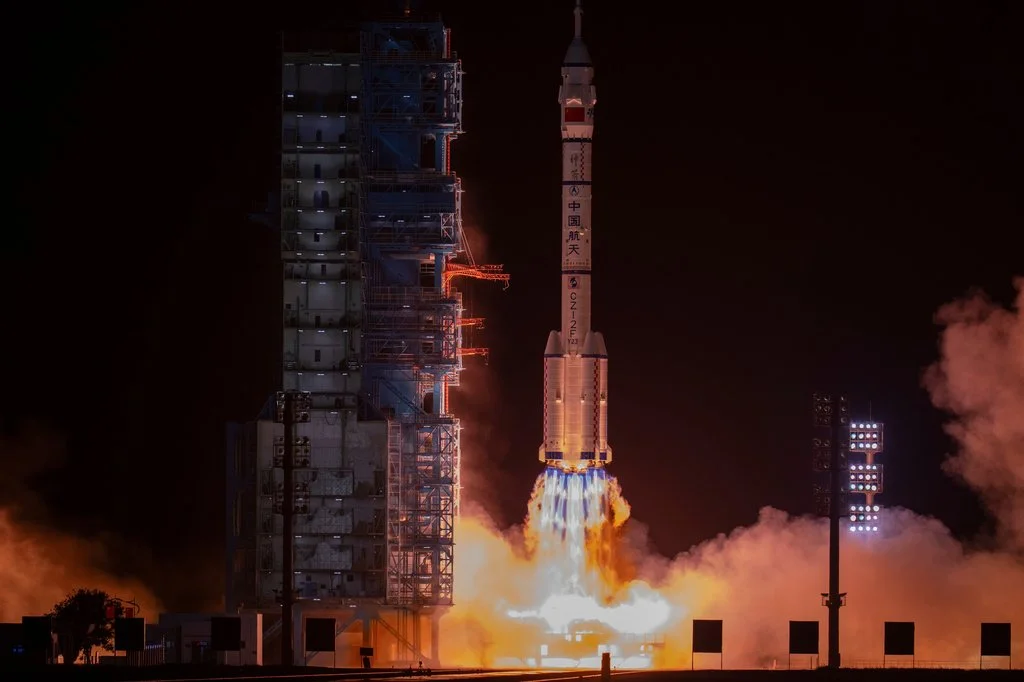
The Shenzhou-23 manned mission launches from the Jiuquan Satellite Launch Center in Jiuquan, northwestern China on Sunday, May 24, 2026. (AP Photo/Ng Han Guan)
On Nov. 7, 2026, the China Manned Space Agency (CMSA) announced it will send a Pakistani astronaut to its Tiangong space station aboard Shenzhou-24. The astronaut will be the station’s first foreign visitor and the flight will be China’s first crewed mission with a foreign astronaut.
The astronaut will work as a payload specialist and spend a short period of time on the station, before returning to Earth aboard the Shenzhou-23 spacecraft. Pakistan’s Space and Upper Atmosphere Research Commission (SUPARCO) has said science experiments are a main goal of the mission. The station has equipment for research in biology, medicine, and physical science.
The flight comes after a February 2025 agreement between China and Pakistan to select and train Pakistani astronauts. Two candidates, Muhammad Zeeshan Ali and Khurram Daud, have since trained with Chinese astronauts. CMSA said the selection involved three rounds of tests, including medical, psychological, and aptitude assessments. However, only one candidate will fly after finishing training and passing the required tests while the other will serve as backup.
In a statement released in May, CMSA said the two Pakistani candidates had entered the China Astronaut Research and Training Center in April. Their training covers basic skills and the tasks they will carry out in space, along with Mandarin language lessons to communicate with their Chinese crewmates.
SUPARCO’s space station research program has invited research institutions, universities, and private companies to suggest experiment proposals. These experiments can use equipment inside and outside the station, giving Pakistani researchers a way to apply for access to orbital laboratories. The agency’s astronaut program lists fluid mechanics, materials science, and space radiation as fields the station can support. SUPARCO also says the research could help with medicine, environmental monitoring, and space technology.
The work builds on research already taking place in Pakistan. For instance, SUPARCO stated its microgravity program studies plant growth using clinostats developed in Pakistan. According to SUPARCO, these devices simulate some effects of low gravity and support research on growing plants for food and oxygen on longer space missions.
Tiangong also supports international research through a program with the United Nations Office for Outer Space Affairs. The program announced its first group of projects in 2019 and included nine experiments involving 23 institutions from 17 countries. The Pakistani astronaut’s planned flight would add a foreign astronaut to China’s research work in space.
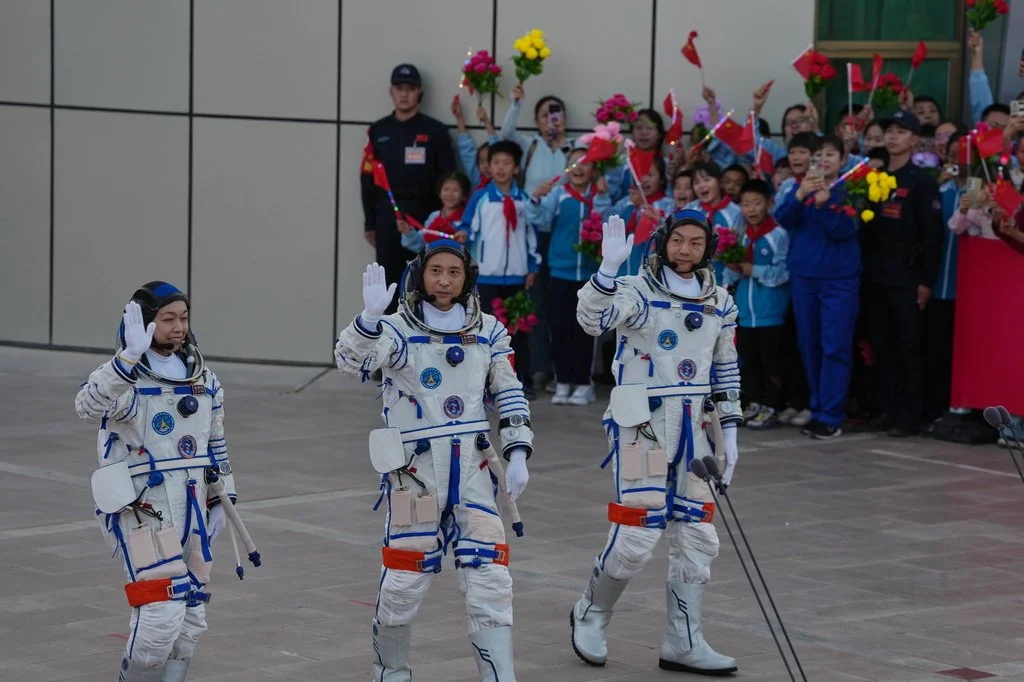
Astronaut for the Shenzhou 23 manned mission from left Hong Kong's Lai Ka-ying, identified by Chinese authorities as Li Jiaying using the Mandarin transliteration of the name, China's Zhu Yangzhu and Zhang Zhiyuan wave as they attend a see-off ceremony for their manned space mission at the Jiuquan Satellite Launch Center in northwestern China, Sunday, May 24, 2026. (AP Photo/Ng Han Guan)
Astronaut for the Shenzhou 23 manned mission from left Hong Kong's Lai Ka-ying, identified by Chinese authorities as Li Jiaying using the Mandarin transliteration of the name, China's Zhu Yangzhu and Zhang Zhiyuan wave as they attend a see-off ceremony for their manned space mission at the Jiuquan Satellite Launch Center in northwestern China, Sunday, May 24, 2026. (AP Photo/Ng Han Guan)
Chinese officials have attributed the flight to cooperation between China and Pakistan. At a Nov. 9 press briefing, Foreign Ministry spokesperson Guo Jiakun said the mission was a result of the two countries working together, claiming he wanted China to work more closely with Pakistan in space and other fields. The two countries are marking 75 years of diplomatic relations in 2026.
Chinese universities also work with researchers in other Belt and Road partner countries on agriculture and medicine. The Belt and Road Initiative is China’s program to expand infrastructure and trade links between countries. In Kenya, Egerton University and Nanjing Agricultural University run a Belt and Road joint laboratory for crop molecular biology. According to Egerton’s report, Nanjing Agricultural University trained 158 Kenyan master’s and doctoral students between 2003 and June 2026. The universities also held 61 agricultural training sessions over that same period. At a July meeting, they discussed plans to expand their shared laboratories and offer more student exchanges, in an effort to strengthen agricultural research and student training.
On July 8, the University of Indonesia, Tsinghua University in Beijing, and local Indonesian company Etana introduced an early version of an mRNA dengue vaccine. It uses genetic material from dengue strains found in Indonesia to target all four types of the virus. The project also promotes knowledge sharing between Chinese and Indonesian researchers.
These global partnerships connect Chinese institutions with research priorities in partner countries. The Pakistani astronaut’s planned flight would extend that cooperation into orbit, giving Pakistan a direct role in research aboard China’s space station.