
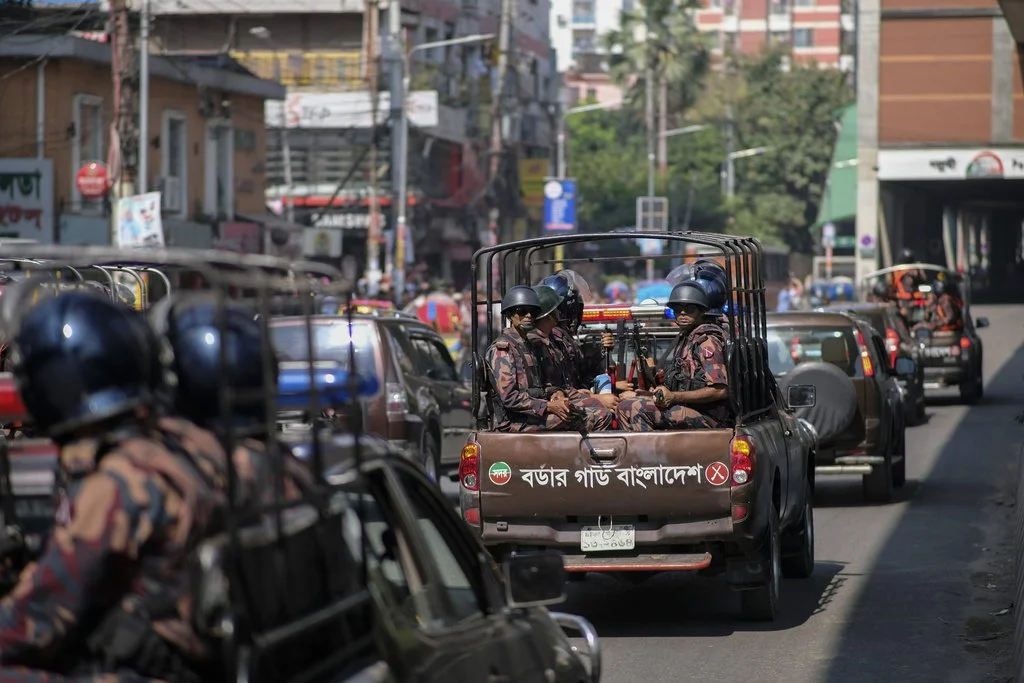
Border Guard Bangladesh (BGB) members patrol as part of enhanced security in the wake of protest by garment factory workers in Mirpur area in Dhaka, Bangladesh, Thursday, Nov.2, 2023. Thousands of garment factory workers have taken to the streets to demand better wages. (AP Photo/Mahmud Hossain Opu)
At the center of the demonstrations is a demand for a minimum monthly wage of 30,000 Bangladeshi taka (approximately $242 in USD), more than double the current monthly wage of 12,500 Bangladeshi taka (approximately $101 in USD). Workers argue that these current wages have not and do not meet their basic needs. Babul Akhter, the General Secretary of the Bangladesh Garment and Industrial Workers Federation and a representative on the wage board, described garment wages in the country as “among the lowest garment wages in the world”.
Industry representatives have urged workers to allow the government’s wage review process to proceed. Mahmud Hasan Khan, president of the Bangladesh Garment Manufacturers and Exporters Association, pointed to the formation of a wage board as evidence of government action. He also warned that continued demonstrations could force employers to involve a “no work, no pay” ruling.
Bangladesh’s current economic position marks a significant transformation from its circumstances following independence in 1971, when it was considered one of the poorest countries in the world. Over the past five decades, the country has made substantial improvements in living standards: life expectancy increased by more than 50 percent and infant mortality decreased by nearly 90 percent. Economic growth has lifted millions out of poverty, and the expansion of garment factories and manufacturing has created considerable employment opportunities, especially for women entering the workforce. By 2022, Bangladesh became one of the world’s largest garment exporters, with ready-made garments accounting for 80 percent of its total exports.
The garment industry has therefore played a remarkable role in Bangladesh’s transformation, connecting the country to international markets while creating jobs and generating export revenue. For example, between July and October 2026, garment exports to the United States grew by 10%, with the country accounting for about 21% of Bangladesh’s total garment exports. Its expansion has helped establish Bangladesh as a major manufacturing center rather than an economy solely defined by its poverty. However, this success has also created economic vulnerability. With such a large share of export coming from just one industry, Bangladesh is exposed in terms of international demand, production costs, global supply chains, and politics. The same industry that brought the country’s economic rise now faces the challenge of remaining competitive while responding to workers who argue they are not compensated fairly.
Bangladesh’s economic progress is increasingly reflected in its position relative to other major South Asian economies. The country’s per capita gross domestic product (GDP) is projected to reach $2,886 this year, surpassing India’s projected $2,749. The comparison is particularly striking given the considerable difference in the size of their economies: India’s total GDP is projected to reach $4.15 trillion , in contrast to Bangladesh’s $506.4 billion. Economists attribute Bangladesh’s economic progress to several factors, including remittances sent by citizens working abroad, increased participation of women in the workforce, and most notably the expansion of its garment industry. Bangladesh’s economic transformation is undoubtedly impressive, but its success also needs to be measured by the opportunities, benefits, and protections that should be surrounding the people driving it.
However, these figures do not necessarily reflect the financial circumstances of ordinary citizens. GDP per capita measures average economic output per person; it does not show how income is distributed or how much individual workers earn. As a result, a country can experience substantial economic growth while their workforce continues to financially struggle. This raises a fundamental question: how can economic success be measured when the people sustaining it cannot experience its benefits?
The garment industry illustrates this gap between national economic progress and individual economic security. Bangladesh accounts for nearly seven percent of the global garment market, exporting clothing to more than 150 countries. Major international companies, including Levi Strauss and VF Corporation, whose brands include Vans, Timberland, and The North Face, rely on Bangladeshi factories to production. The sector’s economic significance is further reflected in its export revenue. According to Fahmida Khatun, the executive director of Centre for Policy Dialogue, the ready-made garment (RMG) sector generated $39.34 billion in exports in 2025, accounting for 81.46 percent of Bangladesh’s total export revenue and 8.5 percent of its GDP. Supplying international markets, particularly the United States and European Union, the industry has integrated Bangladesh into global manufacturing and supply chains.
However, maintaining this position in the global garment market requires manufacturers to navigate growing demands from international buyers. As trading partners place greater emphasis on environmentally friendly standards and productions, Bangladeshi manufacturers and factories face increasing pressure to adapt to more sustainable operations. Yet, the transition comes with unequal financial burdens: larger factories have greater access to the financing and technology needed to adopt environmentally friendly practices, while smaller manufacturers often struggle with the costs. Khatun also highlights a contradiction in the global supply chain: international buyers increasingly demand higher environmental standards but are often reluctant to pay the higher prices to support them. This places manufacturers in a difficult position, forcing them to meet evolving international expectations while keeping production and labor costs low enough to remain competitive. These pressures further complicate workers’ demands for higher wages, as factories and manufacturers face competing financial demands without receiving greater compensation from their international buyers. Nevertheless, the different financial pressures of maintaining this competitiveness should not be transferred onto garment-workers.
Women work in a garment production line in Dhaka, Bangladesh, in April 2026. Millions of women are employed in Bangladesh and support its export-driven economy (AP Photo/Abdul Goni).
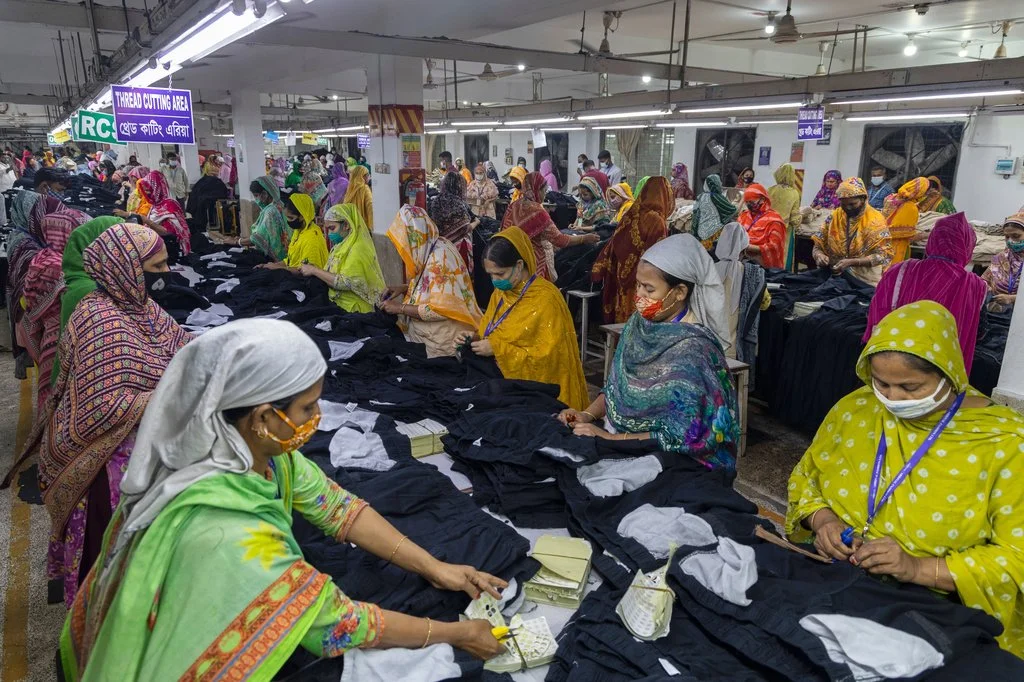
Women workers assemble apparel at a garment factory in Dhaka, Bangladesh, Tuesday, April 28, 2026. (AP Photo/Abdul Goni)
These pressures have intensified amid broader economic difficulties, particularly following the outbreak of the war on Iran. The war has disrupted international energy markets and supply chains, placing additional strain on an economy heavily reliant on imported fuel. Al Jazeera reported that Bangladesh imports nearly 95 percent of the oil and liquefied natural gas needed to meet its energy demands. As global oil prices climbed from approximately $66 to $100 per barrel, the government raised domestic fuel prices by 10 percent to 15 percent in April—further increasing operating costs for businesses.
For Bangladesh, the consequences of these international disruptions have been especially visible in the garment industry. Shipping delays through the Red Sea and Middle East have increased the cost of importing raw materials. These pressures have raised concerns about the industry’s future production and export capacity, with one Bangladeshi garment manufacturer anticipating a 20 percent to 25 percent decline in work orders for the following season. For an economy so heavily reliant on garment exports, these disruptions threaten not only manufacturers’ financial stability, but also the livelihoods of millions of workers. Against this backdrop, the ongoing protests reflect the growing tensions between the economic pressures facing Bangladesh’s garment industry and workers’ demands for wages that allow them to live properly.
Manufacturers and workers both face different consequences of the same economic pressures. Factory owners must contend with higher energy and production costs, shipping disruptions, and international buyers who expect competitive prices. Workers, meanwhile, face rising living expenses while continuing to receive inefficient wages.
This tension raises the idea that if Bangladesh’s position in the global economy depends on keeping production costs low, someone has to bear the burden of maintaining economic competitiveness. Manufacturers’ concerns about rising costs cannot be dismissed, particularly when international buyers may resist paying more for production. However, relying on low wages for high production to preserve Bangladesh’s economic competitiveness risks making workers increasingly bearing the burden of the country’s financial pressures. For example, Rasel Khan, a 30-year-old garment worker, told Al Jazeera, “It’s impossible to support a family on this income anymore. Prices keep rising, and we have to borrow money just to survive”. His need to borrow to cover basic expenses illustrates how inadequate wages can leave workers trapped in a cycle of financial insecurity. The protests therefore represent more than a dispute over minimum wage levels, but the unequal distribution of the benefits and costs of globalization.
In response to the growing unrest, the Bangladeshi government has taken steps to address workers’ demands by establishing a six-member wage board tasked with reviewing the industry’s minimum wage structure. The board includes representatives from the government, factory owners, and workers, creating a formal process for negotiating a potential increase. The board’s chairman, Syed Azad Subhani, said workers are expected to receive their first salaries under the revised pay scale in January 2027. However, the government’s response has yet to resolve the immediate tensions and does not guarantee the workers will receive the 30,000 taka that they are demanding. Demonstrations and clashes with police have continued even after the board was announced, reiterating the urgency of the workers’ concerns. The continued unrest highlights the limitations of a response focused on negotiations and restoring factory operations without first addressing the financial insecurity driving workers to protest.
Ultimately, Bangladesh’s garment industry has not only been central to its economic transformation, but also demonstrates the opportunities that international trade can create. However, continued reliance on low production costs places pressure on the workers whose labor sustains that global competitiveness. Addressing workers’ demands for fairer wages should be treated as part of maintaining the industry’s long-term success, rather than as an obstacle for growth. In order for Bangladesh to sustain its position in the global garment market, manufacturers, international buyers, and policymakers must help ensure that the benefits of its progress are also extended to the workers who make it possible.