
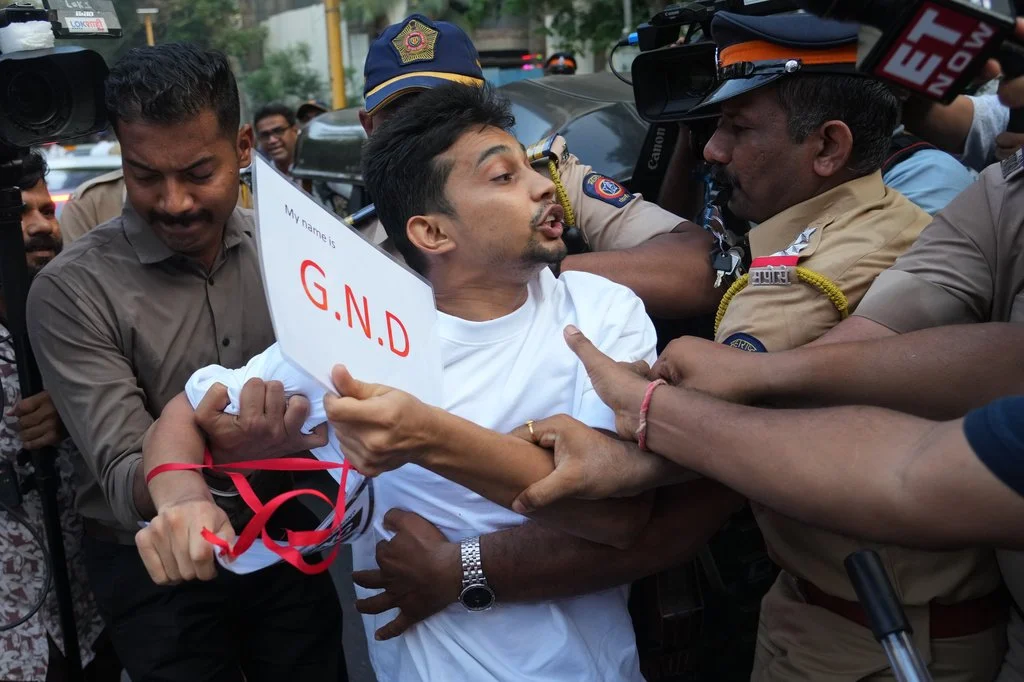
A protester is detained by police during a protest organized by Cockroach Janta Party in Mumbai, India, Sunday, Oct. 18, 2026.(AP Photo/Rafiq Maqbool)
India remains a democracy at face value, but disputes over voting registration, institutional independence, and press freedom have been testing whether its democratic protections are as consistent as its elections. In October 2026, thousands of demonstrators took to the streets across India to challenge the government’s controversial revision of voter registration lists. The demonstrations, organized in part by the youth-led Cockroach Janta Party, called for the resignation of Chief Election Commissioner Gyanesh Kumar, and raised concerns about the removal of more than 130 million names from electoral rolls, arguing that the revisions could prevent eligible citizens from voting. The Election Commission of India, however, has defended the process as an effort to remove deceased, duplicate, and otherwise ineligible registrations.
The controversy quickly drew international attention. The United Nations raised concerns about mass detentions surrounding the demonstrations, and arrests were reported during the crackdown. It was later reported that a court extended the detention of two protest leaders. The allegations surrounding the voter revisions still remain disputed, but the protests show a larger concern: whether or not Indians can trust the institutions defending their right to vote.
India has long been recognized as the world’s largest democracy, and still has many of the features associated with a functioning democratic political system. It maintains a multiparty system, and its Constitution protects the fundamental rights of the people, including. However, holding elections is not the same as having a healthy democracy. International IDEA evaluates democratic performance across four dimensions: representation, rights, rule of law, and participation. These include not only credible elections, but also judicial independence, freedom of expression, access to justice, and civic engagement. Citizens must also be able to criticize their government, institutions must be able to act independently, and everyone must receive equal protection under the law.
India’s democracy has not disappeared, but its democratic foundations have been facing growing challenges. Its 2024 Election showed that political competition still matters. At the same time, the aforementioned concerns about the country’s affairs suggest that the country’s democratic foundations are becoming less robust. . India may officially still be an electoral democracy, but that does not mean its liberal democratic principles are equally protected.
The 2024 Election: A Sign of Democratic Resilience
The result of India’s 2024 election complicates the idea that the country is no longer meaningfully democratic. Despite expectations of another decisive victory, Prime Minister Narendra Modi’s Bharatiya Janata Party (BJP) lost its parliamentary majority for the first time in a decade.
The BJP won 240 seats in the 543-seat Lok Sabha, down from 303 seats in 2019. The opposition Indian National Congress nearly doubled its representation, jumping from 52 seats to 99 seats. The BJP-led National Democratic Alliance still secured a parliamentary majority, but Modi could no longer govern with the same level of independence from coalition partnerships.
People queue up at a polling booth to cast their vote in the sixth round of polling in India's national election in New Delhi, India, Saturday, May 25, 2024. (AP Photo/Manish Swarup)
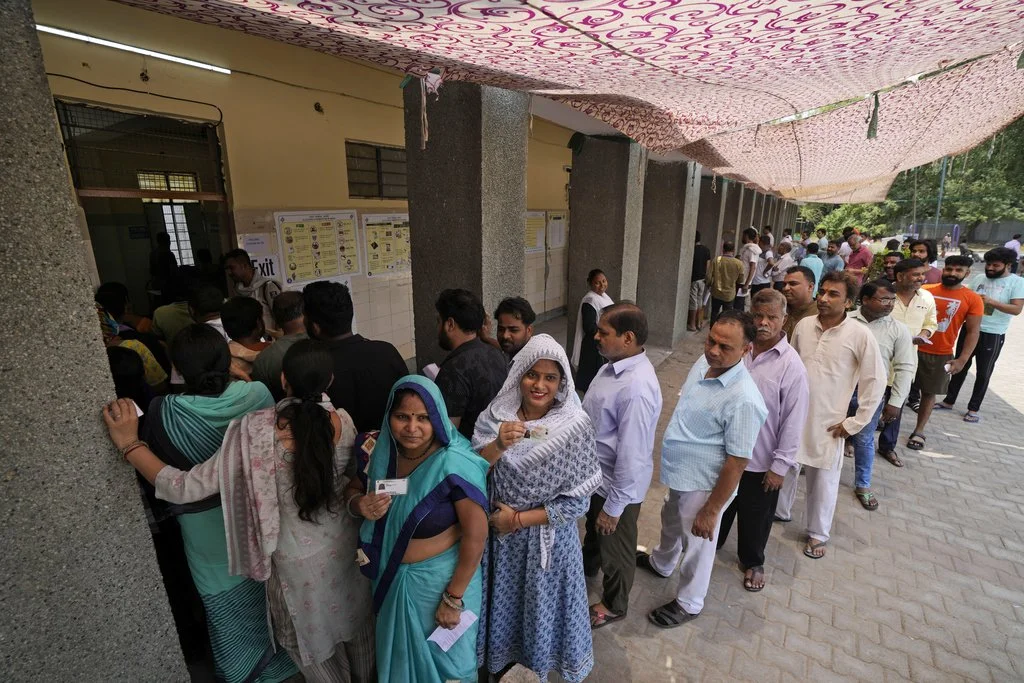
People queue up at a polling booth to cast their vote in the sixth round of polling in India's national election in New Delhi, India, Saturday, May 25, 2024. (AP Photo/Manish Swarup)
For a party that had grown accustomed to dominating Indian politics, the result was a surprising setback. Modi still secured a third term, but his party’s reduced seat count now gave regional parties and formed coalitions greater influence in the government. The BJP still had power, but it was made clear that its position was not untouchable.
The election showed that voters can challenge the ruling party, and that opposition parties can gain ground. It would be inaccurate to suggest that Indian elections no longer matter. However, it would also be inaccurate to treat one competitive election as proof that the country’s democratic institutions and their processes are functioning without problems. Winning elections is only a part of democratic accountability; governments should also face scrutiny between elections, and the institutions responsible for holding it accountable must be able to do their jobs.
The Institutions Behind the Ballot
A functioning democracy needs more than elected leaders. It needs courts, election commissions, and other public institutions to help ensure that those elected leaders operate within the law and remain accountable for their decisions. When these institutions face political interference or cannot carry out their responsibilities independently and consistently, voters may still have a chance at the ballot box, but their ability to hold the government accountable becomes more limited.
International IDEA’s democracy tracker identified declines in India’s performance over the past five years in areas including access to justice, civic engagement, credible elections, free political parties, and judicial independence. Freedom House’s 2026 assessment gives India a score of 62 out of 100, classifying it as “Partly Free.” Its assessment recognizes that India is a multiparty democracy, but raises concerns about the treatment of political opponents, civically engaged organizations.
Despite these concerns, their assessments do not capture the full picture. India’s Supreme Court has shown that it can challenge government policies and enforce constitutional protections. In February 2024, the Court struck down the electoral bonds scheme, which had allowed individuals and corporations to make political donations without publicly disclosing their identities. The Court ruled that the scheme violated the voters’ right to information, and that unlimited corporate political contributions were unconstitutional. The decision was an important reminder that judicial oversight still has a place in India’s political system. By challenging the electoral bonds scheme, the Court reaffirmed that voters should be able to access information about political financing before making any decisions at the polls.
One major judicial ruling shouldn’t kill concerns regarding institutional independence. International IDEA’s mediocre findings on judicial independence show that the strength of India’s checks and balances should still be questioned. Is independent oversight reliable and consistent across India’s political system? The 2026 voter roll scandal brings this question into focus. The Election Commission had defended its Special Intensive Revision as an effort to improve electoral accuracy. Critics, however, questioned the transparency of the process and warned that eligible voters could be excluded. The removal of 130 million names does not mean that 130 million voters have been disenfranchised. Official explanations include deceased, relocated, and untraceable individuals. Even so, a revision of this scale requires clear explanations, and ways for citizens to challenge its removal. The October protests show how quickly questions about electoral processes can turn into concerns about democratic accountability. If citizens don’t trust the institutions responsible for administering elections, confidence in the electoral process itself is at risk.
Press Freedom and the Right to Dissent
A functioning democracy also relies on the protection of freedom of expression and the ability of citizens to hold their government accountable. An independent press gives citizens access to information, exposes corruption, and provides a space for criticism. Without it, voters may still have the right to participate in elections, but they have fewer ways to understand and challenge the decisions being made on their behalf.
India’s record on press freedom is particularly concerning. Reporters Without Borders placed the country as 157th in its 2026 World Press Index, down from 151st in 2025. The organization points to violence against journalists, concentrated media ownership, and political alignment among media outlets as major factors contributing to the country’s press freedom problems.
Freedom House has also documented increasing harassment of journalists, NGOs, and government critics. Journalists face threats, physical violence, and legal pressures. These pressures make reporting on politically sensitive issues increasingly difficult; the consequences extend beyond the media industry. When journalists are discouraged from investigating government decisions, the public loses an important source of accountability. Similarly, when criticism is treated as disloyalty or hostility towards a nation, political disagreement will naturally become harder to express.
The October 2026 protests offer a recent example. The demonstrations over voter-list revisions were not just about the number of names removed from electoral rolls, but also about whether citizens could challenge public institutions and demand answers from their government. The Associated Press reported on arrests surrounding the demonstrations, while the United Nations raised concerns about the treatment of demonstrators, and called on Indian authorities to respect the right to peaceful assembly. Al Jazeera also reported that two protest leaders had their detentions extended. Although these reports do not establish that all police actions were unlawful, they raise concerns about how Indian authorities may respond to political opposition and public demonstrations.
The right to protest matters most when citizens believe that the institutions meant to represent them are not listening. A government that claims democratic legitimacy must be willing to tolerate criticism, even when that criticism is directed at its most powerful or respected officials. Otherwise, political participation risks becoming limited to voting every few years, with little room for citizens to challenge what happens in between. Democracy effectively loses meaning.
What Now?
India’s democratic story is not a simple story of total success or collapse. Despite growing concerns about democratic backsliding, India’s political system continues to retain important tools for public participation and internal oversight. The Supreme Court’s electoral bonds decision showed that institutions can still potentially challenge government policy. However, declining assessments of institutional independence and restrictions on press freedom show that democratic competition alone does not suffice.
So, is Indian democracy still going strong? The answer depends on what democracy is expected to protect. If the standard is simply whether elections take place and governments can lose seats, India still has meaningful democratic competition. But if democracy also means maintaining institutions independent and allowing citizens to criticize those in power without fear, the picture is much less reassuring.
The challenge is now making sure that voice continues to matter between elections. That means protecting institutions from political pressure, and allowing journalists and unapproving citizens to investigate and question freely.
India’s democracy has not disappeared, but it should not be judged by only the fact that people continue to vote. The real test of a democracy is not just who wins power, but whether the rights and freedoms of everyone else remain protected afterward.