
Op-Ed: The Next Phase of the Iran War Will Be Decided by Economic Pressure, Not Airstrikes
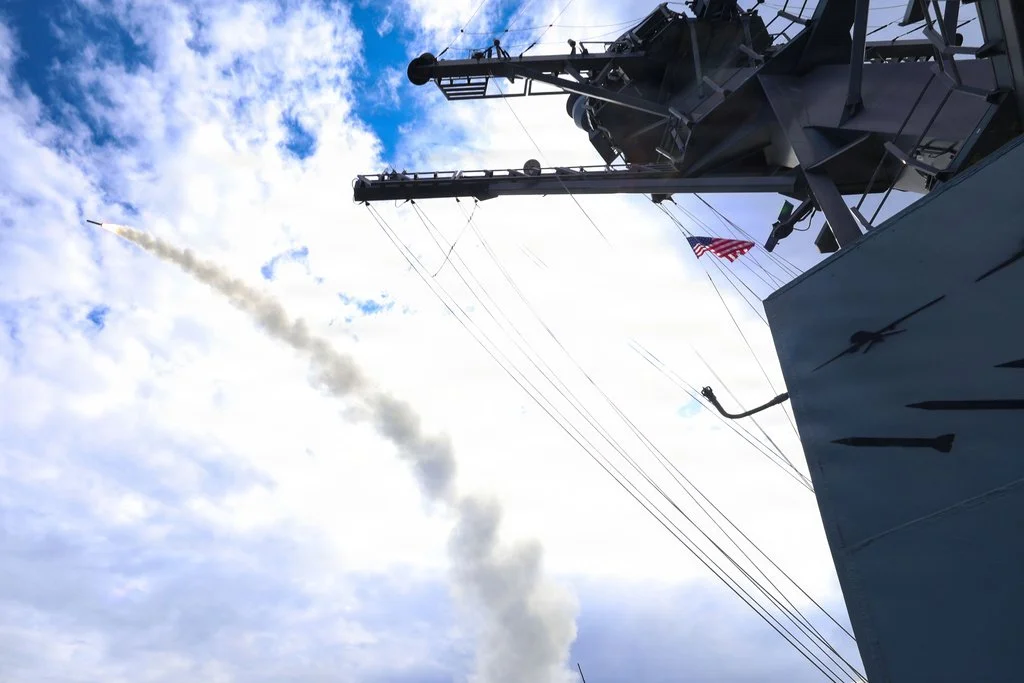
This image provided by U.S. Central Command shows the Arleigh Burke-class guided-missile destroyer USS Thomas Hudner (DDG 116) firing a Tomahawk Land Attack Missile (TLAM) in support of Operation Epic Fury, on Sunday, March 1, 2026. (U.S. Navy via AP)
According to US Central Command, Operation Epic Fury has struck over 9,000 targets across Iran, including naval assets, missile infrastructure, and other strategic capabilities. Secretary of War Pete Hegseth has framed this campaign as sharp, limited, and fundamentally different from the prolonged conflicts that defined the United States involvement in Iraq and Afghanistan. Hegseth has argued that this conflict should not be understood as another open-ended occupation. However, it cuts both ways. Avoiding a major ground deployment may reduce U.S. casualties, but it also limits Washington’s ability to translate battlefield success into lasting political control. Iran may be weakened, yet it has retained a capacity to maintain domestic authority. It still holds one form of leverage that matters deeply to the United States and its allies: the ability to disrupt the Strait of Hormuz and turn global energy markets into a battlefield.
The reality suggests the next phase of the war will look less like a contest over territory and more like a contest over endurance. Air power can degrade command networks, destroy infrastructure, and impose real costs. But airpower alone rarely compels a determined state to accept terms, especially when that state still controls a strategic chokepoint. Iran appears to understand that clearly. Even under sustained military pressure, Tehran has sought to convert geography into bargaining leverage. Its message is blunt: the war may be fought in the skies, but its consequences will be felt in ports, refineries, shipping lanes, and gas stations.
For the United States, the Strait of Hormuz is not merely a regional flashpoint but an artery running right through the global economy. Any serious disruption in Gulf energy flows would not remain confined to the Middle East; it would travel quickly into global oil prices, inflation expectations, shipping costs, and financial markets. That is why this conflict cannot be assessed purely in military terms. The central strategic question is no longer whether the United States can continue striking Iran. It is whether those strikes can achieve meaningful political results before the economic costs begin to outweigh the military gains.
Americans do not need to follow tanker routes to feel the consequences of war in the Gulf. They experience it through rising gasoline prices, greater market uncertainty, and growing concerns about inflation. A March 2026 Dallas Fed analysis found that a disruption removing roughly 20 percent of global oil supplies in the second quarter could push average WTI crude to about $98 per barrel and cut annualized global real GDP growth by 2.9 percentage points in that quarter. If the disruption persists, the modeled oil price rises further to $115 and then $132 in later quarters with deeper growth losses. CFR has also warned that if oil and gas prices stay elevated through the year, 2026 global growth could be reduced. This is what makes the Strait of Hormuz so strategically significant. Even partial disruption can have outsized effects because uncertainty itself is costly. Investors respond to every sign of escalation or diplomacy. In that sense, the administration’s room for maneuver is not defined only by the Pentagon’s target list. It is also defined by markets, prices, and public confidence.
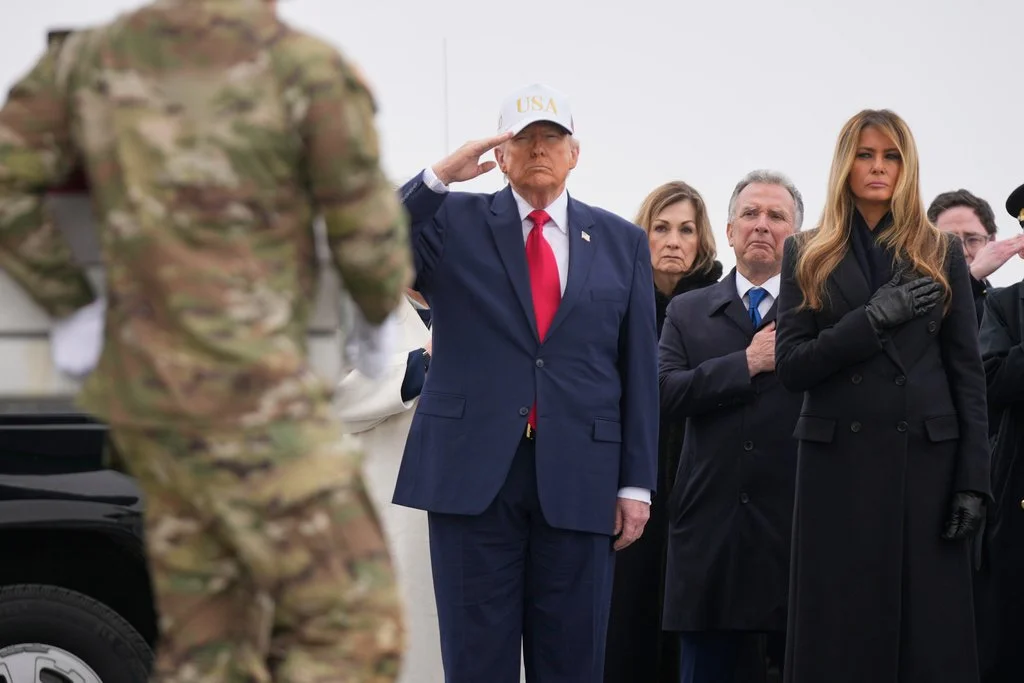
An Army carry team carry a flag-draped transfer case with the remains of U.S. Army Reserve soldier Capt. Cody Khork, 35, of Winter Haven, Fla., who was killed in a drone strike at a command center in Kuwait after the U.S. and Israel launched its military campaign against Iran, past President Donald Trump and first lady Melania Trump during a casualty return, Saturday, March 7, 2026, at Dover Air Force Base, Del. (AP Photo/Mark Schiefelbein)
This is why Tehran’s Hormuz strategy deserves close attention. By signaling that some “non-hostile” ships may pass safely while broader maritime traffic remains under pressure, Iran is not reopening the waterway so much as practicing selective coercion. The issue, then, is not only whether the strait is technically open or closed, but who can weaponize uncertainty more effectively.
The economic problem does not end with oil. It extends to the cost of fighting the war itself. One of the clearest lessons from modern warfare, seen first in Ukraine and now in Iran, is the asymmetry between cheap offensive drones and expensive defensive interceptors. A CSIS analysis estimated Shahed drones at about $20,000-50,000 each and noted that a Patriot PAC-3 interceptor costs more than $4 million. Defense News reported today that the Pentagon has struck agreements to quadruple production of THAAD seekers and increase PAC-3 production from 600 to 2,000 over seven years. For the United States, even a limited war can become financially punishing when high-cost defensive architecture must repeatedly respond to relatively low-cost attacks. The costs of sustaining advanced missile defense and extended force projection fall disproportionately on the United States, and resources allocated to that effort inevitably reduce what can be spent elsewhere.
That same economic logic is also likely to influence domestic politics. Reuters reported in early March that only about one in four Americans supported U.S. strikes on Iran in a Reuters/Ipsos poll. Since then, Reuters and AP reporting have pointed to rising political risk for Trump and growing divisions on the political right over the war. Public support for military action is often fragile, particularly when voters begin to associate conflict with higher living costs, market instability, and strategic ambiguity. At the same time, Trump has claimed that talks with Iran are underway and that Tehran is seeking a deal, while Iranian officials and state-linked voices have rejected that account. This contradiction suggests that both sides understand the military contest and the economic contest are now inseparable. Washington aims to project strength, but it also seeks an exit from a war that threatens gasoline prices, market stability, and the president’s own coalition before the midterms. On March 18th, Joe Kent resigned from his position as Director of the National Counterterrorism Center, stating that Iran “posed no imminent threat” to the United States. If that assessment holds, the mission becomes harder to justify strategically, and more difficult to sustain politically, making an early and face-saving exit increasingly important for Washington.
This is the central dilemma now facing the United States. If Washington refuses ground escalation, it will likely need to pursue some form of compromise, negotiation, or political off-ramp. But if it chooses deeper escalation, it risks sliding toward the very kind of quagmire it insists it wants to avoid. Neither option offers a clean or decisive strategic victory. That is why the next phase of this war will not be decided by body counts or bomb tonnage alone. It will be decided by whether the United States can force concessions without triggering a deeper energy shock, a more inflationary economic environment, and a more skeptical domestic audience. We may still dominate in the air. But in modern conflict, that is not always enough. The United States could win tactically while losing in the arenas that now matter just as much.