
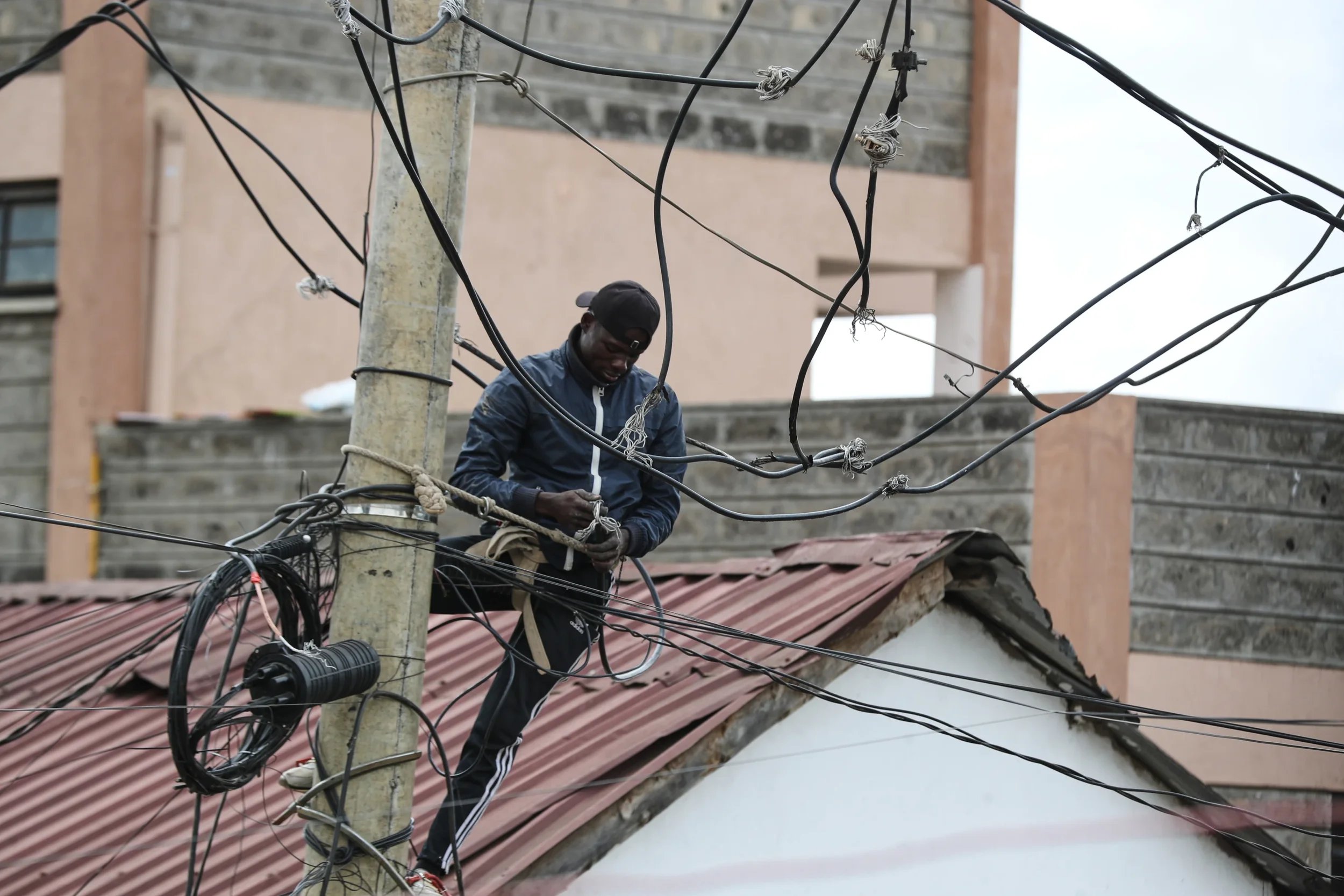
A man connects electric cables on a pole above the Kibera informal settlement in Nairobi, Kenya, Tuesday, March 31, 2026. (AP Photo/Henry Naminde)
Every year, national governments publish budgets — documents that state how much money they expect to gain and what they plan to spend it on. These publications forecast how a country’s government plans to sustain itself. As public documents, they stand to build trust between a country’s government and its citizens. The story isn’t that simple.
A recent International Monetary Fund (IMF) paper, published in April 2026, reinforced long-suspected views of development economists: governments in sub-Saharan Africa consistently fail to execute the budgets they publish. The IMF's largest gap in Africa to date draws on a dataset covering 39 countries from 2021-2024. The budget credibility gap points to deeper issues amongst African nations in upholding budget forecasts. The trend has been deficit overshoots and a subsequent revenue shortfall. This has led to expenditure cuts on clinics, roads, energy, and schooling systems — all foundations of long-term development. The trend stems from competing government incentives rather than total incompetence.
In their study, the IMF found that, on average, a government’s anticipated and actual spending differed, resulting in deficits. Fiscal deficits coming from budgets averaged 1.3 percent of GDP. The IMF identified three consistent failures: revenues were lower than expected, wages ran over, and as a result, capital expenditure took a cut. Their revenue shortfalls were, in part, due to lower-than-expected support from donors, foreign governments and international organizations to fund health programs and infrastructure. Donor countries can face their own budget pressures, and as a result of this, the money promised can arrive late, reduced, or not at all. In response to this, African governments cut what they can, and in most cases, it involves cuts to infrastructure projects, potential expansion of the medical sector, and school funding. These sectors bear the costs of the government-scheduled cuts because civil servant salaries are politically difficult to reduce, leaving the budget to absorb overruns in other areas. African countries are aware of this uncertainty, but still choose to forecast the full amount of income from donor countries in their budgets. The problems that accompany these forecasts compound over time, resulting in a recurring pattern. Less infrastructure impacts businesses because they operate less efficiently. A lowered business productivity means less taxable income and a tighter budget due to less government revenue through taxation. This cut to capital expenditure imposed long-term damage through fewer hospitals being built, road projects left unfinished, and the partial building of electricity plants. The African Development Bank estimated that the continent has an annual infrastructure deficit of around $68 billion. This continues to worsen each cycle because of these budget deficits.
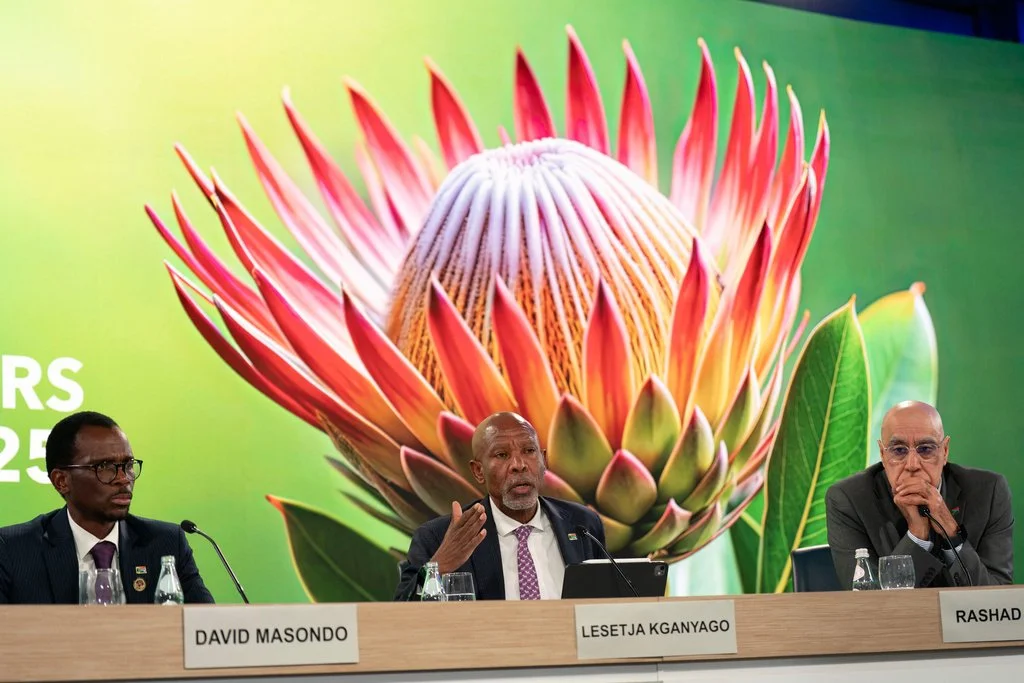
South Africa's Reserve Bank Governor Lesetja Kganyago, center, speaks during the G20 news conference at World Bank/IMF Annual Meetings at the International Monetary Fund (IMF) headquarters in Washington, Thursday, Oct. 16, 2025. (AP Photo/Jose Luis Magana)
Economic growth across the continent is projected to rise to 4 percent in 2026 and 4.1 percent in 2027, which is more than 2024’s 3.5 percent and 2025’s 3.9 percent. Although the economic growth numbers across the continent are positive, the budget deficit is a problem that is swept under the rug. The IMF has recommended fixes that are reasonable: consistent revenue projections, tighter controls on spending, and stronger oversight of institutions. In the study, countries facilitating some of these characteristics showed smaller budget deficit gaps. This raises the question: if this does work, why don’t more countries adopt similar strategies in their holistic financing? The answer is in tandem with the incentive, as it points the other way. A budget only works as a real commitment when there is accountability for breaking it. In much of sub-Saharan Africa, the consequences are weak, meaning there is no accountability. In a volatile environment where parliaments are lax and don’t challenge ‘bad numbers,’ forgetting about a budget deficit is relatively simple in light of elections, and posting another ambitious budget is more beneficial to their campaign. A government that faces no serious penalty next year will continue to make similar forecasts, leading to this continual cycle. This has consequences outside of the region’s borders, too. In bond markets, systematic gaps mean that fiscal projections are untrue and investors take on risks that they cannot price properly. This increases the possibility of a sovereign debt crisis that can destabilize countries with an example being Ghana in recent years. This impacts global investors as African bonds are priced on numbers that don’t reflect reality which makes borrowing more expensive for governments that can least afford it.
The IMF’s budget credibility paper puts a precise value on this problem. A 1.3 percent of GDP execution gap, shown across 39 countries over four years, is a pattern that reflects political systems where budgets are a tool of leverage rather than a commitment. The issue stems domestically, and the solution demands conditions that make fiscal promises binding. This would require a complete overhaul as it entails independent budget offices, well-funded civil society monitoring, and a system that rewards governments for meeting these projections. Until there are real consequences for a missed target that carries political cost, sub-Saharan governments will continue to publish plans that won’t be kept and publish plans that won't be kept for their personal political gains rather than for meeting goals. This continuing issue is a warning sign and one that must be addressed, looking into 2026 and beyond.