
Hungary’s Election Could Challenge Europe’s Right-Wing Momentum
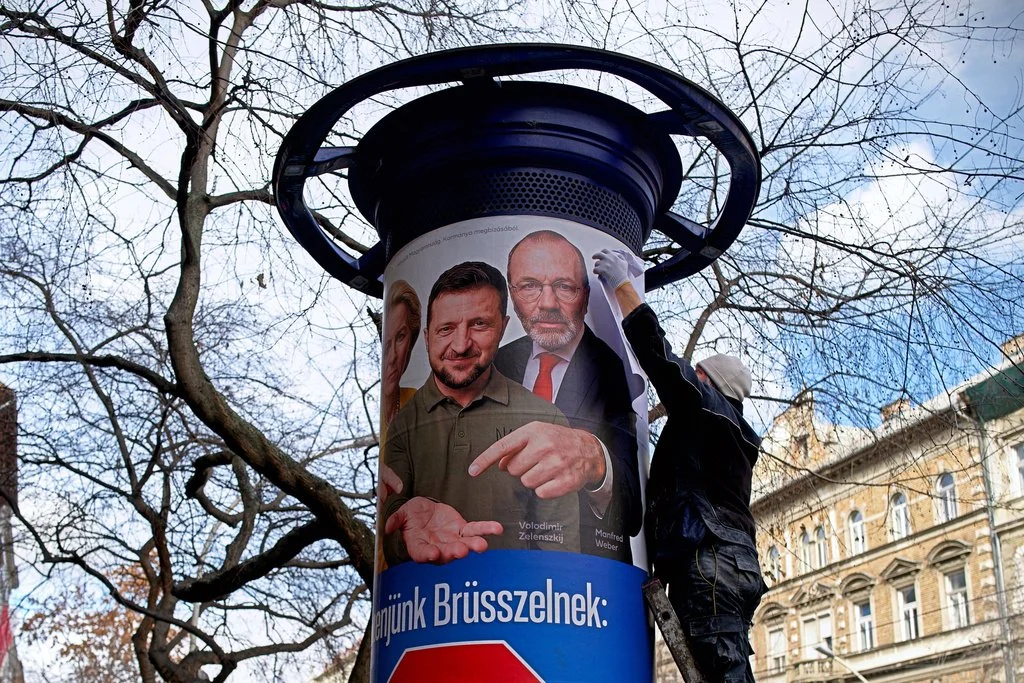
A man fixes a partially damaged billboard showing an AI-generated image of Ukrainian President Volodymyr Zelenskyy, center, flanked by European officials, in Budapest, Hungary, Monday, Feb. 23, 2026. (AP Photo/Bela Szandelszky)
Across Budapest, political posters cover lampposts, subway entrances, and construction fences, signaling just how high the stakes are as Hungary approaches a parliamentary election that could threaten Prime Minister Viktor Orbán’s decade-long hold on power. The vote in the Central European country of roughly 9.5 million people could become one of Hungary’s most important elections since the fall of communism in 1989. After more than a decade of rule by Orbán and his nationalist Fidesz party, the election is raising questions about whether Hungary’s dominant right-wing government can maintain its hold on power.
Some surveys show Tisza, led by former Fidesz member turned opposition leader Péter Magyar, ahead of Orbán’s ruling party, while others give Fidesz a comfortable lead. A January survey reported by Euronews found 40 percent support for Tisza among the general population compared with 33 percent for Fidesz. Meanwhile, other polls show an even larger advantage among decided voters. However, government-aligned research institutes report different results, placing Fidesz ahead by several points. These conflicting figures highlight how methodological differences have made Hungary’s election unusually difficult to predict. Despite the uncertainty, analysts say the election could represent the most serious challenge to Orbán’s political dominance since he returned to power in 2010. Over the past decade, Orbán has reshaped Hungary’s political system, reducing the number of parliamentary seats while increasing the share of single-member districts that tend to favor his party. Critics argue that these changes give Fidesz structural advantages during elections. Analysts estimate that the opposition may need to win the popular vote by several percentage points to secure a parliamentary majority.
Orbán has also positioned himself as one of Europe’s most influential nationalist leaders. Since taking office, he has promoted what he calls an “illiberal state,” emphasizing Hungarian sovereignty, traditional values, and strict immigration policies. His political model has attracted admiration from populist movements across Europe and the United States, particularly among leaders who argue that national governments should resist the influence of global institutions and liberal elites. Hungary has often been cited as an early example of the rise of right-wing populism in The New York Times notes that, in recent years, similar movements have gained momentum across the continent. Examples include, Italy's Prime Minister Giorgia Meloni has led the country’s most right-wing government since World War II. In the Netherlands, Geert Wilders’ anti-immigration Party for Freedom won national elections in 2023. In France, the far-right National Rally, now led by Jordan Bardella, is polling strongly ahead of European Parliament elections and continues to expand its political influence.

People wave the Hungarian national flag during Péter Magyar's speech at a campaign rally in the rural city of Debrecen, Hungary, on Sunday, May 5, 2024. Magyar, whose TISZA party is running in European Union elections, has managed to mobilize large crowds of supporters on a campaign tour of Hungary's heartland, a rarity for an Orbán opponent. (AP Photo/Denes Erdos)
These developments reflect a broader trend within Europe. Far-right parties that were once politically isolated are becoming more influential in national politics. Many of these groups have softened their tone over time but still emphasize opposition to immigration, skepticism toward the European Union, and strong appeals to national identity. Analysts say their growing popularity reflects frustration among voters over economic inequality, migration, and globalization, particularly among those who feel ignored by traditional political parties. Hungary’s upcoming election may offer a different story. While nationalist movements continue to gain ground in parts of Europe, Orbán’s government now faces growing criticism at home. Corruption scandals, economic struggles, and concerns about democratic backsliding have weakened support for Fidesz in some polls, opening the door for the opposition. The result will not only determine Hungary’s political future, but may also offer an early indication of whether Europe’s broader nationalist wave still has momentum, or whether it may be beginning to face its first meaningful tests.