
United States–Spain Dispute Could Test Transatlantic Trade Relations
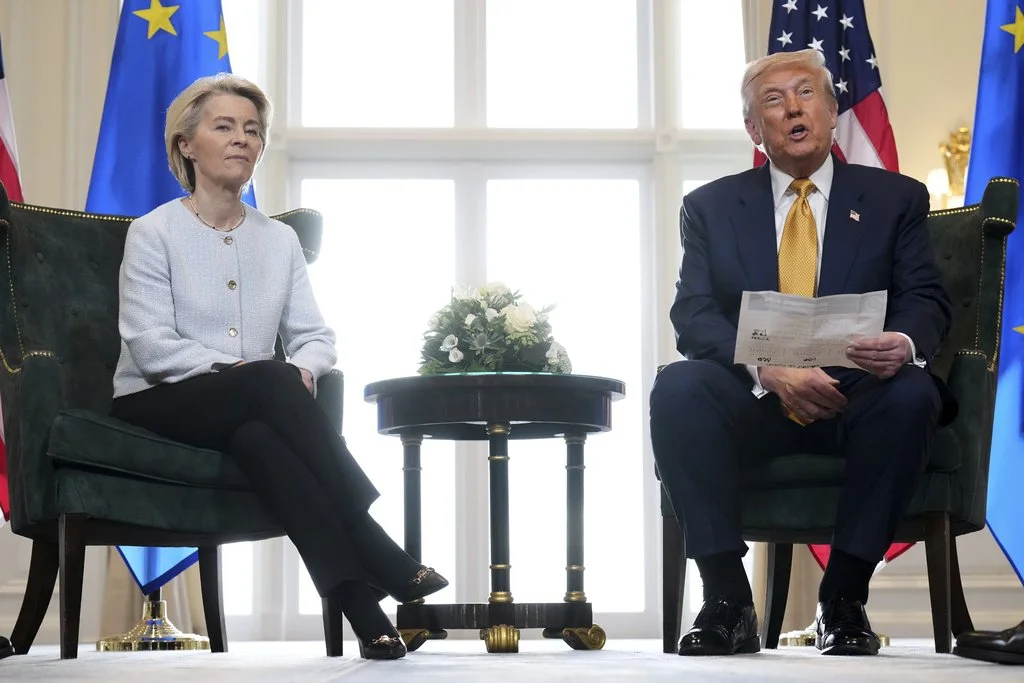
President Donald Trump reads from a paper and European Commission President Ursula von der Leyen listens after reaching a trade deal between the U.S. and the EU at the Trump Turnberry golf course in Turnberry, Scotland Sunday, July 27, 2025. (AP Photo/Jacquelyn Martin)
Earlier this month, Spanish Prime Minister Pedro Sánchez restricted American use of their military bases in response to the ongoing conflict in Iran. The Prime Minister stated, “We are not going to be accomplices to something that is bad for the world, simply because of fear of reprisals from some,” while expressing opposition to the war. Additionally, Donald Trump had previously called for an increase in NATO spending on military budgets from 2% to 5%. Spain declined to support this increase, with Sánchez stating that the idea was “incompatible with our worldview.” In response to both issues surrounding an increase in the military, Trump threatened that the United States could end trade relations with Spain.
Any attempt to restrict trade with Spain would involve legal and structural considerations. As a member of the European Union, Spain participates in a single market in which trade policy is negotiated at the EU level rather than by individual member states. This framework is reflected in Article 207 of the Treaty on the Functioning of the European Union (TFEU), introduced under the Treaty of Lisbon, which states that “the common commercial policy shall be based on uniform principles… [including] the conclusion of tariff and trade agreements relating to trade in goods and services.” This provision establishes that trade policy is applied uniformly across all European Union member states.
The scale of economic integration between the EU and the United States further shapes the context of potential trade restrictions. In 2023, EU–US trade in goods and services totaled €1.6 trillion, with approximately €4.4 billion in exchanges occurring daily. Trade flows between the two are relatively balanced, with a difference of approximately 3% between exports on each side. Investment links are also substantial, with firms holding €4.7 trillion in cross-investments. These economic connections are associated with millions of jobs, including 2.3 million in the United States linked to exports to the European Union and an additional 3.4 million supported by EU-based firms operating in the United States

Greenpeace activists hang a banner reading in Spanish, "Not to war" in downtown Madrid, Spain, Tuesday, March 10, 2026. (AP Photo/Bernat Armangue)
This is further reflected in the scale and structure of EU–US trade, which operates across both goods and services sectors. In 2023, total trade in goods alone reached €851 billion, while trade in services accounted for €746 billion. These figures highlight the width of economic exchange across industries, including manufacturing, energy, and finance, reinforcing that transatlantic trade between the United States and the European Union is heavily intertwined. In addition, the relatively balanced trade across both sectors indicates that economic interdependence exists on both sides of the relationship rather than being concentrated in a single market or industry.
Spain’s trade profile provides additional context. Approximately 4–5% of Spain’s exports are directed to the United States, while a majority of its trade occurs within European markets. As part of the European Union’s single market, goods, services, and capital circulate freely among member states. This structure affects how trade measures aimed at restricting trade between the United States and Spain may have broader implications for the whole European Union, rather than just for Spain itself.