
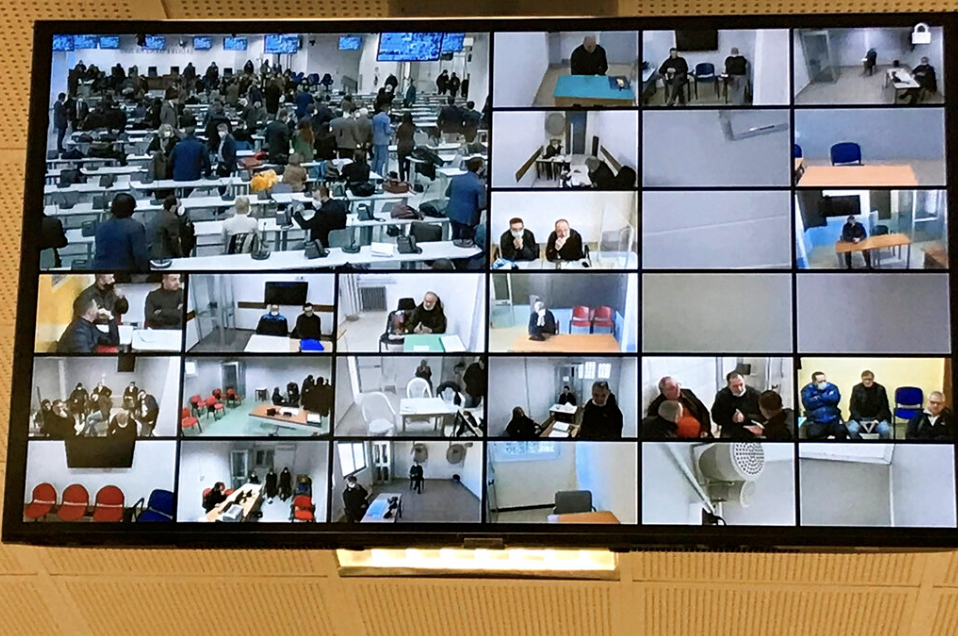
A monitor shows participants following the first hearing of a maxi-trial against more than 300 defendants belonging to the ‘Ndrangehta. The trial took place in southern Italy against arguably one of the world’s richest criminal organizations which rose to power after the fall of the Sicilian Mafia, Wednesday, Jan. 13, 2021. (AP Photo/Gianfranco Stara)
Thanks to the I-CAN project, a total of 181 arrests connected to the ‘Ndrangheta were made across 32 countries in 2026 alone. The first phase of I-CAN began in June 2020 through an agreement between Italy’s Department of Public Security and Interpol, the world's largest international police cooperation organization. Entirely funded by Italy, I-CAN operates across national borders, enabling law enforcement agencies to communicate through international police cooperation channels and access extensive police databases. The initiative aims to use transnational cooperation to combat the ‘Ndrangheta on an international scale. Within the first month of the program, 14 ‘Ndrangheta fugitives were captured in Brazil, Albania, Argentina, Costa Rica, and Switzerland.
As two Italian scholars observed, “The boundary of the ‘Ndrangheta is the world, while its golden opportunity is globalisation.” From a small, localized gang in Calabria, the ‘Ndrangheta has become one of the most powerful mafia organizations in the world. It is estimated to contribute 3.5% of Italy’s Gross Domestic Product and generate around 53 billion to 60 billion euros annually. By working directly with cartels in Latin America and the Andean countries, the ‘Ndrangheta is able to serve as the international middle-men of 80% of the cocaine distribution across Europe. According to the United Nations Office on Drugs and Crime (UNODC) 2025 World Drug Report, the illegal production of cocaine reached a new high of 34% in 2023 from 2022. Simultaneously, cocaine users reached 25 million in 2023, an 8 million increase from 2013.
Due to the risks associated with participating in illicit markets, the ‘Ndrangheta has exploited legitimate industries to conceal its illegal wealth. By owning important legal sectors such as construction and healthcare and investing in foreign markets, including Germany and the Netherlands, their illegal supply network has become nearly undetectable. According to three economists from the Bank of Italy, businesses infiltrated by the ‘Ndrangheta experienced increased revenue, but this did not necessarily translate into genuine economic growth. Its expansion into legal markets drove out honest competitors and distorted local market pricings. Violence and extortion were also common methods of coercing businesses, corrupting markets, and generating profits. Paolo Pinotti, an economics professor at Bocconi University, observed that the ‘Ndrangheta caused homicide rates to quadruple and contributed to the south-eastern region of Italy recording its lowest growth rate in the country. Its global expansion has also contributed to drug addiction, localized street crime, and the mental health crisis.
A woman walks by the Interpol logo located at the international police agency headquarters in Lyon, France, Friday, Sept. 18, 2026. (AP Photo/John Leicester)
Following the success of the first phase, the second phase of I-CAN was launched in 2025 and is scheduled to continue until 2027. The Italian Department of Public Security remains the primary funder, while the German Federal Criminal Police Office has joined as a contributing power. Phase two intends on using the profit-driven nature of criminal organizations to undermine their operations. By aiming to track down their illicit assets and financial resources, I-CAN expects to see exponential success in its endeavors. Nevertheless, the ‘Ndranghtea is believed to still have over 60,000 members worldwide.
As demonstrated by the I-CAN project, when criminal organizations become a national threat, nations use collaboration as a response to fight against it. I-CAN aims to strengthen its operational capacities by bringing additional countries into the initiative. As transnational crime continues to evolve, the project’s planned expansion underscores the importance of sustained collaboration in disrupting the lasting impact of criminal organizations on societies. Looking ahead, I-CAN hopes to strengthen investigative cooperations and shift attention to the Balkans and Latin America. Italy and its partner countries hope that the project’s success will foster global awareness of the dangers of organized crime and encourage more nations to unite against it.