
The Election of the First Far-Right State Parliament Speaker in Germany Since WW2: How the AfD is Shifting German Politics
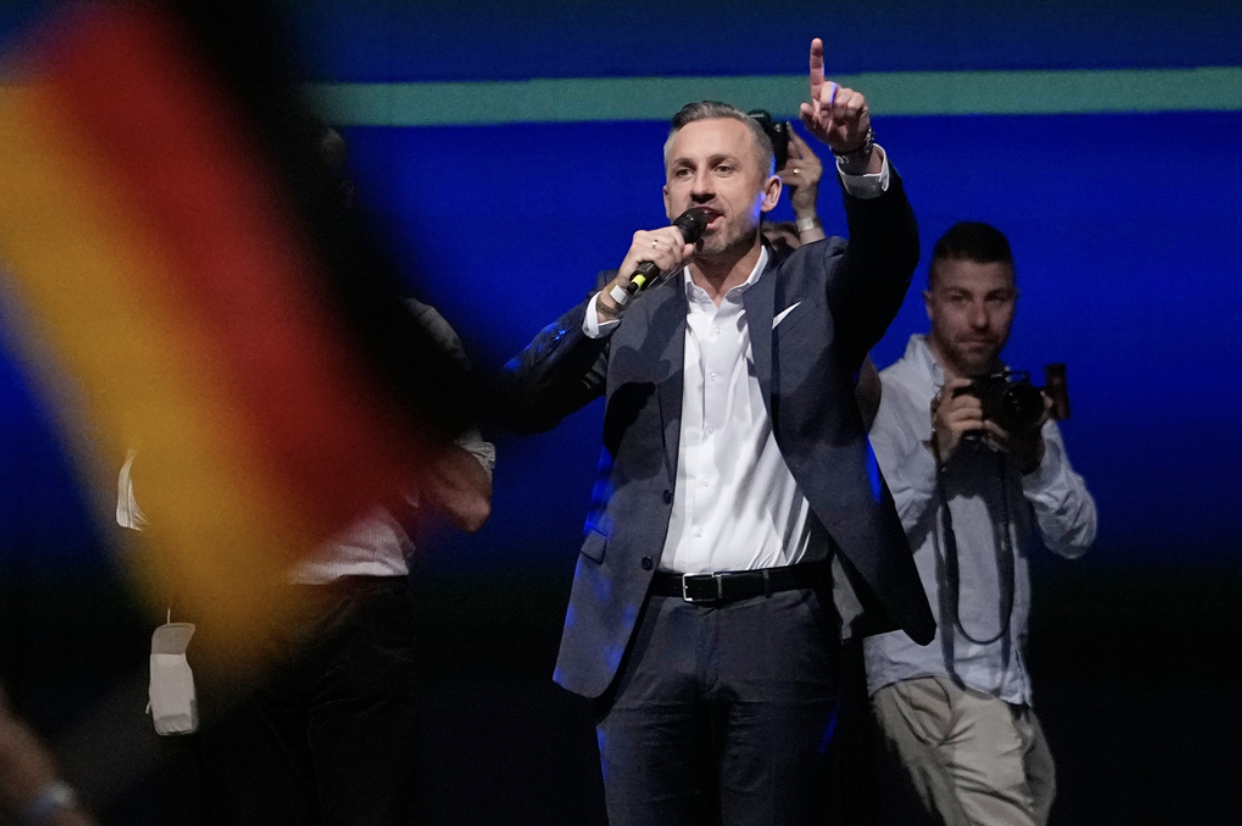
Top Candidate Ulrich Siegmund speaks at an election party for the "Alternative for Germany" (AfD) following the Saxony-Anhalt state elections in Magdeburg, eastern Germany, Sept. 6, 2026. (AP Photo/Matthias Schrader, File)
The recent state elections in Germany reflected major shifts in government composition and growing turmoil in state parliaments. Tobias Rausch of the AfD was recently elected as speaker of the Saxony-Anhalt state parliament with the support of the BSW. In this role, Rausch, 35, will oversee the parliamentary proceedings, assume ceremonial responsibilities, host memorials, and help manage the legislative agenda. This marks the first time that the AfD has held the chamber’s top procedural office, representing a major symbolic victory for the party. The two parties are also entering negotiations on a resolution that would denounce German support for Ukraine and call for the lifting of sanctions on Russia.
Since WW2, German political parties historically maintained a firewall against the rise of far-right parties, namely the Alternative for Germany (AfD), which was founded in 2013. The firewall is an informal agreement among German political parties not to allow far-right and extreme-right parties into government. The AfD was initially formed in response to the European sovereign debt crisis and the eurozone crisis, which involved disputes over how countries would manage debt during the transition to the euro and the need for financial assistance. The AfD originally gained recognition for its critical stance on the transition to the euro, but eventually shifted to the right. The massive influx of immigrants to Germany in 2015 pushed the AfD to become increasingly radical, centering anti-immigration reform as a core staple of its right-wing extremism.
Support for the party has grown considerably in eastern German states within the last decade, driven by its populist platform, anti-immigration stance, and emphasis on nationalization. Despite being classified as a “suspected case of right-wing extremism” by Germany’s Federal Office for the Protection of the Constitution, the AfD is now represented in 15 of the 16 state parliaments as well as in the Bundestag, which is the national parliament and primary legislative body of the Federal Republic of Germany. Following the February 2025 elections, the party more than doubled its representation to 152 seats in a 630-seat parliament Bundestag, making it the main opposition party.
Beyond the federal parliament, the state election in Saxony-Anhalt that occurred this September also reflected a rise in AfD representation. The party won 43.8% of the vote, which doubled the percentage of seats (20.8%) that they occupied only five years earlier. They won 39 of the 83 seats. This was a ‘shocking’ result for members of the German Chancellor Friedrich Merz’s party, the Christian Democratic Union (CDU), whose party lost more than half of its electoral support.
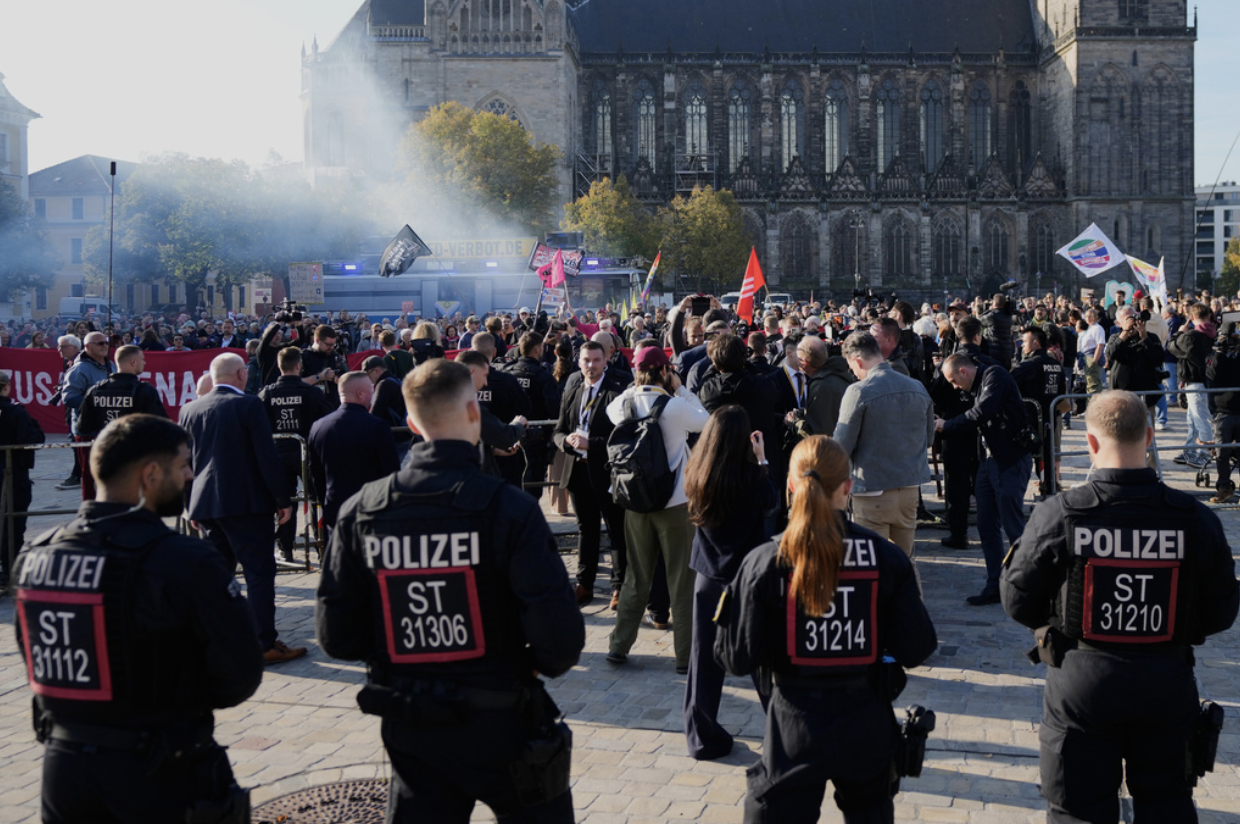
Police officers monitor a protest against the far-right AfD, Alternative for Germany, party prior to the constituent session of the new elected German federal state parliament of Saxony-Anhalt in Magdeburg, Germany, Tuesday, Oct. 6, 2026. (AP Photo/Matthias Schrader)
The parties that maintain the firewall against the AfD do not include the Sahra Wagenknecht Alliance (BSW) in every respect. The BSW takes a conservative approach to social issues, including immigration, while maintaining a left-leaning economic stance. It advocates for social welfare, limits on market power to curb the existence of monopolies, and greater economic support for public infrastructure. Although BSW has ruled out forming coalitions with the AfD, it has not completely withdrawn support for the party, which has drawn criticism from the firewalled parties. Last week, the AfD and BSW held talks about jointly electing an AfD politician as president of the state parliament. On October 6th, the parties demonstrated their ability to cooperate by electing Tobias Rausch as the parliamentary speaker. His victory was achieved by the MPs from the AfD and five confirmed MPs from the BSW. Rausch’s election was met with harsh criticism from protestors outside the Saxony-Anhalt parliamentary building.
Despite strong public criticism, as well as internal criticism from the SPD, Greens, and Left Party over the BSW’s apparent cooperation with it, the right-wing extremist party is gaining a more prominent position in German politics. Further, the AfD and BSW have submitted a joint motion in the state parliament calling for Germany to halt financial assistance and arms supplies to Ukraine. The motion also calls for an immediate lifting of sanctions placed on Russia. The parties have requested a special session to discuss the motion on October 14. Although this resolution is purely symbolic, and carries no legal binding power, it reflects a power shift in the Saxony-Anhalt government. The BSW’s willingness to enter negotiations with the AfD reflects an astounding break in the firewall against far-right extremism in Germany.