
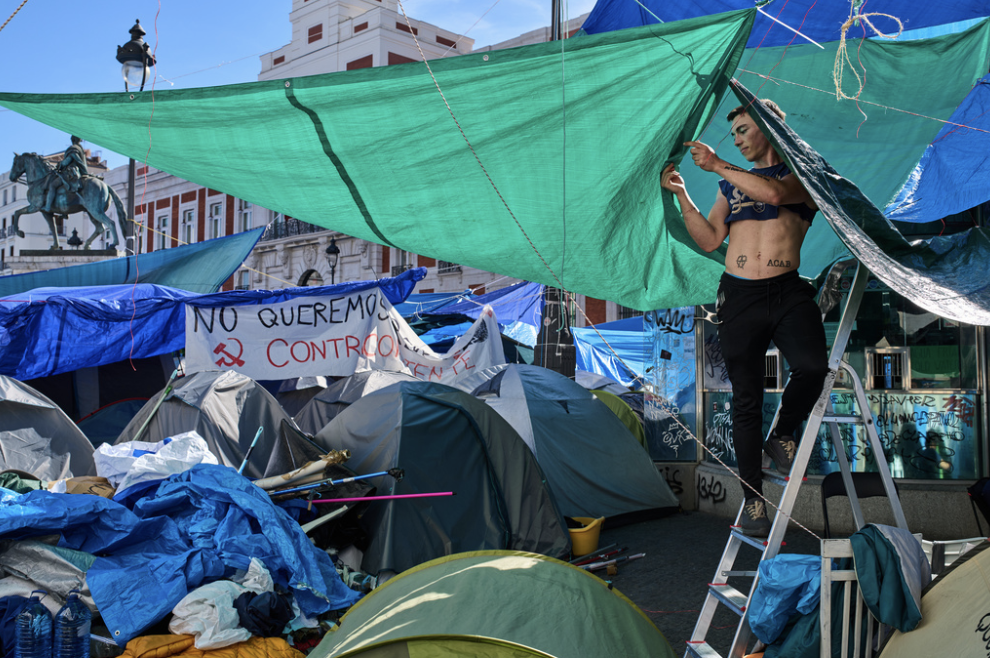
A man sets up a roof cover at a makeshift camp set up by protesters demanding stronger laws to protect renters in Puerta del Sol square in Madrid, Spain, Friday, Oct. 16, 2026. (AP Photo/Bernat Armangue)
The European housing crisis has worsened and reached a breaking point within the past year. The crisis has hit each member state differently, with concerns ranging from the affordability of housing units to their condition. Each state has responded to the housing crisis differently. In Madrid, tens of thousands of protestors took to the streets after legislation intended to improve access to housing was struck down by the right-wing members of the Spanish parliament. Lisbon followed suit, as activists protested the housing crisis and cost of living by pitching over two hundred tents in the city’s two central squares and remaining there for around ten days. On October 20, Portuguese police cleared these camps and made fifty-five arrests. Berlin’s housing crisis, however, is not being protested in the streets but through the left wing of the newly elected parliament.
While citizens in Madrid and Lisbon have resorted to protesting their government’s housing policy, the electorate in Berlin has voted the left-wing party Die Linke into power, whose main platform focuses on housing and rent affordability. This election occurred at a time when housing has become one of the most prominent concerns in Berlin, as well as across the rest of Europe. In the 2026 Berlin Survey, housing emerged as the clearest shared concern among Berliners, with around 95% of responses identifying housing as a serious problem. Berlin is a city in which 85% of inhabitants live in rented housing, and rent prices have soared by more than 70% in the last ten years.
This is not unexpected, as housing prices have surged across Europe, rising by 58.33% from 2015 to 2025. Across Germany, the rise in housing prices is below the EU average, at around a 51.30% increase from 2015 to 2025. In Germany’s capital, however, Berliners spend an average of about 33% of their income on housing. The rental market in Berlin has become increasingly strained and is only expected to worsen, given the latest population forecast from the Senate Department for Urban Development, Construction and Housing. According to the forecast, Berlin’s population is expected to grow from its current 3.7 million to 4.006 million inhabitants by 2040. The areas surrounding Berlin experienced greater population growth than the capital city itself between 2015 and 2024. With this expansion and continued population growth, the city and its surrounding areas can expect even greater pressure applied to the housing market in the coming years.
There are too few units to accommodate Berlin’s current population, but this is only one of the reasons why rent is so high. Building activity in Berlin has declined, particularly since the Covid-19 pandemic, which increased the cost of construction materials. The prices of raw materials, including wood, steel, and concrete, have risen alongside the cost of skilled labor and energy. There is difficulty financing and streamlining high-cost projects for new units because bank lending is becoming more restrictive, while the approval processes for building permits often take 13 to 18 months. These factors have played a major role in Berlin’s housing deficit. In order to reduce this deficit, Berlin would need to build around 98,000 new apartments by 2030, according to a study director at the Pestel Institute.
Not only are there too few rental units, but apartment prices continue to rise. Advertised rents have nearly doubled since 2014, fueling frustration within Berlin’s electorate and the city government. During its campaign for the September elections, the Left Party, Die Linke, ran on a platform advocating for a nationwide rent cap lasting six years, affordable unit refurbishments, and the installment of public and co-operative housing. On September 6, during the Saxony-Anhalt state elections, the far-right AfD party garnered a substantial share of the vote. A few weeks later, on September 20, Die Linke became the most prominent party in Berlin, with 25.7% of the vote in the Berlin state election. This is the highest share of the vote that Die Linke has won since German reunification.
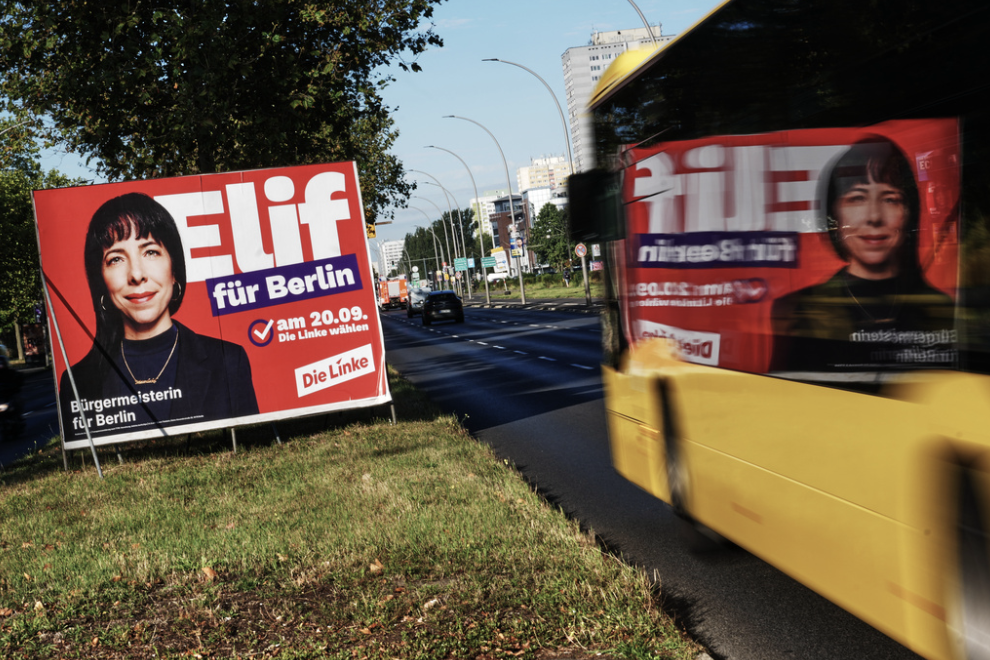
A poster of Left Party top candidate Elif Erlap for the upcoming Berlin state parliament election is placed on a road in Berlin, Germany, Tuesday, Sept. 15, 2026. (AP Photo/Markus Schreiber)
Now the largest party in Berlin’s state parliament, Die Linke is working toward fulfilling their housing-centered campaign promises. However, the party does not hold a governing majority, having secured only 25.7% of the votes, so they need to enter negotiations with other parties to pass their social housing legislation. Their approach is centered on the socialization of housing units, which entails transferring properties owned by private real estate companies into public and collective ownership. This would allow Berliners who qualify for social housing to access accommodations at a lower cost.
This week, Die Linke, the Social Democratic Party of Germany (SPD), and the Green Party (Die Grünen) held exploratory talks and agreed to socialize property owned by real estate companies that hold over ten thousand units. Die Linke announced that it will hold a party conference on October 31 to decide whether or not to invite the SPD and Die Grünen to coalition negotiations on social housing.