
The Second Space Race is Underway: The US-China Space Race
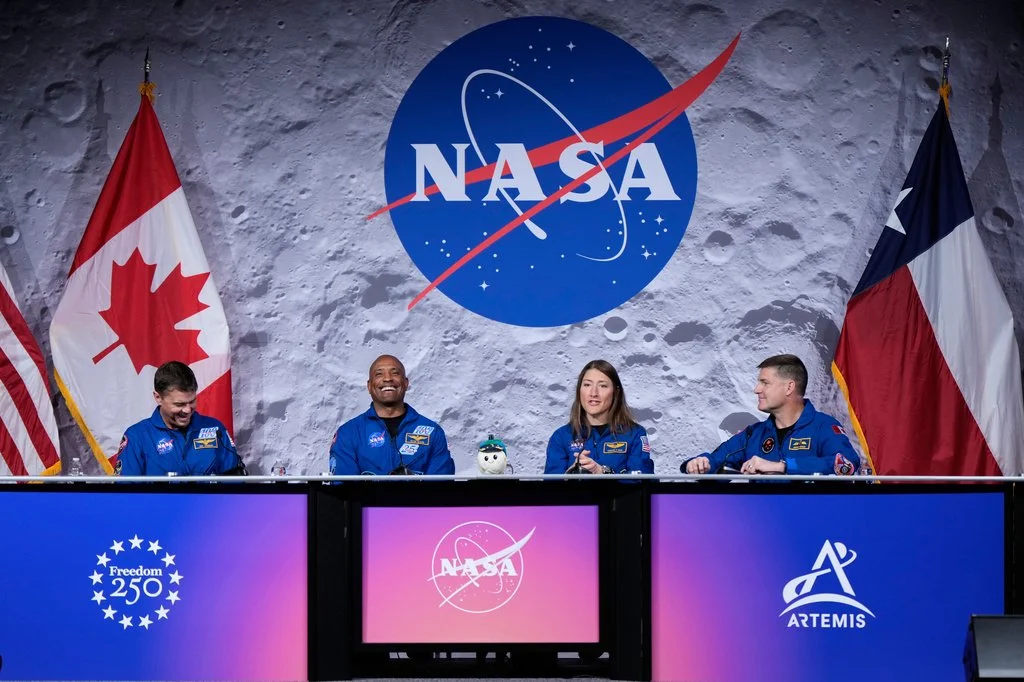
NASA's Artemis II crew - NASA astronauts Reid Wiseman, Victor Glover, and Christina Koch, and Canadian Space Agency (CSA) astronaut Jeremy Hansen speak during a press conference on Thursday, April 16, 2026, in Houston. (AP Photo/Ashley Landis)
Artemis II, the first crewed flight of the Artemis program, returned to Earth on April 11 after completing its 10-day flyby. It marked the first human spaceflight to go beyond low Earth orbit since Apollo 17 in 1972. The mission’s success has fueled renewed sentiments of American exceptionalism, drawing inevitable comparisons to the last time Americans set foot on the Moon—an achievement shaped by Cold War competition with the Soviet Union.
In the 21st century, a new space race between the United States and China is heating up. Both nations are competing to reach the lunar south pole, where they aim to build bases, search for rare resources, and lay the groundwork for future crewed missions to Mars. With global attention returning to space exploration, America’s dominance may be more precarious than it appears. America’s National Aeronautics and Space Administration (NASA) is targeting a 2028 American Moon landing, although delays remain possible. Meanwhile, the China National Space Administration (CNSA) is targeting 2030, but it could be achieved sooner.
China embarked on its first spaceflight mission in 1964, much later than the US, but since then, its advancements have accelerated rapidly. Although no Chinese astronaut, a taikonaut, has yet gone beyond low Earth orbit, Beijing operates its own space station and continues to make steady progress. In 2019, it successfully grew a green leaf on the Moon, and in 2024, it became the first country to retrieve samples from the lunar far side. Xie Gengxin, a scientist and professor at Chongqing University, comments: “Overall, progress appears to be proceeding smoothly.”
In February, the CNSA conducted a successful in-flight abort test. During the rocket’s early ascent, the escape system was deliberately triggered, allowing an unmanned escape capsule to parachute safely back to Earth while the rocket continued its flight. Upon re-entry, the rocket executed a controlled ocean landing using its engines rather than relying on free fall or parachutes. This breakthrough, combined with CNSA’s exceptional lunar landing capabilities, makes Beijing’s goal of putting astronauts on the Moon before 2030 increasingly realistic.
Despite China’s progress, NASA still has the advantage of knowledge from having already landed on the Moon with its Apollo program. Qian Yuqi, a lunar geologist at the University of Hong Kong, notes that China’s first crewed missions are still only revisiting ground first covered during the Apollo era. Moreover, recent Artemis missions have reinforced US leadership—Artemis II has traveled further from Earth than any manned spacecraft in history. In the race to land astronauts at the lunar south pole, the US remains ahead.
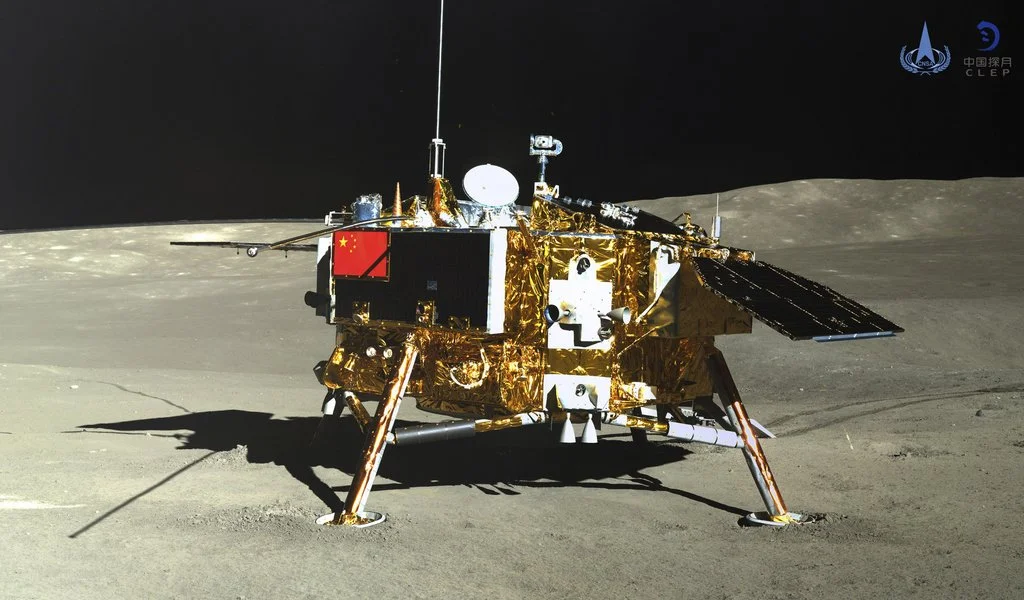
FILE - This photo provided on Jan. 12, 2019, by the China National Space Administration via Xinhua News Agency shows the lunar lander of the Chang'e-4 probe in a photo taken by the rover Yutu-2 on Jan. 11. (China National Space Administration/Xinhua News Agency via AP, File)
Oliver Holmes and Alastair McCready from the Guardian have compared this space race to that of the proverbial race between the tortoise and the hare—with the US potentially taking on the role of the hare. In fact, NASA had intended to launch Artemis II in 2023. The program’s lag can be attributed to technical difficulties and, more broadly, to political uncertainty stemming from structural differences between the two countries.
A series of technical issues had forced the space agency to scale back Artemis III from a crewed lunar landing to an Earth-orbit docking test. Unlike the Apollo era, NASA now depends heavily on private contractors to develop key components. Elon Musk’s SpaceX and Jeff Bezos’s Blue Origin, in particular, are rushing to finish their parts in time for NASA’s next deadline.
More significantly, China’s advantage lies in its one-party political structure, which insulates long-term space objectives from changes in leadership. In contrast, NASA’s direction and funding are closely tied to the US political climate. During the Apollo program, Congress dramatically increased funding from $8 million in 1961 to $11.6 billion in 1966, in 2020 dollars. By comparison, the budget for the current initiative went from $1.8 billion in 2011 to $2 billion in 2016. China, on the other hand, has consistently increased investments in its space program—from $4.9 billion in 2016 to nearly $20 billion in 2024.
In response to the US’s structural disadvantages, Stephen Buono writes in the Wall Street Journal: “Artemis missions won’t matter if voters think the [Moon] is yesterday’s achievement.” Buono argues that the government must gain public support for its space initiative if the United States hopes to once again be the first to land on the moon.
For both countries, the stakes extend far beyond symbolic victory. Dean Cheng, a non-resident scholar at George Washington University’s Space Policy Institute, highlights that leadership in space will shape access to critical resources, the ability to build infrastructure, and overall governance—factors that will ultimately determine the economic and military activity in space for future generations. The “Earth-Moon space economic zone,” as the Chinese have dubbed it, is projected to have a total annual output value of $10 trillion by 2046. Although it may take years for either nation to reach the lunar south pole, the first country to do so will be seen as the global leader in space.