
Haiti’s Prime Minister Alix Didier Fils-Aimé Speaks Out About the Treatment of Haitian Immigrants
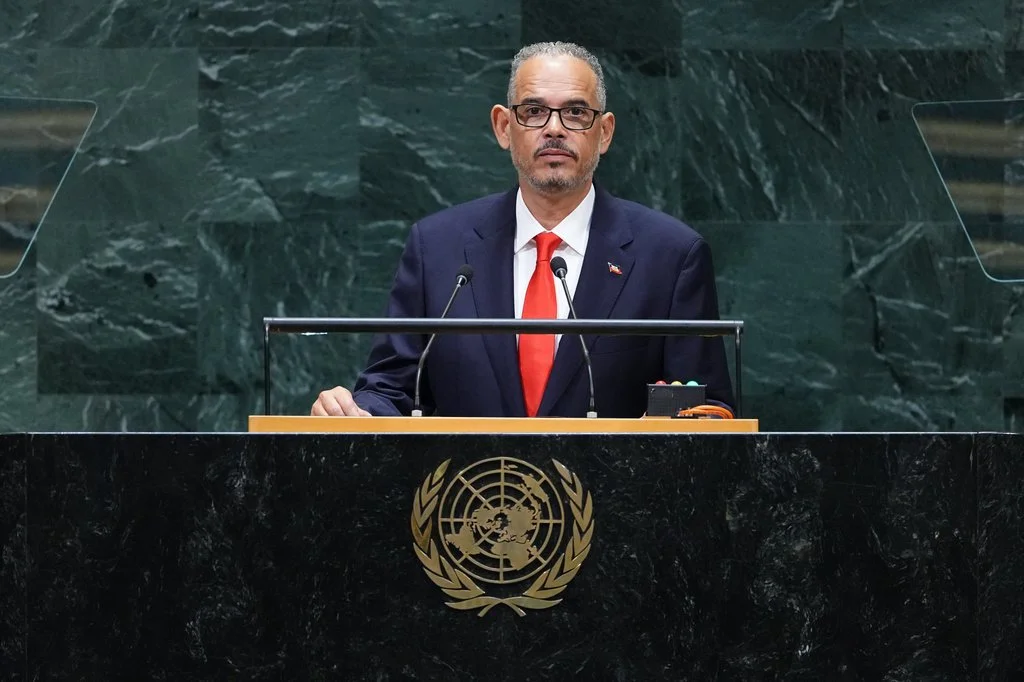
Haiti’s Prime Minister Alix Didier Fils-Aimé addressing the 81st session of the UN General Assembly on Friday, Sept. 25, 2026 (AP Photo/Frank Franklin II)
On Friday, September 25, 2026, Haiti’s Prime Minister Alix Didier Fils-Aimé addressed the 81st session of the United Nations (UN) General Assembly. Fils-Aimé discussed issues Haiti faces, including the humanitarian crisis, gang violence, and uncertainty about the nation’s future. His three priorities for Haiti’s government are “reestablishing security, stability, and economic recovery.”
He cited the conflict between Haitian immigrants and the US government as one major issue. During his speech, Fils-Aimé expressed his appreciation for Haiti’s “privileged partnership” with the US and the “steadfast support” coming from Canada. Yet, more seriously, Fils-Aimé said that “the protection of a border and respect for human dignity are not incompatible,” and that both must be considered together. He also stated that “The destiny of migrants calls upon us to shoulder a shared responsibility and ensure sustainable responses.”
Through general statements about migrants, borders, and human dignity, Fils-Aimé implied that the US must consider these factors when deciding policies for Haitian immigrants in the US. Fils-Aimé was referring to the termination of Haiti’s Temporary Protected Status (TPS), a “lawful immigration status and work authorization to migrants who cannot return to their countries of origin due to war or other disasters.” In June 2026, the US Supreme Court allowed Trump’s Department of Homeland Security (DHS) to end Haiti’s TPS, which had protected close to 330,000 Haitians in the US.
The conflict in Haiti had been deteriorating, with the UN estimating that at least 19,380 people were killed in Haiti between Jan. 2023 and June 2026. The US State Department ranked Haiti at a Level 4 “Do Not Travel” due to safety issues such as terrorism, crime, and kidnappings.

An armored police vehicle that’s part of the UN-approved multinational Gang Suppression Force patrols in Port-au-Prince on Tuesday, Sept. 29, 2026. (AP Photo/Odelyn Joseph)
Since July 2026, hundreds of Haitians have been deported, and deportation flights to Haiti have changed from monthly to weekly. Deportees are sent to Cap Haitien instead of the nation’s capital, Port-au-Prince, since the Federal Aviation Administration prohibits U.S. aircraft from flying below 10,000 feet over the city due to extreme violence. Once they landed in Haiti, many deportees described how their personal belongings, such as legal documents and money, were not returned to them. After arrival, deportees trying to leave Cap Haitien faced difficulty, as the road out of the city was controlled by gangs that kidnapped and killed travelers.
Once TPS ended, Haitian recipients had been given ankle monitors and were summoned by the DHS for in-person “check-ins.” On Monday, Aug. 31, 2026, 20-year-old Pierre Damas Bel, an ankle monitor recipient, committed suicide by walking onto oncoming highway traffic near Springfield, OH. Bel came to the US from Haiti in 2024 to join his family, since he, his younger sibling, and parents were recipients of TPS. Bel had recently started attending Wright State University in Dayton, OH. While attending Springfield High School, Bel was a co-captain of the soccer team, a member of the National Honor Society, and a lieutenant in the Marine Corps Junior ROTC.
Deportations are also affecting state and national economies. One state with a large Haitian community is Massachusetts, where over 10,000 Haitians with TPS in the workforce contributed about $480 million a year to the economy. Massachusetts has also provided numerous resources to Haitian TPS recipients over the years, such as English classes and skills training.
Some Haitians have begun seeking refuge in Canada, especially in Quebec, a French-speaking province. Most Haitians who lose TPS in the US either have to remain in the country and work illegally or flee to another nation. Some Haitians have relied on TPS for years, given that TPS was first granted to Haitians in Jan. 2010 by President Barack Obama.
Additionally, some have seen the termination of TPS as a business opportunity rather than a humanitarian crisis. Roger J. Stone Jr., a Republican who has ties to the Trump administration, was hired by Haiti’s Foreign Ministry to lobby the US government for Haiti and paid close to $800,000 for the role. Haiti also pays $35,000 monthly to the lobbying firm Continental Strategy, run by former ambassador Carlos Trujillo, who has ties to the Trump administration. Also, former governor of Maine, congressional candidate, and early Trump supporter, Paul LePage, expressed some frustration with ICE’s deportations, saying “his son’s father-in-law was being wrongfully deported because of his country of origin.”
While the fate of thousands of Haitian immigrants remains uncertain, Haiti’s Prime Minister Alix Didier Fils-Aimé used part of his speech at the UN to bring awareness to the treatment of Haitian immigrants. Along with the humanitarian crisis that deportees face, national and international economies will be affected by the huge loss to the US workforce.