
Iranian War Escalates: American Troops in the Mideast Surge to 50,000 Amidst Possible American War Crimes in Force Placement
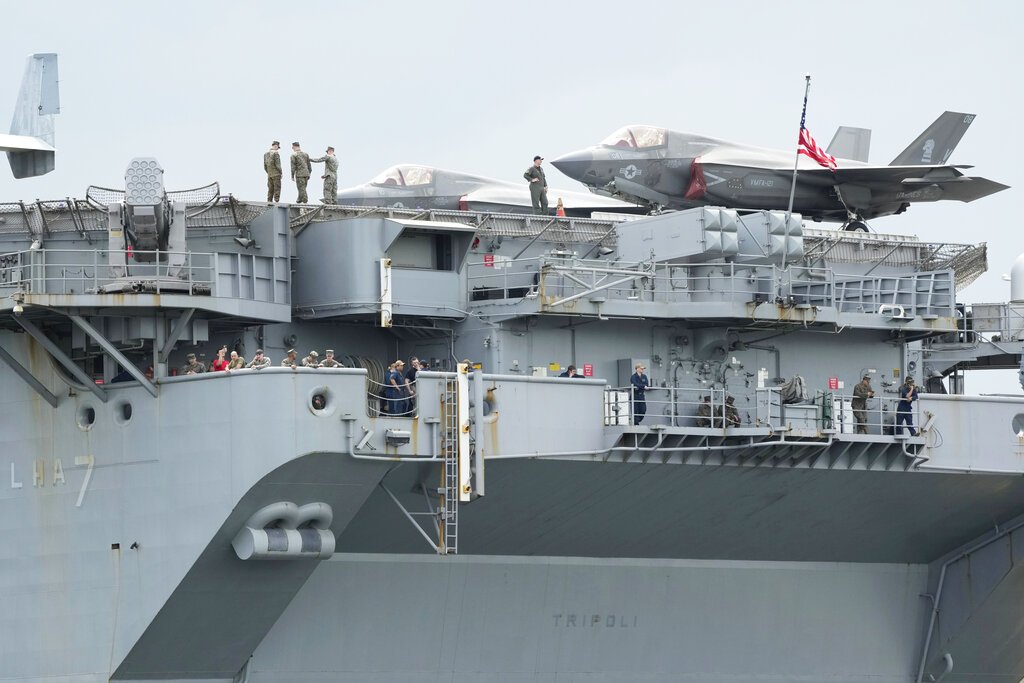
U.S. personnel stand beside an F-35B Lightning II aircraft on board the U.S. Navy USS Tripoli (LHA-7) amphibious assault ship during a port call in Manila, Philippines, Tuesday, Sept. 27, 2022. (AP Photo/Aaron Favila)
On Monday, March 17, the USS Tripoli was seen off the coast of Singapore en route to the Middle East. Earlier satellite imagery placed the ship west of Malaysia. U.S. officials had already confirmed that it had been ordered to the Middle East. As of March 28, U.S. Central Command confirmed that the USS Tripoli had arrived in the region.
The America-class amphibious assault ship had been conducting exercises near Taiwan, and was stationed in Okinawa, Japan. It now enters the region with the 31st Marine Expeditionary Unit (MEU) aboard — roughly half of the new Marine deployment to the region. While motivations for the 31st MEU remain unconfirmed, U.S. officials say the president is weighing a broader escalation, including the possibility of seizing an island or other strategic territories as part of an effort to open the Strait of Hormuz.
These moves don’t stand alone. On March 9, reports indicated that the Pentagon had transferred Patriot and Terminal High Altitude Area Defense (THAAD) anti-missile batteries from the U.S. Forces Korea (USFK) to the Middle East. At the same time, Washington announced postponing a $14 billion arms package sale to Taiwan. The deal, originally expected to be negotiated this month between President Donald Trump and Chinese leader Xi Jinping, has been pushed to May 14-15, stalling plans of American support for Taipei.
In reaction, leaders across Asia — from Tokyo to Manila to Taipei to Seoul — say they are waiting anxiously for the Trump administration to find an exit ramp from the Iran conflict as Chinese and North Korean threats persist. On March 14, North Korea fired 10 ballistic missiles during USFK drills. Although the U.S. Indo-Pacific Command assured there was no immediate threat to U.S. allies, China has kept up intense pressure on Taiwan, while leaning more heavily on Japan. On March 30, Beijing imposed sanctions on Japanese lawmaker Keiji Furuya over his ties to Taiwan; both Reuters and AP described it as retaliation tied to Beijing’s red lines on support for Taiwan.
U.S. officials also confirmed that the Navy has expedited the deployment of a group of ships carrying a rapid-response Marine force (11th MEU) to the Middle East from their home port of San Diego. The 11th Marine Expeditionary Unit, composed of at least 2,200 Marines, departed San Diego aboard the amphibious assault ship USS Boxer on Wednesday, earlier than expected, according to multiple reports. Reuters reported that the troops departed the U.S. about three weeks ahead of schedule.
The pair of Marine Expeditionary Units represents the addition of over 5,000 troops to an already strained region. Meanwhile, Iran has denied that negotiations have taken place despite Washington's claim that they have begun.
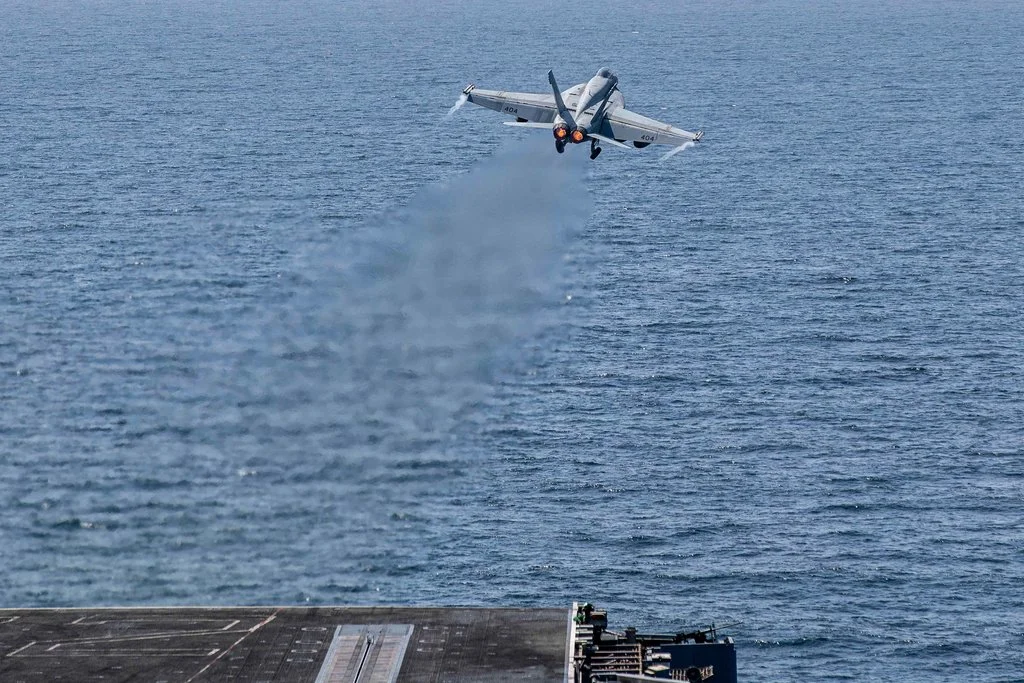
This image provided by U.S. Central Command shows a F/A-18E Super Hornet launching from the USS Abraham Lincoln (CVN 72) for a mission in support of Operation Epic Fury, on Saturday, Feb. 28, 2026. (U.S. Navy via AP)
The USS Boxer and USS Tripoli will join the USS Abraham Lincoln carrier strike group, which has been involved in the U.S. bombing campaign on Iran. They would also reinforce the 82nd Airborne Division, the Army’s emergency response force which would include a battalion of the 1st Brigade Combat Team as well as Maj. Gen. Brandon Tegtmeier, the division’s commander, and division staff, according to officials, who spoke Tuesday (March 24) on condition of anonymity. The exact location of the Army paratroopers has not been disclosed, but officials indicate they will be within striking distance of Iran. The paratroopers could be used to seize Kharg Island, Iran’s main oil export hub in the northern Persian Gulf, where U.S. warplanes bombed more than 90 military targets earlier this month. Or they could be deployed for other ground operations alongside the Marines.
The USS Gerald R. Ford was also operating in the region but is being sent to Crete for repairs following a fire aboard it last week. However, as of April 3rd, 12:06 AM, the Navy has reported that repairs of the world’s largest aircraft carrier have been completed. The vessel will head back to the Middle East for Operation Epic Fury after receiving supplies to sustain operations while docked in Split, Croatia.
Escalation in naval force posture in the region occurs simultaneously as the U.S. comes under fire over possible war crimes in the Persian Gulf countries, including the United Arab Emirates, Bahrain, and Kuwait. As U.S. forces contend with Iranian drone attacks, the latest choice by the U.S. military to relocate troops from vulnerable military bases under Iranian attack to hotels and office spaces in civilian areas may amount to violations of the Geneva Conventions and the law of war in the U.S. U.S. defense officials say that commanders have relocated many of their troops because the sprawling compounds did not have adequate defenses to protect from Iranian ballistic missiles and drones, drawing international ridicule over the ethical implications of disregarding the duty for military initiatives to avoid civilian proximity.
“It is unconscionable that U.S. forces would knowingly put civilians at risk by leaving their bases and moving to hotels in the densely populated city centers,” said Brian Castner, a crisis researcher at Amnesty International, a human rights organization. “The commanders who ordered these relocations, not out of the conflict area but right into the heart of the civilian populations, should be investigated for violating U.S. laws of war.”
The concerns raised by Castner are shared by many, including Michael Schmitt, a professor of international law at the University of Reading and an emeritus professor at the U.S. Naval War College. Schmitt emphasizes the fine line the U.S. Military will walk if it continues its deployment of troops in civilian cities. While there is “wiggle room” in both violating the U.S. Law of War Manual and the First Protocol of the Geneva Conventions, the U.S. actions still raise possible war crimes issues. Where the U.S. military crosses the line in international humanitarian law is around what are called “passive precautions,” or the measures militaries take to protect civilians in the vicinity of military positions from attack. “Passive precautions are required, but they are often not followed,” said Schmitt.
The First Protocol of the Geneva Conventions and U.S. law of war allow some discretion when placing forces among civilians during active combat in those areas. One example would be Ukrainian forces defending the southern city of Mariupol in 2022. Ukrainian troops were among the civilians because Russian forces were directly attacking the city with ground troops, artillery, and air strikes.
“This would not apply to the current situation of U.S. forces in the Middle East because the soldiers are not deployed to the cities to defend the civilian population from attack,” Mr. Castner said. “In fact, the opposite. The forces are trying to avoid attack by being in the hotels, which would not be lawful targets otherwise.”