
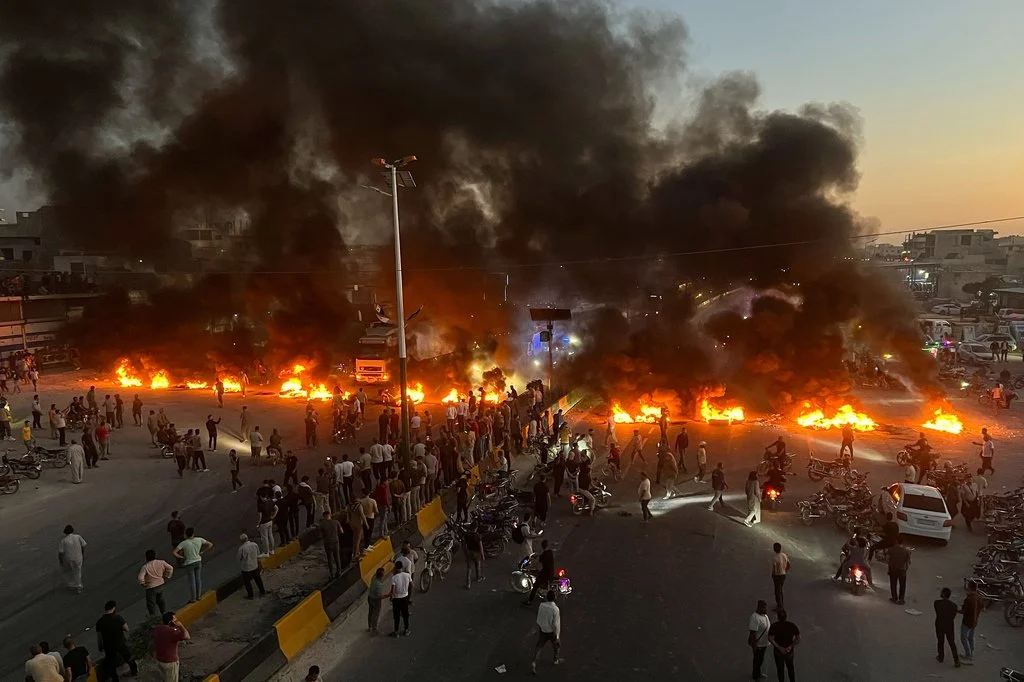
Protesters burn tires and other debris to block a highway as demonstrations over fuel price increases spread across Syria, in Maarat al-Numan, Idlib province, Sunday, Sept. 13, 2026. (AP Photo/Ahmed Albam)
Protests broke out across Syria following the government’s Sept. 12 decision to increase diesel prices by 40 percent, bringing the per-liter cost to 175 Syrian pounds, or about $1.32. In the broadest demonstrations since the fall of former President Bashar al-Assad in December 2024, thousands took to the streets in six governorates, blocking roads around the country.
Fuel prices in Syria have risen by 79 to 94 percent since the start of this year. The government attributed the spike to high energy prices around the globe amid the US-Iran war and to the repair of Syria’s petroleum refining industry. Rehabilitation work at the Baniyas refinery—Syria’s largest oil refinery—is expected to continue for two months, compromising the country’s domestic refining capabilities. Syria’s reduction of Russian oil imports has further strained fuel availability; the country imports approximately three-quarters of its diesel and four-fifths of its gasoline, leaving it particularly vulnerable to mounting international energy costs.
The government stated that the increases are temporary and that Syrian economic recovery will take time. “The state has adopted a policy of moving from a socialist economy to a free-market system, and we recognize the difficulties that this entails,” Energy Minister Mohammed al-Bashir stated at a news conference on Sept. 17. During the conference, al-Bashir introduced diesel subsidies that would reduce diesel costs for heating, agricultural, and industrial use.
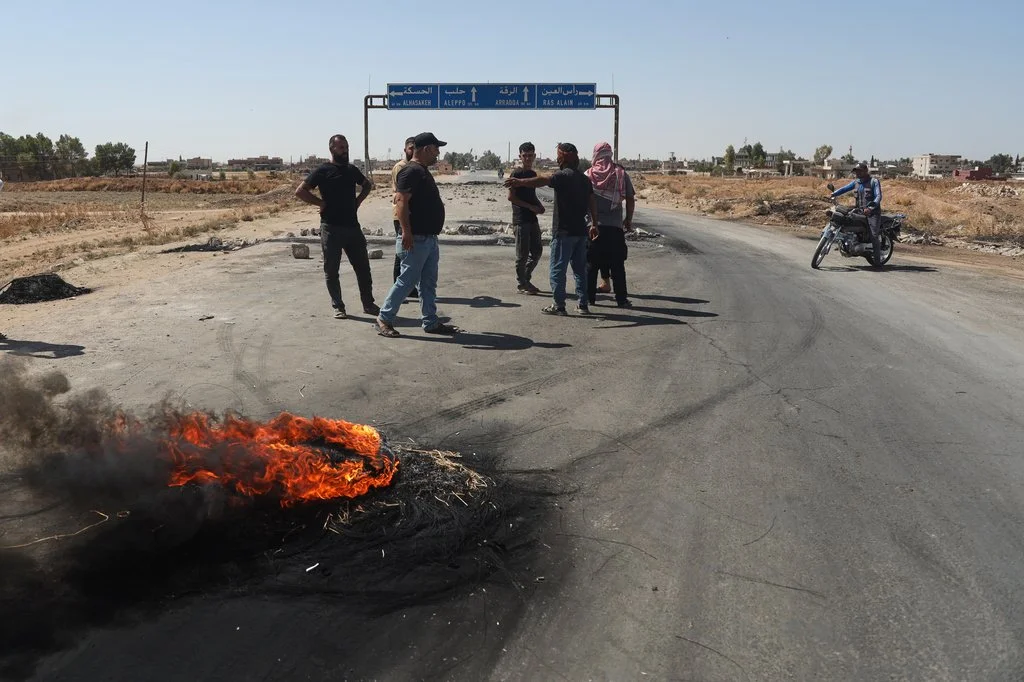
Local residents block a road to prevent oil tankers from the Rmeilan oil fields from passing during ongoing protests against higher fuel prices at the entrance to Tal Tamr, northeastern Syria, Wednesday, Sept. 16, 2026. (AP Photo/Baderkhan Ahmad)
Protests have since died down, but they exposed the fragility of the government’s own base. Analysts state that the demonstrations reveal underlying frustration that conditions have not improved since the fall of the Assad regime. Idlib and Aleppo were central to President Ahmed al-Sharaa’s rise to power. Yet it is in these areas where residents burned tires in mass gatherings in response to fuel price increases. Unrest in places that have been historically loyal to the al-Sharaa government may suggest increasing frustration among his supporters.
This unrest also threatens the integration of northeastern Syria’s Kurdish region, where the Syrian Democratic Forces—the armed wing of the Rojava regime—recently merged with the Syrian army. The northeast accounted for nearly 80 percent of the demonstrations on Sept. 13. Under Rojava control, fuel was heavily subsidized, and the removal of those subsidies when Damascus gained control already strained household budgets before the latest price hike compounded that burden.
Combined with signs of eroding patience in Idlib and Aleppo, the unrest in the northeast suggests that al-Sharaa’s government is facing pressure from all sides. Neither the former SDF territories nor constituencies that helped bring him to power can accept the rising cost of living; UNICEF estimates that 90 percent of Syrians live below the poverty line. Such increases threaten the ability of families to put food on the table and subsequently threaten the state’s political stability. Syrians have cited reductions in business, travel, and energy use in response to soaring prices.
The broader economic picture, however, is shifting. On Sept. 30, the US removed its arms export ban on Syria, the latest in a series of efforts from Western countries to lessen economic sanctions on the nation. As sanctions ease, Syrian authorities may lose their ability to attribute economic hardship to external forces, and the cost-of-living crisis exposes continued discontent with the interim government’s inability to improve financial conditions.
Al-Sharaa's swift rise to power was supported under the premise that it would be accompanied by economic recovery; however, to many Syrians, this promise has felt unfulfilled. The new Syrian government’s pursuit of rapid economic liberalization by eliminating subsidies, allowing imports, and bringing prices in line with global averages is accelerating at a rate that most Syrians cannot afford.
In his address to the Syrian parliament on Sept. 20, Energy Minister al-Bashir made no mention of a reduction in petroleum prices. “We recognize the scale of the challenges facing Syria’s energy sector and do not underestimate them,” al-Bashir stated. “But we know where we stand and what resources are available to us.” The al-Sharaa government’s long-term response to the protests and the issues of unaffordability driving them will test the durability of Syria’s transitional authority.