
Op-Ed: Red Sea Disruption Turns Shipping Route Into Supply Chain Shock
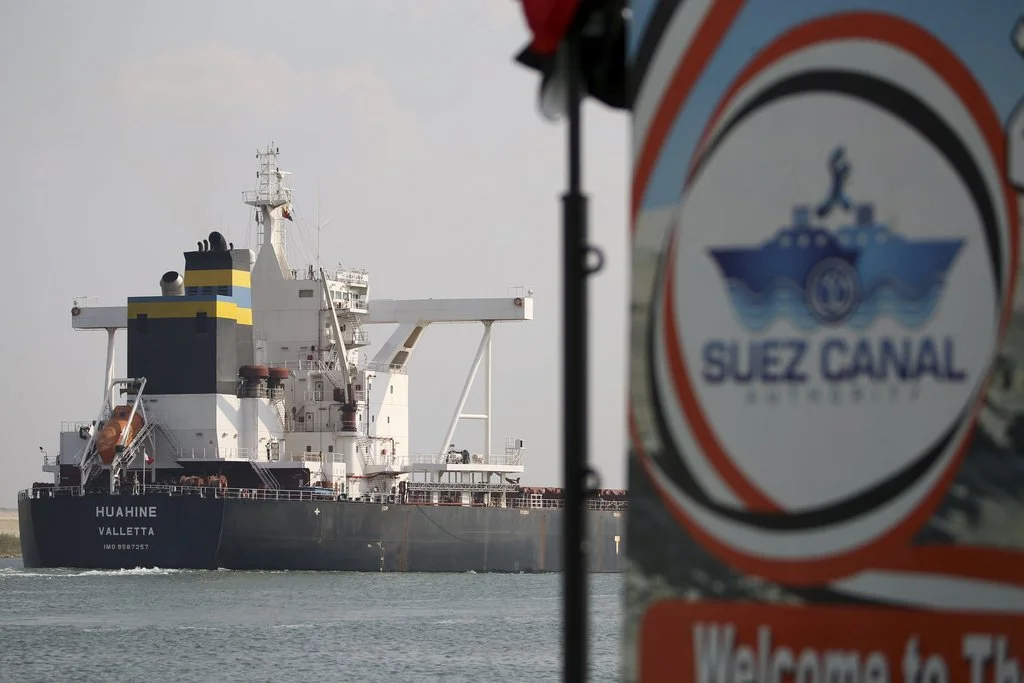
A cargo ship sails through the town of Ismailia, Egypt, March 30, 2021. Houthi rebels in Yemen are attacking cargo ships plying the waters connecting Asia with Europe and the United States, forcing traffic away from the Suez Canal and around the tip of Africa. (AP Photo/Ayman Aref, File)
Attacks on commercial shipping in the Red Sea have turned a regional security crisis into a global supply chain problem. Since late 2023, repeated attacks on vessels have forced many shipping lines to avoid the Suez Canal and Bab el Mandeb route, rerouting ships around the Cape of Good Hope at the southern tip of Africa. The added time, insurance and fuel costs of the longer journey have depressed trade between Asia and Europe, changing the commercial outlook for ports, carriers and states across the region. What the disruption also revealed, however, is something the shipping industry had long understated: the degree to which global trade depends on a small number of fixed corridors, and how little redundancy exists when one of them fails.
The Suez Canal sits at the center of this shock. As one of the shortest and most important maritime links between Europe and Asia, disruption has quickly spread across global supply chains. By May 2025, tonnage through the canal decreased to 70% below 2023 levels, according to UN Trade and Development. Egyptian officials have linked the disruption to a steep financial hit. President Abdel Fattah el Sisi claimed that Suez Canal revenue fell by more than 60% due to the campaign, costing Egypt approximately $7 billion in 2024.
Rerouting through the Cape of Good Hope adds thousands of miles and weeks of transit time to each voyage, driving up fuel, labor and carrying costs across the supply chain. At the height of the disruption, ships that once transited the Red Sea in days were rerouting for weeks around the Cape of Good Hope, a shift that, even as some traffic has returned, has kept Suez Canal volumes roughly 60% below pre-crisis levels. Global ton-miles rose 6% in 2024, not because more goods were being traded, but because the same goods were traveling much farther to get there. Longer routes require more fuel, more labor time and more buffer stock. The longer journey reduces the effective supply of ships, resulting in elevated and volatile freight rates even after firms adapt to the new route. A full return to the Red Sea may introduce a different kind of pressure. With a projected 36% surge in new vessel capacity entering the market between 2023 and 2027, reopening the shorter route would release absorbed capacity back into an already oversupplied market, placing downward pressure on freight rates and carrier margins.

File - Houthi rebel fighters march during a rally of support for the Palestinians in the Gaza Strip and against the U.S. strikes on Yemen outside Sanaa on Jan. 22, 2024. (AP Photo, File)
Insurance has made each voyage considerably more expensive for carriers. Reuters reported in April 2026 that war risk premiums, the extra charges insurers levy on vessels entering designated conflict zones, had surged as much as 1,000% during the latest regional escalation, showing how quickly a localized threat can raise the cost of moving goods even before a ship sets sail. Higher insurance costs matter because they are harder for firms to offset than a one-time delay. They raise the cost of each shipment and force companies to rethink routing, pricing and inventory decisions. That pressure is no longer confined to the Red Sea. As of May 2026, shipping through the Strait of Hormuz continues under significant restriction, with US Navy escort operations and tanker seizures compounding insurance and routing costs across the wider region.
Egypt's canal revenue falls directly with ship traffic. But some ports and logistics operators have benefited from rerouting and regional redistribution. S&P Global reported that longer routes have increased bunker fuel demand at alternate ports along the Cape route. Separately, Abu Dhabi-based AD Ports said opportunities remained for firms able to provide reliable passage and alternative trade routes amid continuing disruption. In 2025, AD Ports reported strong feeder volume growth, with a quarter of first-half volume tied to the Red Sea. Those gains may now be unwinding as traffic returns to the Red Sea and the alternate bunker demand that sustained them recedes. But the contrast between Egypt's losses and Abu Dhabi's gains points to something worth examining: the states that fared best were those that had invested in port capacity and logistics infrastructure before the crisis began, not those that relied on geography alone.
The disruption extended well beyond the shipping industry. The more important story is what it revealed about how firms had structured their supply chains in the years before the crisis. Decades of investment in just-in-time logistics had optimized global supply chains for efficiency and cost, eliminating the buffer stocks, redundant suppliers and flexible routing arrangements that would have absorbed a disruption of this scale. The Red Sea crisis did not create that vulnerability. It exposed it. The World Bank and S&P Global found that rerouting and off-schedule arrivals worsened port performance in 2024, with roughly 2 million twenty-foot equivalent units (TEUs) delayed or stalled. Even where goods still moved, the system became less predictable. Firms that lacked alternative routing arrangements or flexible inventory strategies had no contingency when their primary route became unavailable. Those that adapted fastest had diversified supplier bases, buffer inventory and alternative routing arrangements already in place. The difference between those two groups was not luck. It was how seriously each had treated geographic risk as a planning variable before the crisis materialized.
The implications for governments in the region are similarly structural. Egypt's position illustrates the problem clearly: a state whose fiscal position depends heavily on canal transit fees has limited capacity to absorb a sustained reduction in shipping traffic, regardless of the diplomatic or military steps it takes to restore stability. The crisis demonstrated that control over a maritime chokepoint generates revenue in stable conditions but provides little protection when those conditions deteriorate. What protects a state in disruption is the infrastructure it has built around the chokepoint: deep-water port capacity, bonded storage, intermodal logistics networks and the ability to attract diverted cargo rather than simply watching it bypass the canal entirely. The states in the region that emerged from the crisis in a stronger competitive position were precisely those that had made those investments.
Egypt's canal authority has argued that the Cape route is not a sustainable long-term alternative, and the data suggests they may be right. Passages through the Red Sea rose 34% in March and April 2026 compared with the 2025 average, as tankers rushed back partly to avoid new risks emerging around the Strait of Hormuz. That recovery reflects rerouting pressure from the Strait of Hormuz rather than restored confidence in Red Sea security. The underlying instability has shifted geography rather than dissipated. In a trade system dependent on a small number of fixed maritime corridors, a threat to any one of them produces consequences well beyond its immediate location, and the conditions that created the Red Sea shock remain present across the wider region.