
Op-Ed: The World Economy Withers as The Strait of Hormuz Standoff Continues
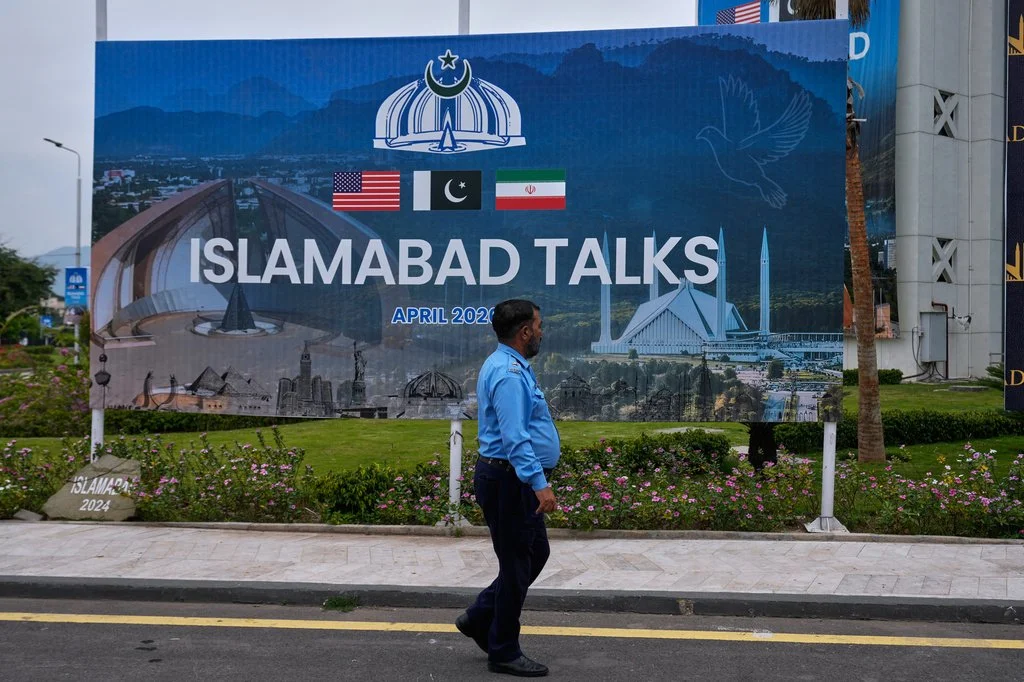
A police officer walks past a billboard regarding U.S. and Iran negotiations, outside a media facilitation center in Islamabad, Pakistan, Saturday, April 11, 2026. (AP Photo/Anjum Naveed)
On April 8, 2026, the US and Iran struck a temporary two-week ceasefire mediated by Pakistan, just hours after US President Donald Trump threatened to end “an entire civilization”. Yet, the ceasefire left thorny issues unresolved, leading the US to impose a blockade on the Strait of Hormuz, in an effort to apply pressure on the Iranians in negotiations. The US Navy announced that any ships coming from or heading towards an Iranian port would be intercepted. Recent information points to the US blockade being a long-term affair, as it was viewed as “somewhat more effective than the bombing” due to the tremendous economic impact a blockade on the Strait of Hormuz will have on the country domestically, as Iran was already deep in its hyperinflationary crisis before the war, and a shortage of trading revenues would deepen such crisis. Yet, what makes this blockade different is the fact that it effectively seals the Strait of Hormuz, one of the most important chokepoints in international maritime trade, creating repercussions that are expected to be felt across the world.
Meanwhile, Iran has also sought to exert control of the Strait, forcing commercial ships passing through to pay a considerable toll as a source of revenue for the Iranian government. Iran’s economy, long suffering from hyperinflation, was hit hard by the US blockade. Iran, however, is unlikely to bend to the pressure because the war has effectively fostered the rise of a ruling class dominated by hardliners from the country’s powerful Islamic Revolutionary Guard Corps (IRGC), increasingly sidelining the country’s mostly civilian reformists and moderates. This shift within the IRGC has also resulted in the regime adopting a more confrontational approach to foreign policy. Thus, Iran has continued its wartime blockade of the strait, creating a naval standoff between it and the US.
Negotiations have been “on and off” for weeks since the initial ceasefire on April 8, with Iran insisting that the two countries first close a deal on the Strait of Hormuz while the US has sought to put an end to Iran’s nuclear programs. In their April 11 negotiations, the US demanded that Iran halt its uranium enrichment program for 20 years, while Iran only agreed to halt it for a maximum of 5 years. As the two countries’ objectives misalign on key issues such as Iran’s nuclear and ballistic missile programs, Iranian proxies across the Middle East, US and international sanctions, and navigation of the Strait of Hormuz, the naval blockade in the Persian Gulf will likely persist. Resultingly, most commercial ships have decided not to move as fears mount over Iranian naval mines and a flurry of ship seizing by both the US and Iran. Serious doubts among shipping and insurance companies have also kept marine traffic well below prewar levels. The instability of conditions also created a flourishing business of “shadow fleet” and “shell companies” run by Iran that evades the American blockade through a wide range of tools such as signal jamming and employing smaller vessels.
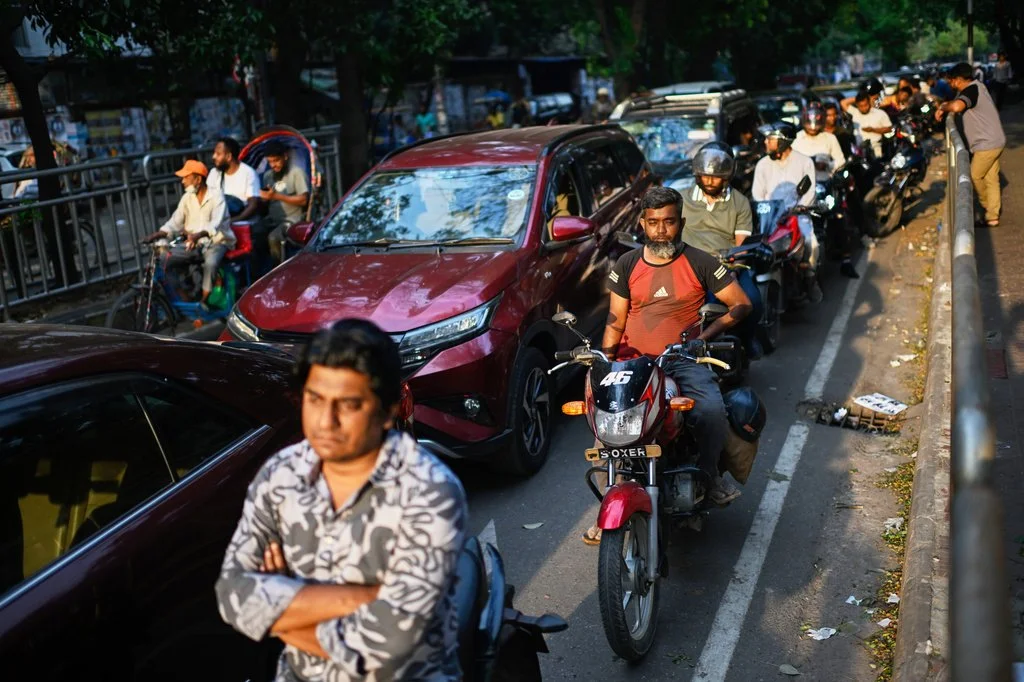
Motorists queue up outside a fuel pump in Dhaka, as Bangladesh tries to handle its energy crisis related to the Iran war, Sunday, April 5, 2026. (AP Photo/Mahmud Hossain Opu)
The continued blockade and confrontation in the Strait of Hormuz has brought tremendous pain to the global economy, especially the energy markets. Crude oil prices hit $120 for the first time since 2022, while estimates suggest that over $50 billion USD worth of crude oil supply had been lost since the start of the war in February 2026. The strains from this sudden drop in oil supplies have been evident. The UAE, one of the world’s wealthiest oil exporters, recently asked the US for a currency swap line to support its dwindling foreign reserve of US dollars, while other Gulf States are also sustaining economic pains from the inability to export their commodities. Nonetheless, the Gulf countries are arguably in a good place compared to Asian and European economies, with Asia in a particularly vulnerable position as 80% of its oil supplies go through the Strait. The Philippines, for example, declared a national energy emergency due to the severity of its fuel supply crunch. Japan and South Korea also put forward their initiatives to cut energy costs and release emergency oil reserves, and Vietnam and Thailand both called on their citizens to reduce their energy use. Inflation also skyrocketed. In the Indian city of Firozabad, cooking oil, which normally costs 80 Rupees, now costs more than 200 Rupees. A continued blockade of the Strait also risks deep damages to the aviation industry. Gulf countries supplied about 60% of European Jet Fuel and 70% of African Jet Fuel. Germany’s Lufthansa airline already announced its cancellation of 20,000 flights, and most major airlines have made cuts to their flights due to the crunch of jet fuel supply. Simultaneously, the growing shortage of fertilizers could bring much more dire ramifications for the rest of the world. About one-third of the world’s fertilizer supplies pass through the Strait of Hormuz due to its demand for ammonia, a crucial input of fertilizers, which is primarily sourced from the Persian Gulf. A shortage of fertilizers could mean a bleak crop season for much of the world’s food-producing regions, such as India, China, and Eastern Europe. Liquefied Natural Gas also took a direct hit in the literal sense. Qatar’s Ras Laffan Gas field supplies 20% of the world’s liquefied natural gas supply, but the facility had been hit heavily by missiles in the early days of the war, and a period of three to five years is expected to restore its full production capacity, while cuts in shipping further impede exports of Liquefied Natural Gas from the country.
As the US and Iran struggle to work out a deal to end their war, the global economy increasingly feels the shockwaves coming from the Persian Gulf. From Europe to Asia and Africa, many countries find themselves on the same footing as their once stable supply of energy and important commodities has been choked off. However, their cries are unlikely to be heard by an increasingly hardline Iran and a determined US.