
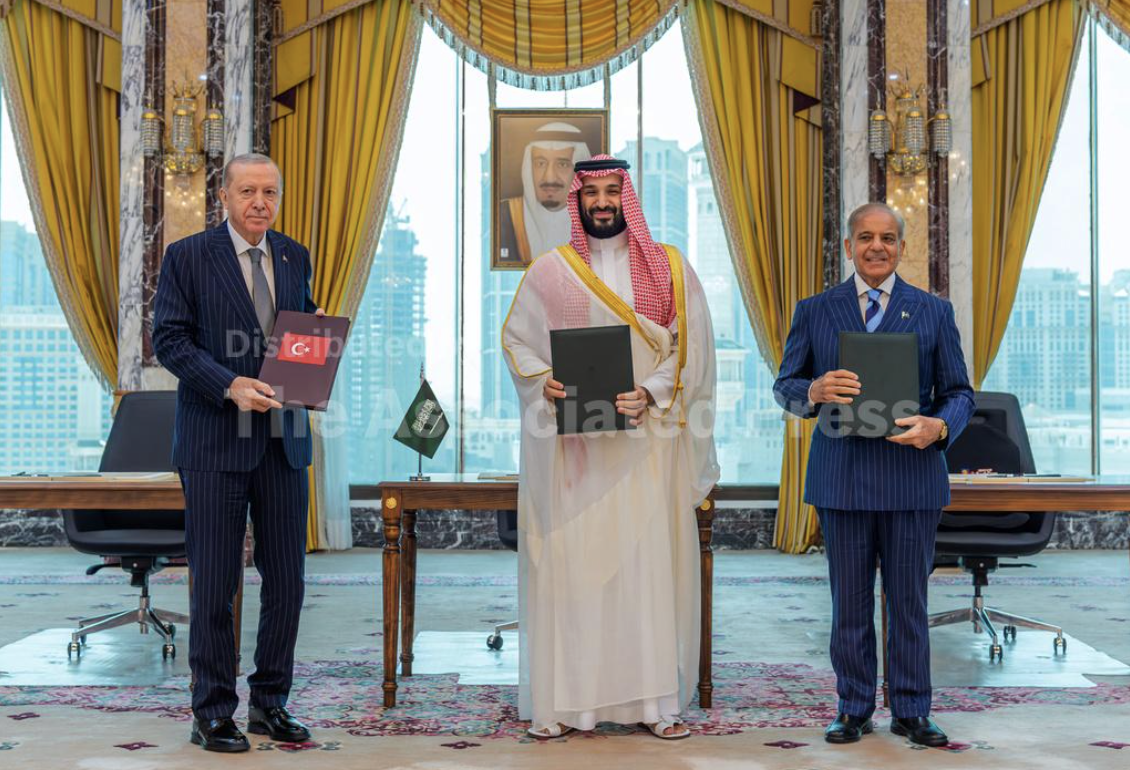
From left, Turkish President Recep Tayyip Erdogan, Saudi Crown Prince Mohammed bin Salman and Pakistani Prime Minister Shehbaz Sharif stand together after signing a trilateral defense agreement in Mecca, Saudi Arabia, Aug. 7, 2026. (Saudi Press Agency via AP, File)
On Aug. 7, 2026, Saudi Arabia, Turkey, and Pakistan signed the Mecca Joint Defence Agreement. Crown Prince Mohammed bin Salman, President Erdoğan, and Prime Minister Shehbaz Sharif declared that an attack on one party is an attack on all. On Oct. 5, the pact was invoked for the first time, as tensions between Yemen’s Houthi rebel group and Saudi Arabia have led to direct conflict, testing the brand-new defense pact. The agreement builds on the Saudi-Pakistani Strategic Mutual Defense Agreement, signed in 2025 eight days after Israel struck Hamas leadership in Doha. The new agreement includes Turkey, creating one of the world's strongest military defence pacts. The defence agreement comes as Gulf anxiety over US reliability grows. For much of the 21st century, the United States has acted as the main security guarantor for the Gulf states. In the last few years under President Trump’s shift in foreign policy, and the US-Israeli conflict in Iran, Saudi Arabia and its Gulf neighbors tried to stay out of the conflict, yet they have been directly struck by Iran and the non-state armed Houthi group in Yemen, exposing how little control the Gulf states have over the potential risks Washington’s choices create. When the United States and Israel struck Iran on Feb. 28, Iranian missiles hit all six Gulf states within 24 hours, and later strikes reached civilian infrastructure such as Dubai’s airport, a Bahraini desalination plant, and fuel tanks at Kuwait’s airport. The conflict has exposed the Gulf Cooperation Council (GCC) to unprecedented security and economic risks despite their attempt to avoid any direct conflict.
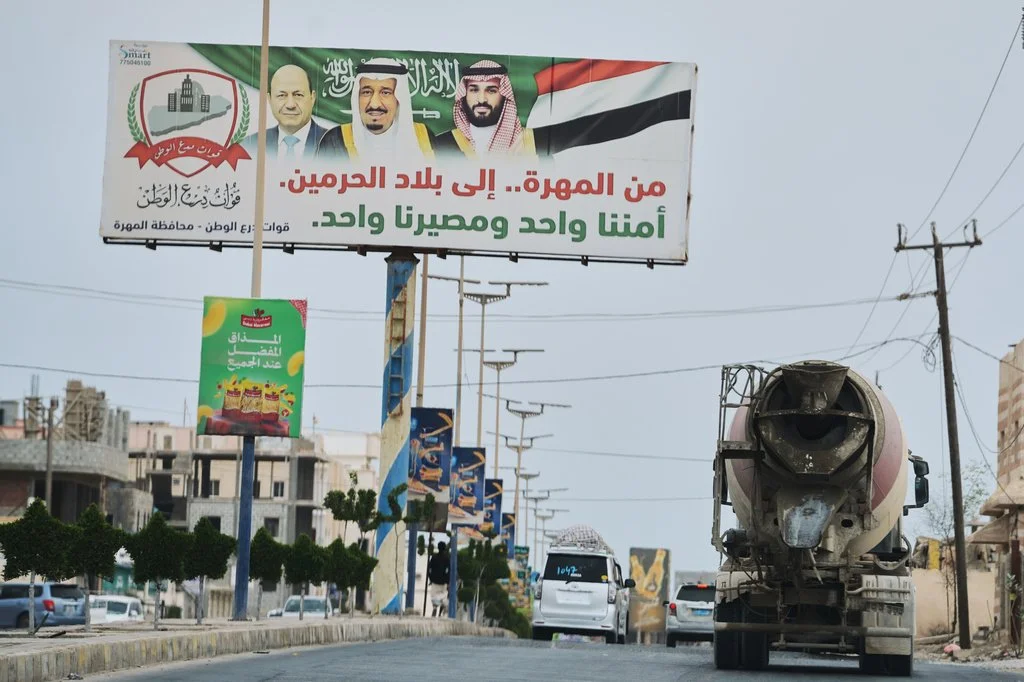
A billboard showing, from right to left, Saudi King Salman, Crown Prince Mohammed bin Salman and Yemen President Rashad Mohammed Al-Alimi is erected at a main street in Mahra, Yemen, Wednesday, Sept. 9, 2026. Arabic reads, "Our hope and destiny are the same". (AP Photo/Abdulnasser Alseddik)
For decades, Saudi Arabia’s security has relied on its partnership with the US, which has maintained a strong military role in the region since the 1980s. President Jimmy Carter declared the region a vital US interest in 1980, and the Rapid Deployment Joint Task Force was established that year, which later transitioned into CENTCOM. The partnership gave the Gulf monarchies access to American military technology and gave the United States more control over its strategic interests in the region. Gulf monarchies and Washington shared interests in the stable flow of oil and regional stability, which made the partnership valuable for both sides. Further, as the Gulf states have boosted their economies, they have continued to support the US defence industry, as Saudi Arabia is the largest foreign customer of US arms, and the Gulf states so far in 2026 have spent $41 billion on US munitions. Despite these massive spending budgets, GCC armies have not been as effective as they should be on paper. This has resulted in the Gulf States’ continued reliance on the United States in the face of large-scale security threats. However, this relationship has become increasingly complicated as American and Gulf interests diverged. While Washington has continued to prioritize its partnership with Israel and pursue its own regional security objectives, Gulf states have faced the consequences of Washington’s conflicts, which threaten their territory, energy infrastructure, and economic development. These tensions have likely encouraged Saudi Arabia to seek additional security partnerships that offer greater flexibility in responding to regional threats. Saudi Arabia’s new defence agreement closely aligns it with Turkey, one of the largest standing militaries in the world, and the second-largest standing military in NATO. Pakistan is the only muslim-majority country with nuclear weapons and is also one of the largest standing militaries.
However, the extent of the alliance's military commitments remains unclear. Throughout the Iran war, the GCC countries have suffered significant attacks on infrastructure from Iran. However, the more direct threat to Saudi Arabia is the Houthis, a group based in Yemen which is aligned with Iran and has fought the Saudis since 2015. As the conflict has continued, the worst of the fighting has shifted toward the Houthi-Saudi conflict. On Oct. 5, after a series of strikes on Saudi territory, the pact saw its first formal implementation. Turkey and Pakistan have avoided direct military engagement against the Houthis, instead assisting in other ways. Turkey has emphasized that it only provided technical assistance, mainly in air defence and technology. Pakistan has deployed personnel, air defence systems, and jet squadrons but has maintained a strictly defensive posture focused on protecting Saudi sovereignty and the two holy cities, Mecca and Medina. A Turkish official stated, “The support expected from Turkey was only in the form of military equipment, intelligence sharing, and weapons systems, adding that no other form of deployment had taken place as part of the alliance so far.” These responses raise questions about how the agreement would operate in a wider regional crisis. While this sounds like meaningful assistance, it is currently difficult to determine how effective Turkish and Pakistani support has been. By bringing together three regional powers, the credibility and future of the pact will rely on how the initiation is perceived internationally.
The agreement also comes amid growing differences between Saudi Arabia and the United Arab Emirates over regional conflicts, including Yemen’s conflict and Sudan’s civil war. Although both countries remain members of the GCC, their competing understandings of regional politics and relationships with local factions have complicated the two states' relationship. While both continue to rely on the United States for security, the Mecca Joint Defence Agreement complicates regional dynamics as the GCC has had diverging perspectives. These developments add to the challenges of Gulf security cooperation, even as Saudi Arabia and the UAE continue to rely on the United States. The Mecca Joint Defence Agreement unveiled a new alliance, one that will be essential to the future of the region, whether it is successful or not. All three states have emphasised their shared interests in trade protection and security, which is convincing. Whether the pact can translate these commitments into a coordinated, credible response doctrine will determine its significance to regional security and the world as a whole.