
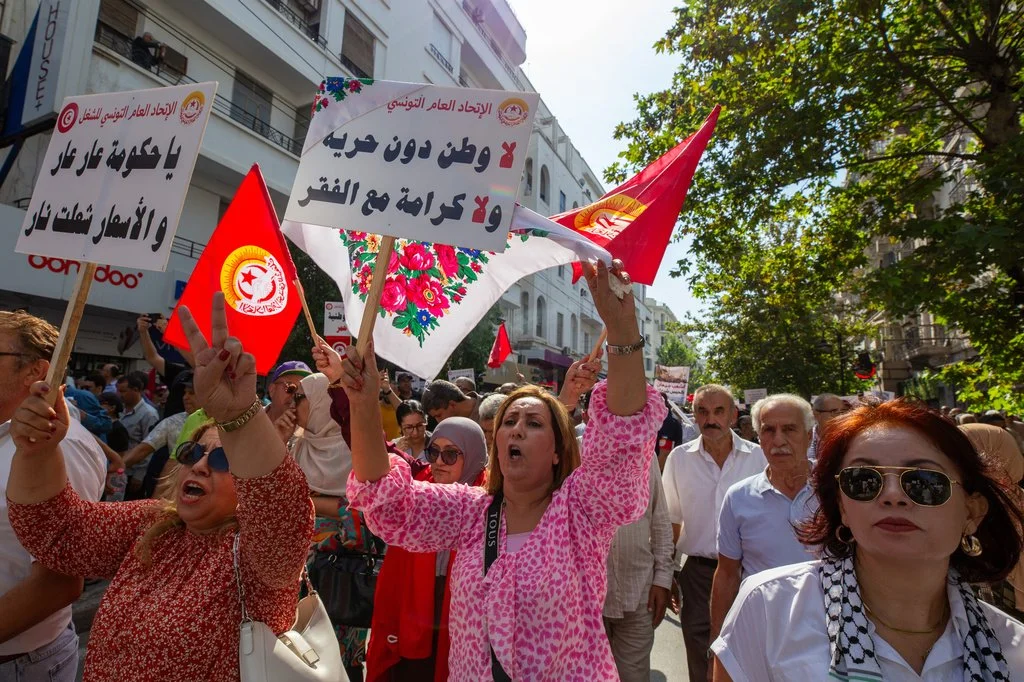
People wave flags and chant slogans during a protest against the policies of President Kais Saied in Tunis, Tunisia, Saturday, Oct. 17, 2026. Banner in Arabic reads, "No nation without freedom. No dignity amidst poverty." (AP Photo/Anis Mili)
During an era of division within President Saied's opposition, the streets of Tunis experienced a period of unity in which over 3,000 lawyers, doctors, journalists, unemployed people, union members, and political parties unified to voice their economic and political grievances. The Oct. 17 protest led by the Tunisian General Labour Union was the country’s largest demonstration in years, marking a potential shift away from the polarization that until recently impeded mass mobilization.
Tunisia’s contemporary political and economic issues mirror those that plagued the country 16 years ago on the eve of Mohamed Bouazizi’s self-immolation: unemployment, inflation, and infringements on civil liberties. Protesters during the Tunisian Revolution, outraged over the abuses they suffered under Ben Ali’s authoritarian regime, chanted the slogan: “The People demand the fall of the regime!”
This same slogan was chanted again during the Oct. 17 protest, underscoring Tunisia’s democratic backsliding.
Since being elected in 2019, President Kais Saied has suspended the democratically elected parliament, arrested at least 97 political opponents during the 2024 election, and rewritten the post-revolution constitution to ensure that he cannot be impeached and that he maintains authority over judicial appointments. At the height of the economic crisis, Saied alienated US and European Union allies by rejecting an IMF loan that was supported by the governor of the Central Bank of Tunisia, claiming that the agreement would threaten Tunisian sovereignty. Saied’s economic policies have been largely unsuccessful, and citizens endure frequent electricity and water shortages.
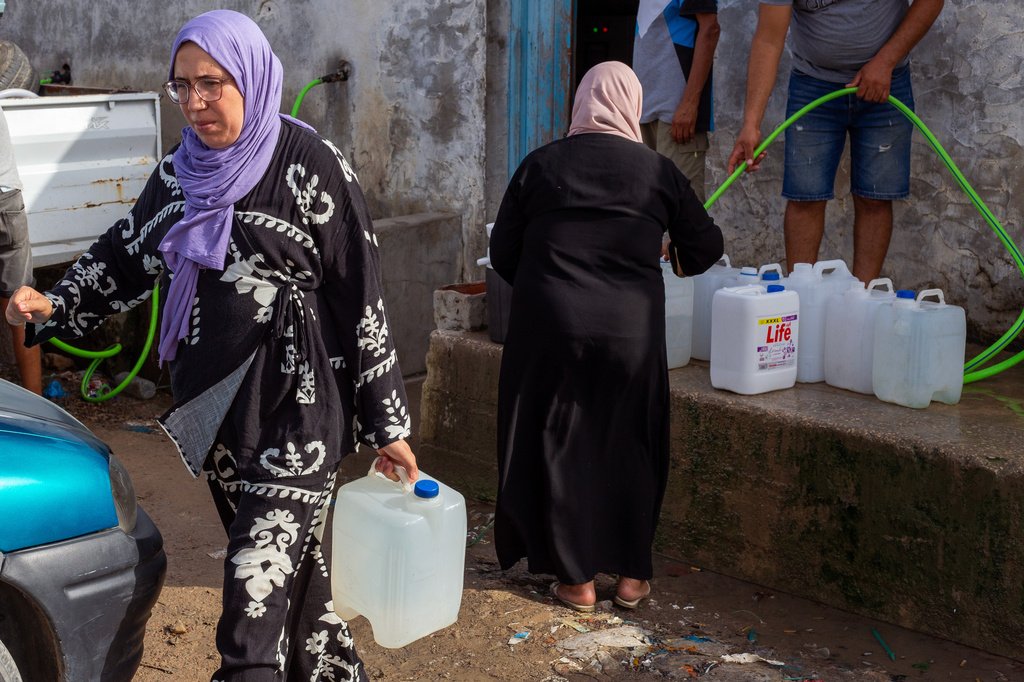
Women fill containers with water from a well owner during a water crisis in Nabeul, Tunisia, Aug. 30, 2026. (AP Photo/Anis Mili)
While 2026 has been the year in which Tunisia has experienced the most protests in a decade, the inability to mobilize large numbers of people and the unwillingness of different groups within the opposition to collaborate have hindered efforts to form any impactful, unified resistance against Saied. The Tunisian Network for Rights and Freedoms and the National Salvation Front are Tunisian political parties that oppose Saied. Both refused to protest together, and parties such as the Ennahdha Movement and Free Dostourian Party continue to be divided over the role of Islam in politics. The co-founder of the opposition Tunisian activist group Citizens Against the Coup views these political divisions as detrimental, stating that “Some [opposition] actors prefer a deadly status quo to unity.”
These divisions are deeply entrenched in Tunisia’s political landscape. Whether protesters will be able to sustain the current unity and transcend their differences to spark a unified uprising against President Saied remains uncertain.