
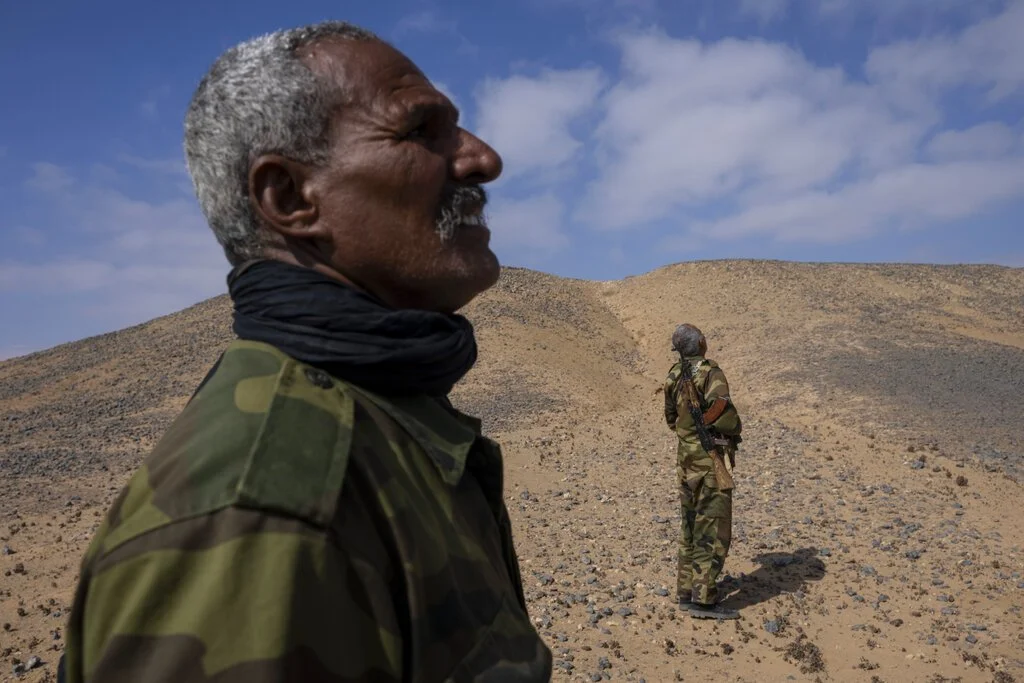
Polisario Front soldiers look at a Minurso helicopter, not pictured, near Mehaires, Western Sahara, Thursday, Oct. 14, 2021. Drawing attention to a conflict with few known casualties in a vast but forgotten corner of the Sahara desert has been a challenge for the Polisario, whose leaders want to leverage the guerrilla-war-reminiscent imagery ahead of a key U.N. meeting on Oct. 28. Security Council members are due to vote on extending the mission for the Minurso, the force that for years, and at a cost of over $4 billion, has overseen the ceasefire while supposedly paving the way for a referendum. (AP Photo/Bernat Armangue).
The United Nations Security Council is scheduled to vote on renewing the UN mission in Western Sahara on Oct. 31. Since 1991, the Mission for the Referendum in Western Sahara (MINURSO) has operated amid the unresolved dispute between Morocco, which claims sovereignty over Western Sahara, and the Polisario Front, which seeks self-determination for the Sahrawi people. Last year, a Security Council resolution ordered a review of MINURSO’s future to take into account Morocco's autonomy proposal. The renewal will have serious implications for tensions involving Morocco, the Polisario Front, and Algeria.
Since 1963, the United Nations has recognized Western Sahara as a Non-Self-Governing Territory. As a former Spanish-controlled territory, its political status has been contested by neighbouring countries. Morocco considers the territory its own and has proposed autonomy under Moroccan sovereignty. The Polisario Front is an Algeria-backed armed movement that advocates for an independent Sahrawi state and self-determination for the Sahrawi people, including those living in Western Sahara and in refugee communities abroad.
After Morocco took control of most of Western Sahara in 1975, fighting broke out between Moroccan forces and the Polisario Front, beginning an insurgency that lasted until a UN-brokered ceasefire in 1991. The Security Council then established MINURSO to monitor the ceasefire and support a settlement plan between the two sides. One of MINURSO’s original goals was to organize a referendum in which Western Saharans would decide the territory’s future.
The referendum never occurred because Morocco and the Polisario Front could not agree on issues, including who would be eligible to vote. Despite a lack of progress towards a political settlement, MINURSO remained, and today its work focuses on reporting the security situation and trying to reduce regional tensions. The ceasefire broke down in 2020, but fighting between Morocco and the Polisario Front has remained relatively low-intensity rather than returning to large-scale conflict.
In October 2025, the Security Council adopted Resolution 2797, which renewed MINURSO through Oct 31, 2026. The resolution also called for negotiations based on Morocco’s autonomy proposal and described genuine autonomy as potentially the “most feasible” outcome while maintaining that a final solution must provide for the self-determination of Western Sahara’s people. Algeria objected to the resolution's approach and did not participate in the vote. Polisario said it would not join negotiations designed to legitimize Moroccan control. The Security Council also ordered a strategic review of MINURSO’s future mandate.
While Algeria does not claim sovereignty over Western Sahara, it does support the Polisario Front. Five major camps housing Sahrawi refugees are located near Tindouf in western Algeria. The UN political process therefore includes Algeria in its discussions with Morocco and the Polisario Front. Western Sahara has also become part of the wider Morocco-Algeria rivalry. This contention between the countries has expanded into disputes with other international governments. Morocco severed ties with the UAE amid regional tensions and the Emirati recognition of Moroccan sovereignty over Western Sahara.
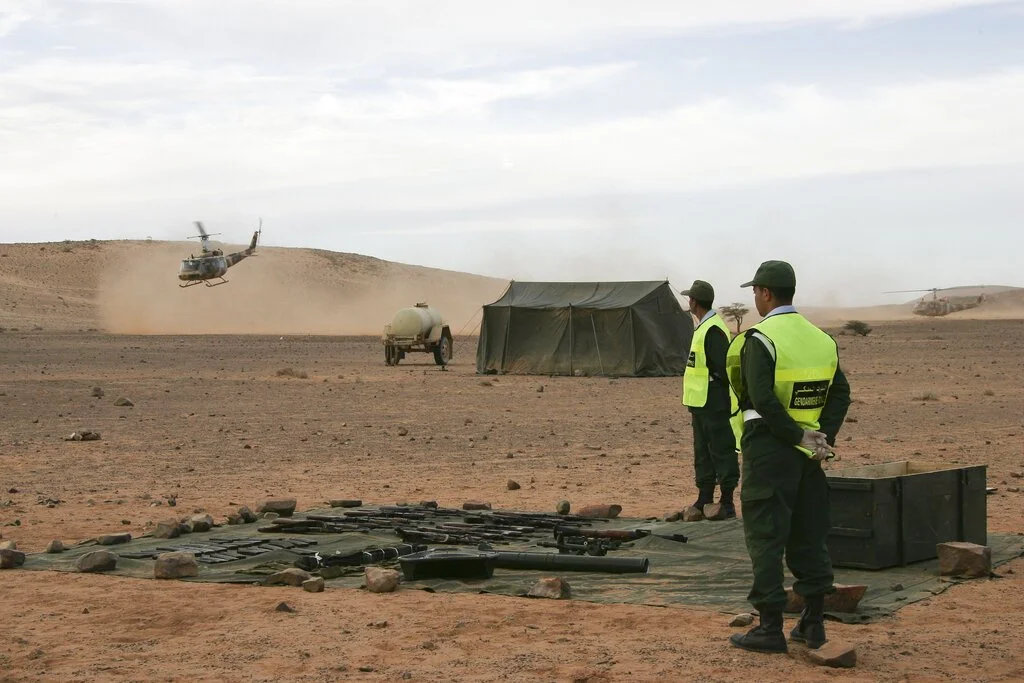
FILE - In this Jan.5, 2011 file photo, weapons discovered by Morocco's police in Western Sahara are placed in Laayoune. The Moroccan military has intervened in a U.N.-patrolled border zone in the disputed Western Sahara to clear a key road it said was being blockaded for weeks by supporters of the pro-independence Polisario Front. Moroccan forces set up a security cordon overnight in the Guerguerat buffer zone on Western Sahara's southern border with Mauritania, "in order to secure the flow of goods and people through this axis," (AP Photo/Abdeljalil Bounhar, File)
The larger challenge facing the UNSC is whether the mission should continue in its current form or change alongside political negotiations. The Middle East Institute (MEI) identifies possible scenarios including maintaining the mission, narrowing it to be mostly monitoring, or eventually transforming its responsibilities if a political settlement develops. MINURSO remains the impartial international presence monitoring events on the ground and communicating with both sides, which makes major changes to the mission politically consequential.
The Western Sahara dispute also has serious effects on the rivalry between Morocco and Algeria. Morocco has gained increasing international support for its autonomy proposal, including support from countries such as the United States and France. Algeria continues to support Polisario and remains involved in the diplomatic process, making its continued participation important to any settlement negotiations. MEI specifically identifies Algerian involvement in the diplomatic process as a challenge in negotiations. Therefore, a change to MINURSO or the Security Council’s language could potentially affect not only Morocco and Polisario but also the balance of power across the Maghreb.
Before Oct. 31, the Security Council must decide whether to extend MINURSO’s mandate. Whatever it decides will not, by itself, settle Western Sahara’s status. The United Nations still formally treats the territory’s status as unresolved. The terms of the renewal could indicate the role the United Nations expects MINURSO to play as negotiations continue.