
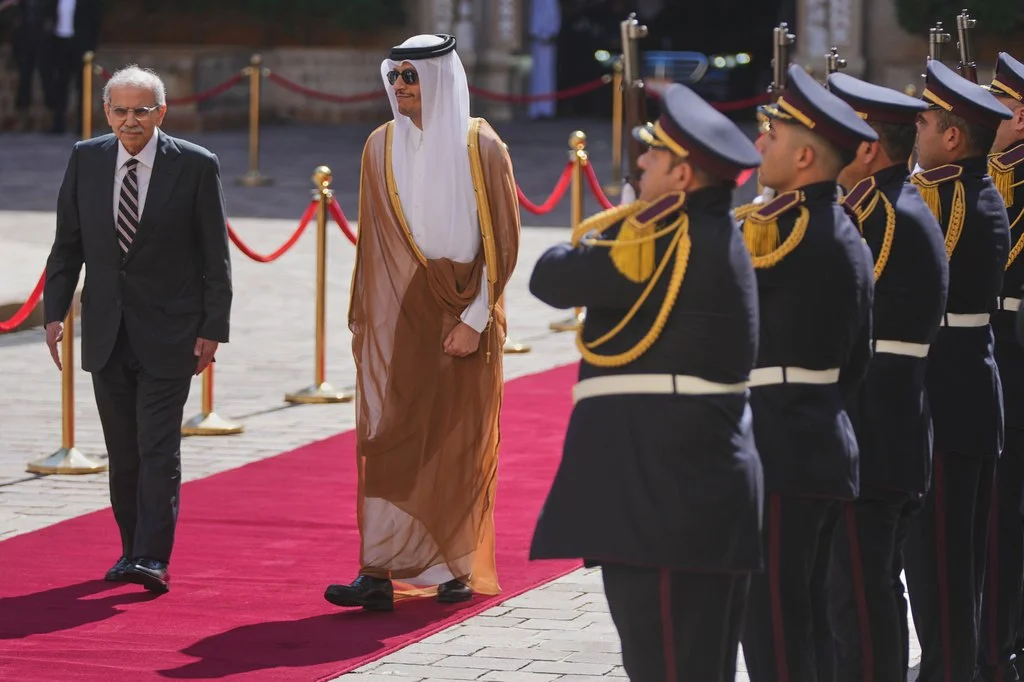
Lebanese Prime Minister Nawaf Salam, left, and Qatar's Prime Minister Mohammed bin Abdulrahman bin Jassim Al Thani review an honor guard at the Government Palace in Beirut, Lebanon, Friday, Oct. 16, 2026. (AP Photo/Hassan Ammar)
In August, Talal Fayed, a 67-year-old driver in Beirut, paid $300 for electricity, which accounts for about half a month of Lebanon's minimum wage, and the money went to a neighborhood generator. More than half of Lebanon's power comes from private diesel generators and less than a third from the state, whose electricity supply averaged about four hours of supply a day in July.
On Oct. 16, standing alongside Qatari Prime Minister Sheikh Mohammed bin Abdulrahman Al Thani in Beirut, Lebanese Prime Minister Nawaf Salam announced that Doha would finance, build, and operate an electricity project at no upfront charge to the Lebanese treasury. Sheikh Mohammed added that QatarEnergy and France's TotalEnergies had already agreed to build a solar plant as the first phase of the project. Three days later, Reuters reported on an ambitious draft that calls for two 825-megawatt gas-fired plants at Deir Ammar in the north, and Zahrani in the south, supplied by a 20-year supply of Qatari liquefied natural gas (LNG), along with 1,240 megawatts of solar and wind. Running at full capacity, the two gas plants alone can satisfy about four-fifths of Lebanon's electricity demand in 2024. If both governments approve the plan, the first imports would be routed through Syria, where a Qatari conglomerate already holds contracts for thousands of megawatts of power generation capacity.
If fruitful, the proposal will mark the largest entry yet in a long Qatari ledger to the Lebanese state. After the 2006 war between Israel and Hezbollah in Southern Lebanon, Qatar spent about $300 million rebuilding four towns in Southern Lebanon, among them Bint Jbeil, a largely Shia town where Hezbollah has long drawn support. In May 2008, with Lebanon at the edge of civil war, Qatar brokered the Doha Agreement, which ended an 18-month standoff, at the concession of handing the Hezbollah-led opposition a veto in the government cabinet. When Saudi Arabia halted a $3 billion arms package for the Lebanese army in 2016, citing Hezbollah's strong influence on the state, Qatar not only maintained its presence, but increased support. Qatar’s foreign ministry says it has helped pay Lebanese soldiers' salaries for four years and provided three years of fuel for the Lebanese army.
Doha has been a particularly consistent backer to Lebanon, as it keeps open lines of communication with various Lebanese political factions. Many of Lebanon's other patrons are stretched thin, setting conditions, or genuinely preoccupied. Iran is under an American maritime blockade, Saudi Arabia is busy intercepting aerial attacks over its capital, and Washington conditions reconstruction funding on Hezbollah's disarmament.
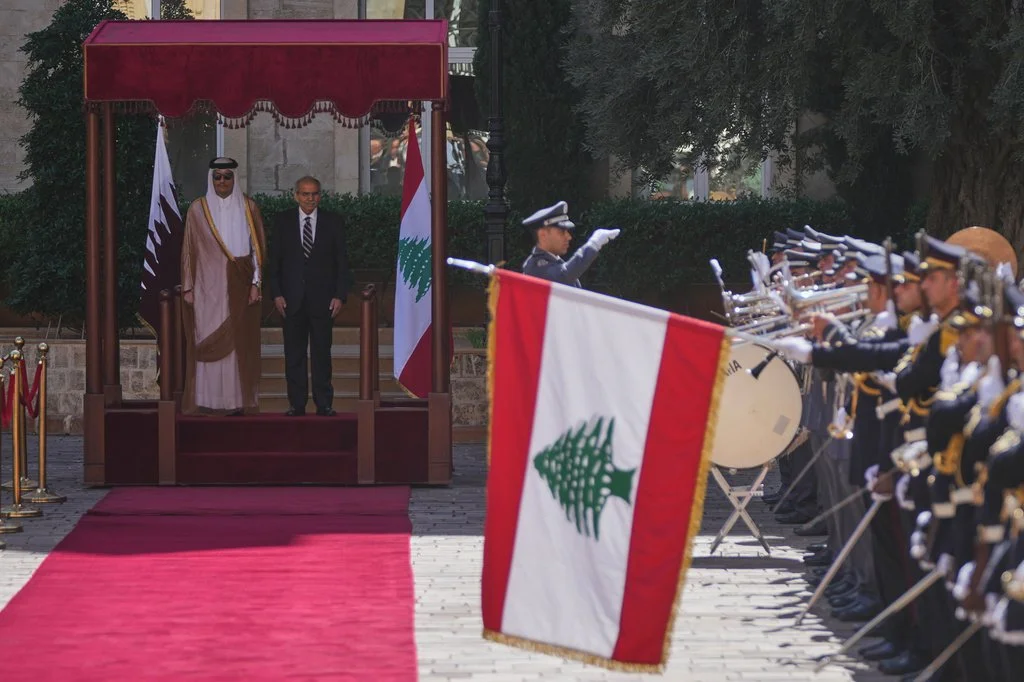
Qatari Prime Minister Sheikh Mohammed bin Abdulrahman Al Thani, left, and Lebanese Prime Minister Nawaf Salam stand during a welcome ceremony in Beirut on Oct. 16, 2026. (AP Photo/Hassan Ammar)
Generosity has never been Lebanon's problem, as Électricité du Liban, the state electricity corporation, has lost more than $40 billion since the civil war ended in 1990, and only two of the country's seven thermal plants still run. Reform plans have stalled for years because of political feuding and the stakes senior politicians hold in the fuel trade. “The problem is that nobody has provided state electricity over the past three decades,” Jessica Obeid, a Lebanese energy expert, told The National this month.
Qatar’s last offer stalled the same way. In 2024, Lebanon's temporary economy minister said the political class, fuel companies, and generator operators had blocked a Qatari offer to build three power plants; the energy minister later disputed his account. This January, Qatar had pledged $400 million for Lebanon’s power sector.
Salam said he did not want to add “another promise” to the many failed ones the Lebanese people have come to learn as routine. A 2022 government reform plan set 2026 as the year round-the-clock electricity would be available, but this still nascent draft leaves the hardest question unanswered: Lebanon's payment obligations and guarantees “remain subject to negotiation”. The cabinet responsible for these issues is already feuding over the project. Energy Minister Joe Saddi has boycotted its sessions since Oct. 6, warning that foreign investors want financial and security guarantees. On Oct. 15, the three other ministers from his Lebanese Forces party stormed out of a cabinet session. Still, Salam has said the plan will be proposed to the cabinet in due course.
The rest of Qatar's offer consisted of support for the army and the rebuilding of the south, which still awaits the cessation of hostilities that broke out in March. Israeli troops still hold considerable territory in the south. The talks meant to change that are going slowly; Lebanese and Israeli officers met in Tampa, Florida, this month for US-mediated talks, and the Lebanese army expects no breakthrough before Israel’s parliamentary election on Oct. 27. A French conference in support of the Lebanese army, which President Emmanuel Macron announced during his trip to Qatar on Oct. 21, is expected to follow the elections.
Since 2006, Qatar has rebuilt Lebanon's towns, brokered its politics and helped pay its soldiers, and it now offers to build the plants and ship the gas. Whether Talal Fayed's next bill is any smaller depends on a guarantee only Beirut can give; the ball is in their court.