
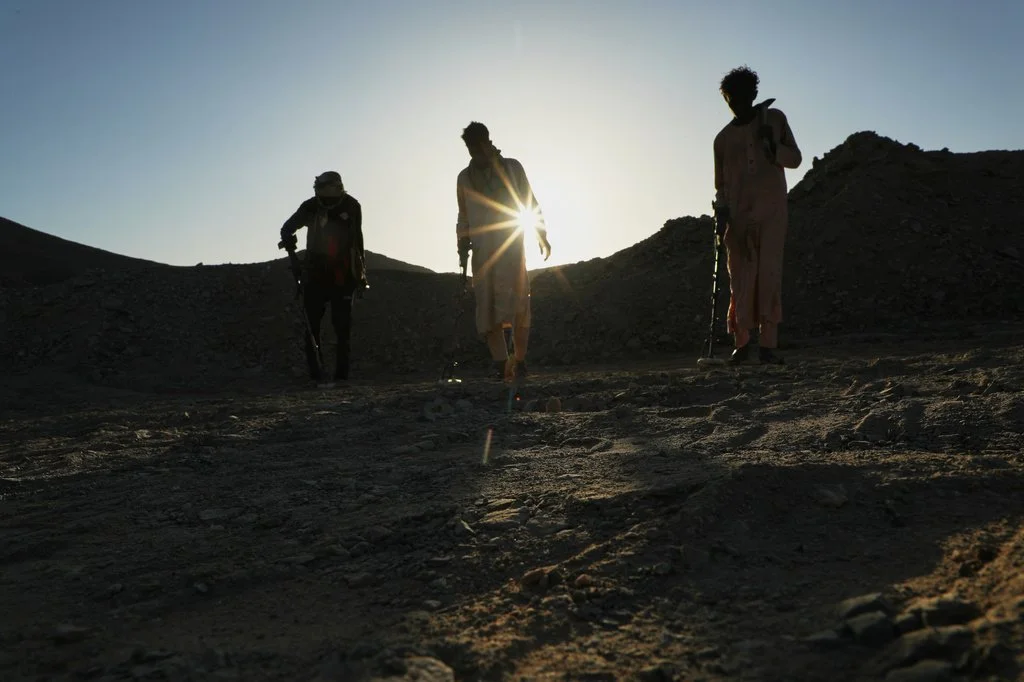
Miners use metal detectors to search for gold at an artisanal mining site in Dalago Mahas, Sudan's Northern State, Thursday, May 7, 2026. (AP Photo/Mohnd Blal)
On Oct. 10, airstrikes hit a mining site in Jabal al-Uqaydat, a contested borderland between Egypt and Sudan. Emergency Lawyers, a Sudanese rights monitor, stated that at least 72 workers were killed; some sources estimate that up to 200 people were killed. The rights monitor attributed the attack to the Egyptian military, though Reuters and AP could not independently verify the claim.
Egypt did not explicitly claim responsibility for the strike. In an Oct. 12 statement, Egypt indicated that it was carrying out a “large-scale operation” as part of its campaign against illegal gold mining within its territory. It stated that leaflets were dropped to warn “criminal elements” to cease activity in the area. On Oct. 12, Sudan’s de facto leader Abdel Fattah al-Burhan created a fact-finding committee to investigate the attack, calling it a “painful incident.”
The attack follows a similar episode in June, when heavy artillery and drone strikes killed several miners in the same area. Survivors of the attack accused Egypt of the aggression. Egypt maintained that its operations were within its own borders and targeted illegal gold mining, smuggling, and unauthorized border crossings. Cairo also reported detaining 223 people in its border sweep. The strike followed intermittent clashes where Egyptian border guards would burn temporary shelters and equipment and fire live ammunition in attempts to disperse mine workers.
State authority is fragmented in this border region. Egypt maintains that it carries out its operations within its own territory, while Reuters and the New York Times placed the incursion in northern Sudan. Despite border tensions and longstanding territorial disputes, Sudan’s army-backed government and Egypt maintain diplomatic relations. Egypt supports army chief al-Burhan in the Sudanese civil war, considering the war a major security concern and threat.
The conflict in Sudan has regional implications beyond Egypt. Over 4.3 million people have fled Sudan to neighboring countries since the start of the war. In an April 2026 report, the International Crisis Group found “spillover effects apparent in Chad, Ethiopia, South Sudan and Yemen.” Analysts believe that Sudanese actors could support Ethiopian, Eritrean, or Tigrayan forces if unrest in Ethiopia continues to escalate. Sudan’s borders with Chad and Ethiopia have also seen growing conflict.
October’s incursion by Egypt occurred three and a half years into the civil war between the Sudanese Armed Forces and Rapid Support Forces (RSF). Fighting began in April 2023, when the power struggle between the two military factions became deadly. The conflict has been defined by drone warfare, displacement, hunger, and sexual violence, and it has produced the world’s largest humanitarian crisis.
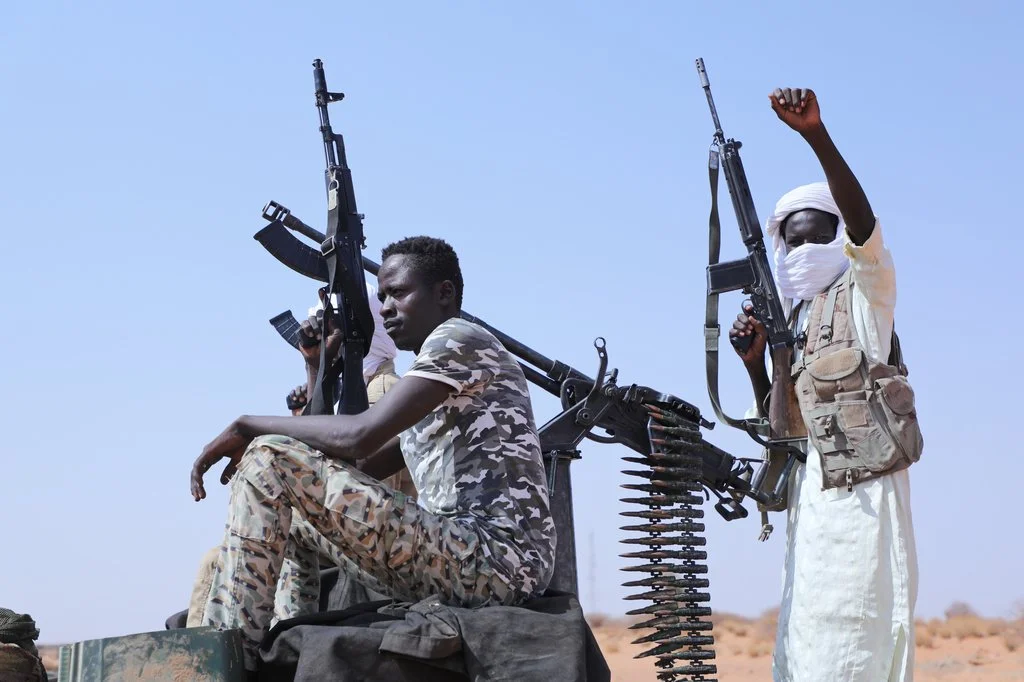
Fighters of armed defectors from the paramilitary Rapid Support Forces (RSF) celebrate, as they are believed to be surrendering to the Sudanese army, in the west of Omdurman, just outside Khartoum, Sudan, Wednesday, Aug. 19, 2026. (AP Photo/Mohnd Blal)
Gold is central to Sudan’s conflict economy, and deposits along disputed portions of the Egypt-Sudan border create strain between the two countries. Artisanal mining and makeshift gold mining operations in northern Sudan have increased during the conflict, generating significant revenue for both sides of the civil war. CSIS estimates that 50 to 70 percent of gold produced in Sudan is smuggled out of the country each year, a share that has risen since the war broke out as the conflict parties are economically dependent on gold exports.
Data from the Sudanese Central Bank reveals that the UAE, a major global hub for gold trade, imports about 90 percent of Sudan’s officially recorded gold exports. The UAE has also been accused of backing Sudan’s RSF, allegations it denies. This illustrates how Sudan’s war is tied to regional commercial and political networks, making its domestic dynamics inseparable from external influence.
The recent strikes demonstrate how porous borders surround the Sudanese civil war and how its gold is vital not only to the conflict but to the countries involved in it. Beyond competition for gold, these attacks matter because they highlight a regional struggle to extract Sudan’s resources at a moment when the country is extremely vulnerable. Egypt has yet to acknowledge the casualties of the attack, and al-Burhan’s committee has not yet released any findings publicly.