
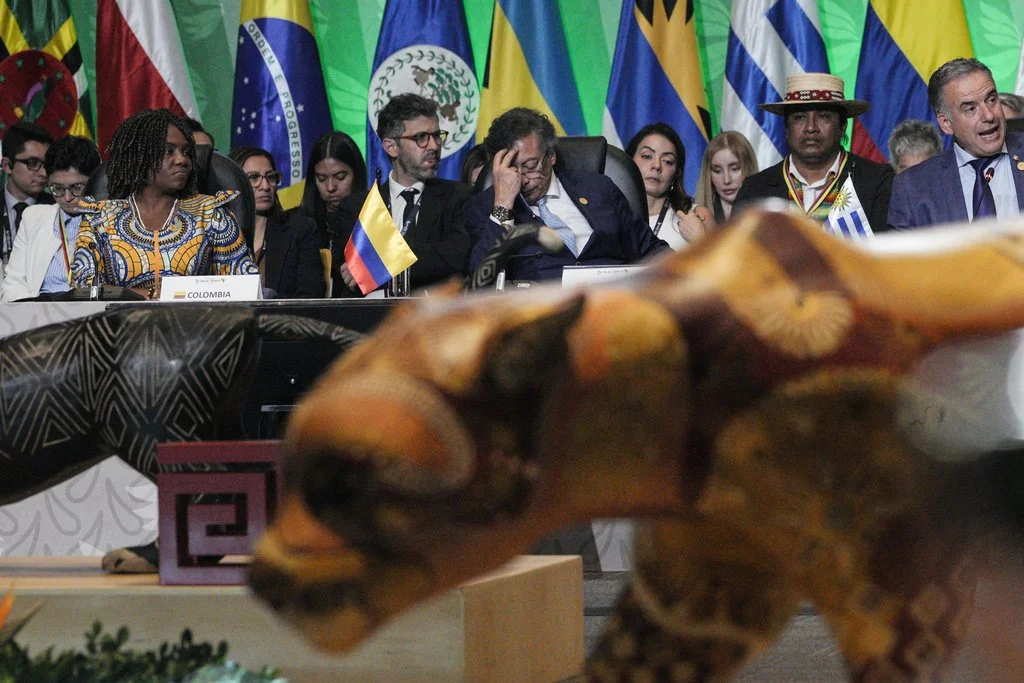
Colombia's President Gustavo Petro rests his head on his fingers as Uruguayan President Yamandu Orsi, right, speaks during the summit of the Community of Latin American and Caribbean, or CELAC, in Bogota, Colombia, Saturday, March 21, 2026. (AP Photo/Ivan Valencia)
From March 18 to 21, 2026, the Community of Latin American and Caribbean States (CELAC) held its 10th summit, and concurrently its first CELAC-Africa forum, in Bogotá, Colombia. The summit, attended by only five heads of state out of thirty-three members, called for an end to the US blockade of Cuba, urged greater regional cohesion, and denounced external influence in Latin America and the Caribbean.
Those present included Brazilian President Luiz Inácio Lula da Silva, Uruguayan President Yamandú Orsi, and Colombian President Gustavo Petro. They were joined by Prime Minister Godwin Friday of Saint Vincent and the Grenadines, Guyanese Prime Minister Mark Phillips, and Burundian President Évariste Ndayishimiye. Most other countries sent lower-level delegations.
CELAC was formed in 2011 as a regional international organization, an alternative to the Organization of American States (OAS). It aims to enhance discourse and integration between the member states without the involvement and dominance of North America, particularly that of the United States.
The institution is widely recognized as weak, even by its biggest supporters, due to its primary role as a forum for dialogue, rather than action. Despite attempts to change this, member states are often politically misaligned, hindering any potential consensus. Many also consider the bloc controversial due to its inclusion of Cuba, its ties with China, and the fact that Hugo Chávez was central to its founding.
This year’s forum coalesced with the African Union in an attempt to strengthen the bi-regional alliance of the Global South, drawing parallels with their shared heritage and history of slavery, racism, and colonialism. Around one in four Latin Americans identify as being of African descent, stressing the importance of cultivating solidarity and growing the ties between the regions.
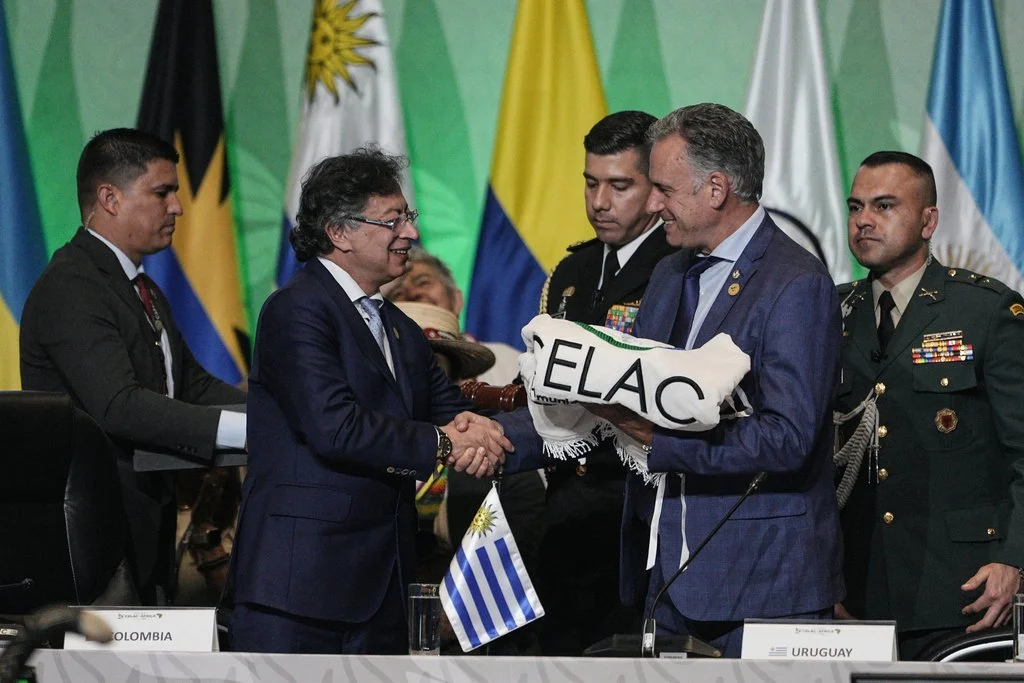
Colombia's President Gustavo Petro, left, passes over the Community of Latin American and Caribbean States, or CELAC, presidency to Uruguayan President Yamandu Orsi, during the CELAC summit in Bogota, Colombia, Saturday, March 21, 2026. (AP Photo/Ivan Valencia)
In the last few years, many Latin American governments have taken measures to prioritize relations with African nations by opening embassies or increasing trade. This is particularly evident in Colombia, where President Petro and Vice President Francia Márquez, the country’s first Black vice president, implemented a strategy that has skyrocketed bilateral trade, noting a twentyfold increase with Ethiopia.
The summit also marked the transition of CELAC’s pro tempore presidency from Colombia to Uruguay. During its one-year term, Colombiawas responsible for expanding the organization's dialogue with China, the European Union, and now the African Union, a fact which Brazilian President Lula praised.
Only five heads of state attended the summit, potentially reflecting a degree of restraint among leaders seeking to protect their positive relations with the US. It seems they wanted to avoid any action that might strain that relationship, especially considering the recent geopolitical tensions and external interference tied to the Trump administration’s policies and actions.
For around two centuries, Latin America has been derogatively referred to as “America’s backyard”, a term that has time and time again been used to justify the involvement of the United States in the nations below the Rio Grande. The region’s fragility is entrenched in a history of foreign interventions and exploitation, which continues to shape the regional dynamics and fosters a fear of earning the antipathy of the United States. As President Lula stated at the summit, “Latin America and the Caribbean do not fit in anyone’s backyard.”
Despite its ambitions, the summit’s low turnout underscores the enduring influence of the United States in the region. While CELAC increasingly aligns itself with broader Global South partnerships, the limited and inconsistent participation of its members suggests that its ability to translate dialogue into meaningful action remains uncertain.