
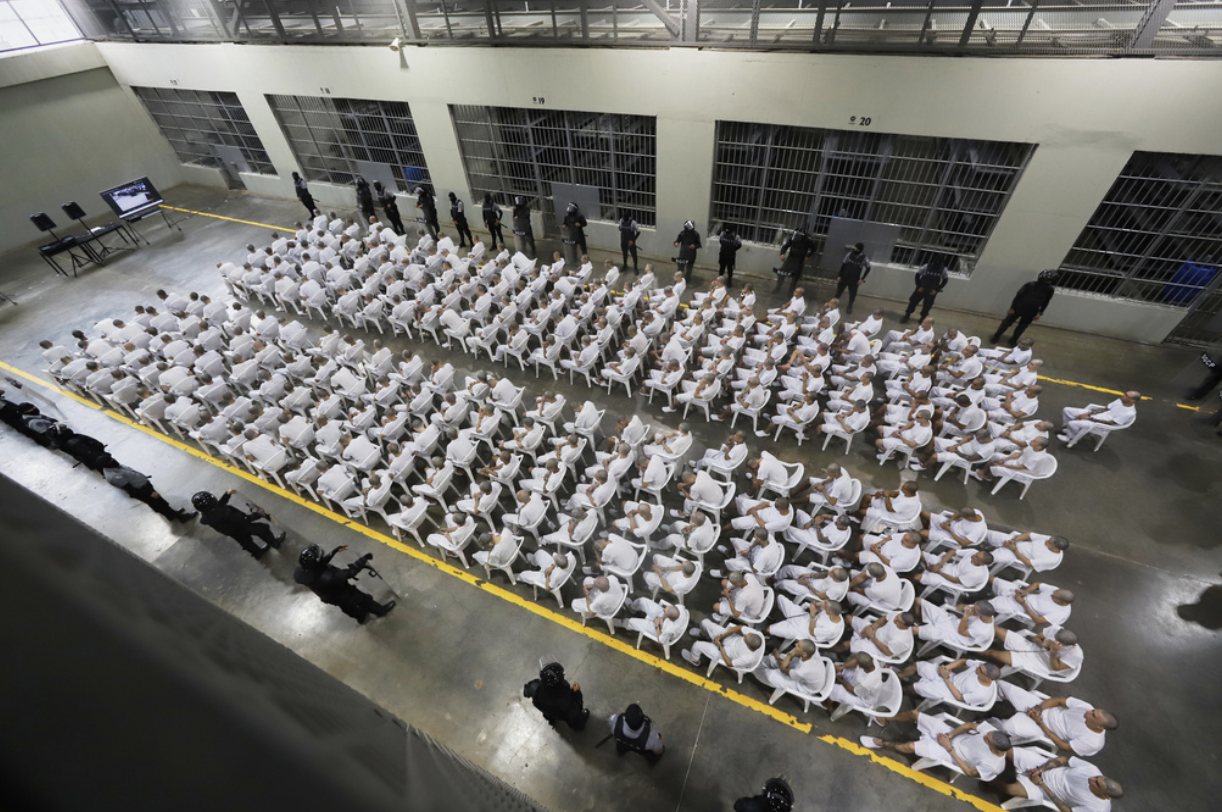
Mass trial of alleged gang members at Confinement Center (CECOT) in Tecoluca, El Salvador. Photo: AP Photo/Salvador Melendez.
Hundreds of alleged gang members are now appearing before Salvadoran courts at once in mass proceedings, raising concerns among lawyers and human rights groups about individualized evidence and defendants’ ability to mount an adequate defense. The trials are the latest phase of President Nayib Bukele’s sweeping anti-gang campaign, which has led to the arrests of more than 90,000 people since a state of emergency was declared in March 2022.
From 2011 to 2020, more than 71,000 people were displaced as a result of violence perpetrated by gangs and security forces. An estimated 60,000 gang members operated throughout El Salvador, exercising control over territories and committing serious abuses, including killings and sexual violence.
During this period, authorities also reported more than 13,000 disappearances. In response to longstanding gang violence, Bukele’s government has repeatedly renewed the state of exception, originally declared as a 30-day emergency measure in March 2022. The measure has restricted certain constitutional protections, including freedom of assembly and access to legal counsel, while expanding law enforcement powers to arrest suspects without warrants. These measures have coincided with a substantial decline in violent crime, with El Salvador's reported homicide rate falling from approximately 103 per 100,000 people in 2015 to 1.3 per 100,000 in 2025, transforming a country once among the most violent in Latin America into one reporting some of the region's lowest homicide rates.
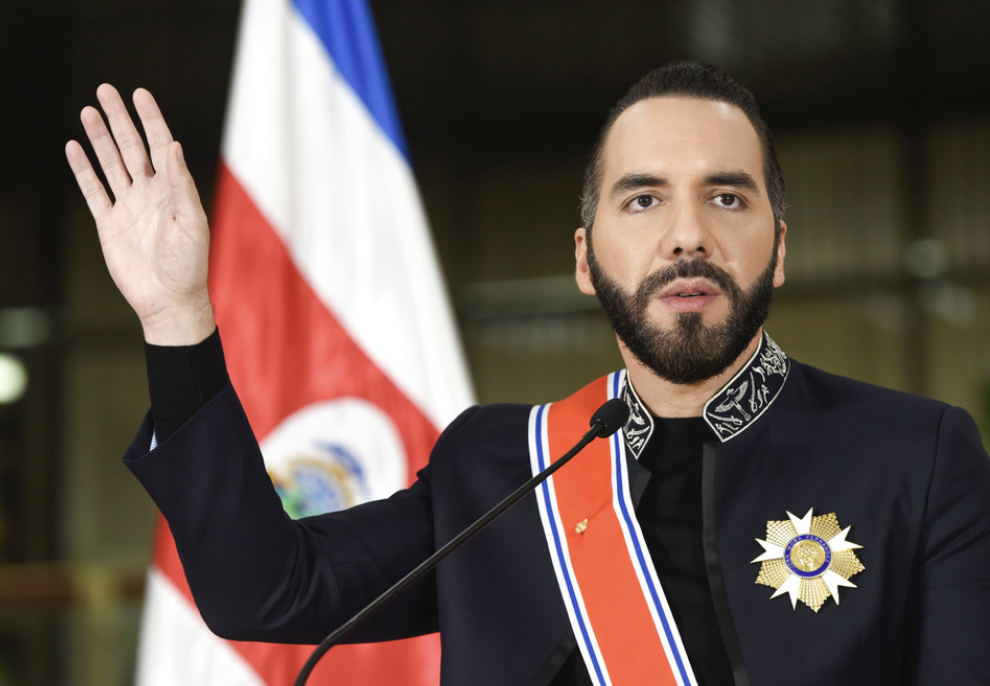
El Salvador’s President Nayib Bukele addresses an audience during an official ceremony. His administration’s sweeping crackdown on gang violence has significantly reduced crime while raising concerns over human rights and due process. Photo: AP Photo/Jose Diaz
Despite these improvements in public safety, the United Nations Human Rights Office warned in June 2023 that the situation was "seriously concerning, especially given the consequences for people's human rights." One major concern involves allegations that national police officers have faced intense pressure to meet arrest quotas. Officers continued making arrests even after exhausting databases of known gang members, reflecting what critics have described as an arrest first, investigate later approach. The crackdown has also contributed to a dramatic increase in El Salvador's prison population, reportedly rising from approximately 36,000 to 120,000 inmates. This expansion has intensified concerns about prison overcrowding, dangerous detention conditions, and reports of hundreds of deaths in custody.
These concerns have recently regained attention following reports of mass trials that Human Rights Watch has characterized as a "mockery of justice." Hundreds of defendants are being prosecuted simultaneously, raising serious questions about their ability to receive fair trials. Defense lawyers have reported meeting their clients for the first time on the day of their hearings, while anonymous witnesses have allegedly testified against dozens of defendants at once. Concerns have also emerged over the reliability of witness testimony, including allegations of fabricated evidence. These proceedings, which have reportedly resulted in extremely high conviction rates for gang-related offenses, have drawn renewed scrutiny to the country's judicial system. In one mass trial reviewed by Human Rights Watch, more than 120 defendants were convicted of unlawful association, with no acquittals; sentences ranged from 30 to 45 years.
The mass trials raise questions under binding international human rights treaties to which El Salvador is a party. Article 14 of the International Covenant on Civil and Political Rights guarantees the right to a fair hearing, the presumption of innocence, and adequate time and facilities to prepare a defense, while Article 8 of the American Convention on Human Rights provides similar protections, including the right to communicate freely with legal counsel. Organization of American States.
The United Nations’ Body of Principles for the Protection of All Persons under Any Form of Detention or Imprisonment, a non-binding General Assembly resolution, provides additional guidance. Principle 11 requires an effective opportunity for detained people to be heard and to defend themselves or receive legal assistance, while Principle 18 protects communication and consultation with counsel. Reports that some defendants first meet their lawyers on the day of their hearings and are tried alongside hundreds of others raise questions about whether these protections are being met
Bukele's crackdown has significantly transformed public safety in El Salvador, offering relief to communities that endured decades of gang violence. His policies have also maintained substantial public support, with his approval rating reaching 87.8% in May 2026. However, the methods used to achieve these security gains have raised broader questions about the role of due process and individual rights in the pursuit of national security. As mass trials continue and tens of thousands remain imprisoned, El Salvador's experience presents a fundamental question about the relationship between security and justice: to what extent can a government restrict individual freedoms to protect the broader population, and what are the long-term implications of doing so?