
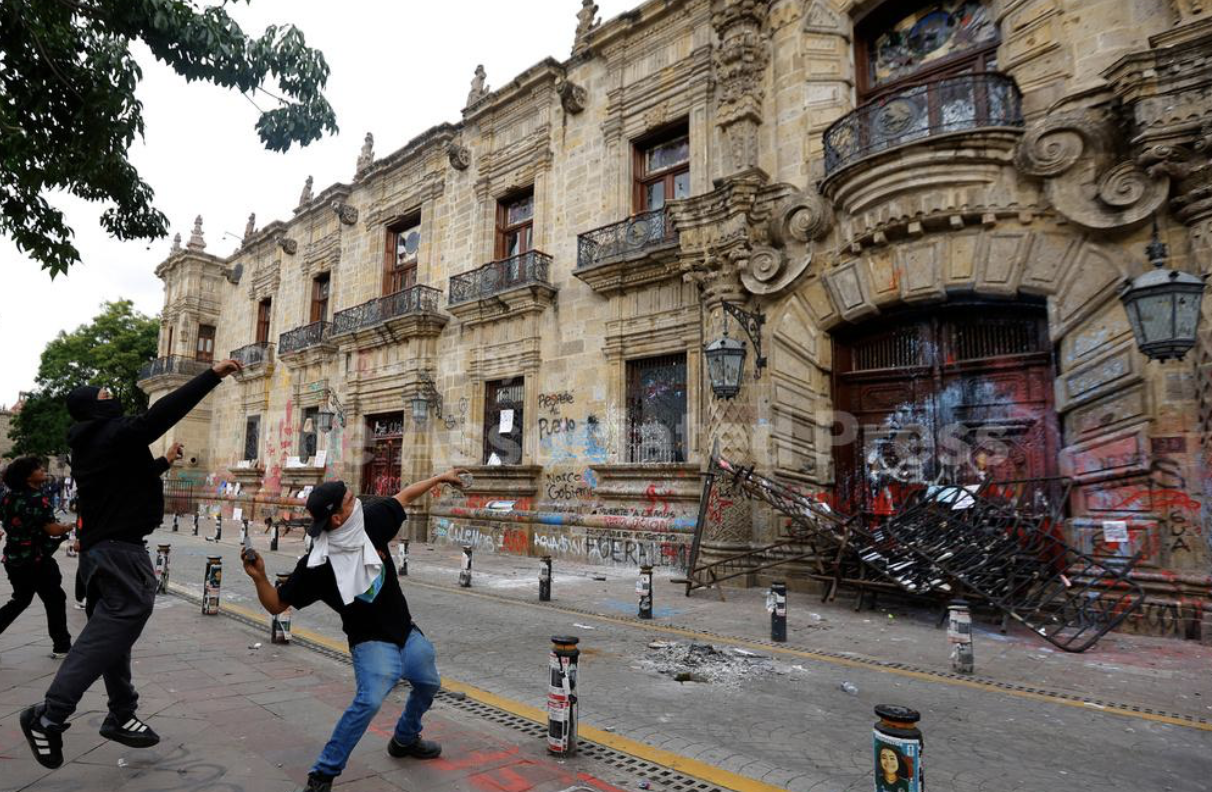
Protesters throw objects toward the Jalisco government palace during a demonstration. Hundreds of citizens in Jalisco demonstrated for the second consecutive Sunday over poor water quality and demanded the removal of Pablo Lemus, the governor of Jalisco; some participants caused disturbances, reaching as far as the Government Palace. (Photo by Cesar Gomez / SOPA Images/Sipa USA)(Sipa via AP Images)
Residents of Guadalajara, in the western Mexican state of Jalisco, have staged repeated protests over the area’s contaminated tap water, with recent demonstrations leading to clashes between protesters and police.
Protesters say their tap water has been foul-smelling and murky brown or black for years. IMDEC found no detectable residual chlorine in more than 93% of 184 household water samples collected across 90 neighborhoods in the Guadalajara metropolitan area, raising concerns about water disinfection. The organization’s analysis also found elevated levels of lead, mercury, and aluminum and positive results for total coliforms and E. coli, indicating fecal contamination. The IMDEC stated that this water is unfit for human consumption, even after boiling or passing it through carbon water filters.
This ongoing water quality crisis stems from severe pollution in Jalisco’s primary water source, Lake Chapala, which receives untreated municipal sewage and industrial runoff from the towns along its shores and its main tributary, the Lerma River. One of Mexico’s longest rivers, the Lerma River, runs through five heavily populated, industrialized states before emptying into Lake Chapala. Additionally, rapid industrial growth in Jalisco has outpaced investment in water-treatment technology, creating a systemic inability to adequately remove heavy metals from the water supply.
Many residents have turned to bottled water for drinking, cooking, and personal hygiene because of contamination concerns. Another IMDEC study found that 51.9% of surveyed families in Jalisco reported at least one member falling ill due to the municipal water supply. The study also found skin conditions in 66% of these cases, gastrointestinal illnesses in 34.8%, and eye problems in 18.3%. Residents blame local and state water management services, including the Intermunicipal Drinking Water and Sewerage Services System (SIAPA), the frontline entity responsible for physical supply and infrastructure. They also blame Jalisco governor Pablo Lemus, since the state government holds executive, financial, and regulatory power over the region’s overall hydraulic strategy. Lately, residents have taken their grievances to the streets.
On Oct. 11, more than 10,000 residents marched 1.5 kilometers from La Minerva roundabout to the governor’s official residence, chanting slogans like “Water is a right, not a business” and holding signs. Though the march began peacefully, clashes erupted near the governor’s residence after some participants started throwing rocks, firecrackers, chlorine, and dirty water at authorities. Police responded by using tear gas, water cannons, physical beatings, and mass arbitrary arrests to disperse the crowd, leading to 57 injuries and 39 arrests. The state also reported that 28 police officers were injured, with two in critical condition. The police’s forceful tactics against the protesters led to public outrage, including condemnation of police and protesters’ actions from Mexico’s president, Claudia Sheinbaum.
“We have always believed in peaceful demonstrations,” Sheinbaum said the following morning at her daily news conference. “There should be no repression, dialogue should be opened, and there should be no violent demonstrations, either.”
Sheinbaum criticized Jalisco authorities, questioning why the police turned to such forceful strategies and demanding an explanation from Lemus.
Initially, Lemus justified the police’s actions, calling the protesters “a group of violent thugs” in a post on X. However, as a result of pressure from federal officials and human rights groups, he later acknowledged that the police’s force was excessive.
A few days before this protest, Lemus announced a six-month water-rationing scheme that would halt water extraction from the Lake Chapala system. He also later proposed an 11.9-billion-peso initiative to build a replacement aqueduct, further fueling protesters’ anger. The Jalisco congress officially defeated the plan and withdrew it from consideration because of intense political opposition. Despite accusations that Lemus is trying to privatize the water service and that this procedure is a detour from the immediate public health crisis, Lemus’ administration claims it is seeking public-private partnerships to build and rehabilitate infrastructure, and emphasizes that water will remain a public resource.
On Oct. 18, residents held a second protest, marching from Parque Rojo to the governor’s residence again, with many participants citing the state’s violent response to their initial protest as the reason they returned. This time, the group demanded not only acceptable water quality, but also accountability for those detained at the first protest, punishment for the officers accused of excessive force, and Lemus’s removal.
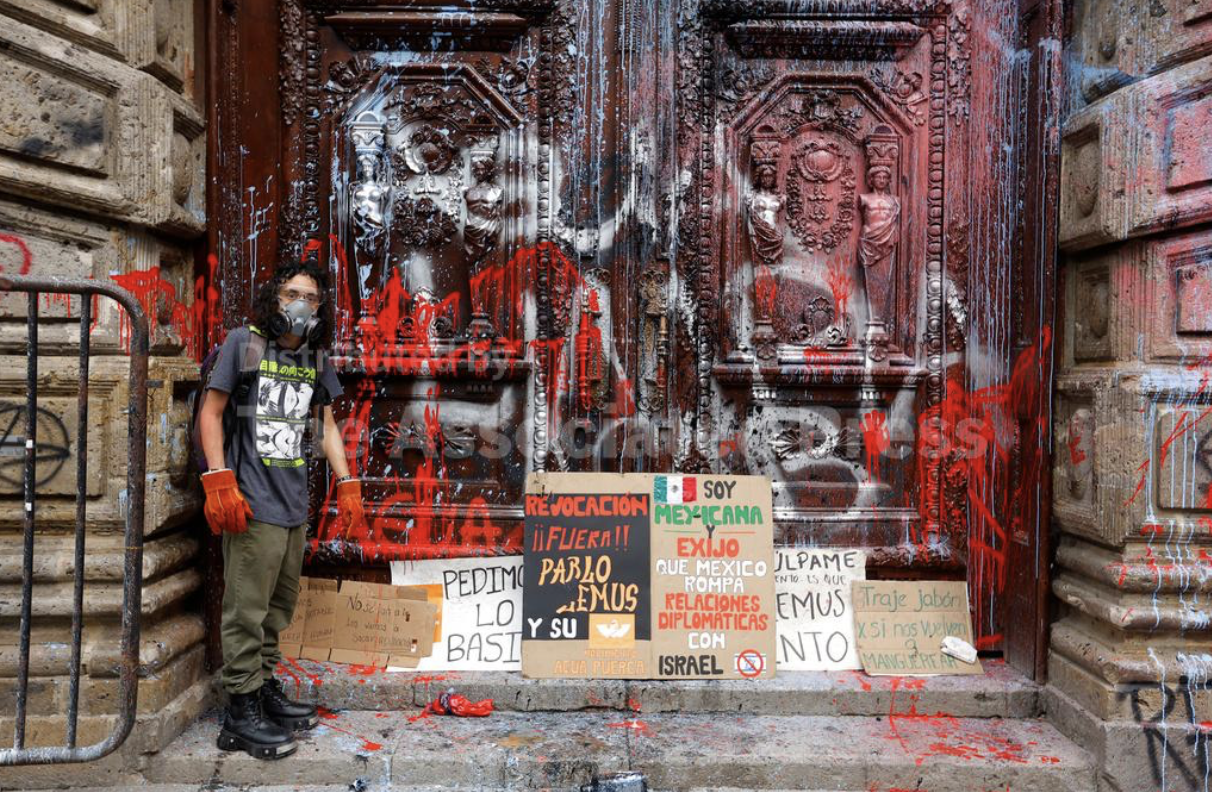
Protesters throw objects toward the Jalisco government palace during a demonstration. Hundreds of citizens in Jalisco demonstrated for the second consecutive Sunday over poor water quality and demanded the removal of Pablo Lemus, the governor of Jalisco; some participants caused disturbances, reaching as far as the Government Palace. (Photo by Cesar Gomez / SOPA Images/Sipa USA)(Sipa via AP Images)
Masked individuals who protesters described as infiltrators — their affiliations remain unverified — threatened to intensify the protest, vandalizing and looting nearby businesses and defacing the exterior of the governor’s residence, setting two of the residence’s three main entrance doors on fire. Peaceful protesters tried to separate themselves and physically eject the agitators, who additionally set fire to the entrance of the Jalisco State Congress building. Though the riot police deployed throughout the area never encircled the attackers, according to La Jornada, and the police’s response wasn’t as harsh as the first march, authorities confirmed at least four arrests of suspects linked to the arson and vandalism.
Still, neighborhoods in Jalisco remain without clean water, and many expect a third protest in the coming weeks. This ongoing water crisis points to broader issues in Mexico’s infrastructure, where there’s a staggering reliance on obsolete technology and widespread environmental oversight. Across the country, municipal water lines are aging and heavily degraded. In Mexico City, aging distribution pipes contribute to water losses estimated at up to 40% of the city's supply
The National Assembly for Water, Life and Territory, a Mexican rights coalition that advocates for environmental justice, emphasized the need for the government to develop a verifiable solution to the region’s water crisis.
“Water is not a concession granted by governments nor a privilege reserved for those who can afford to pay for it,” the organization said in a public statement. “It is indispensable for life, health, food, work and the survival of our communities.”