
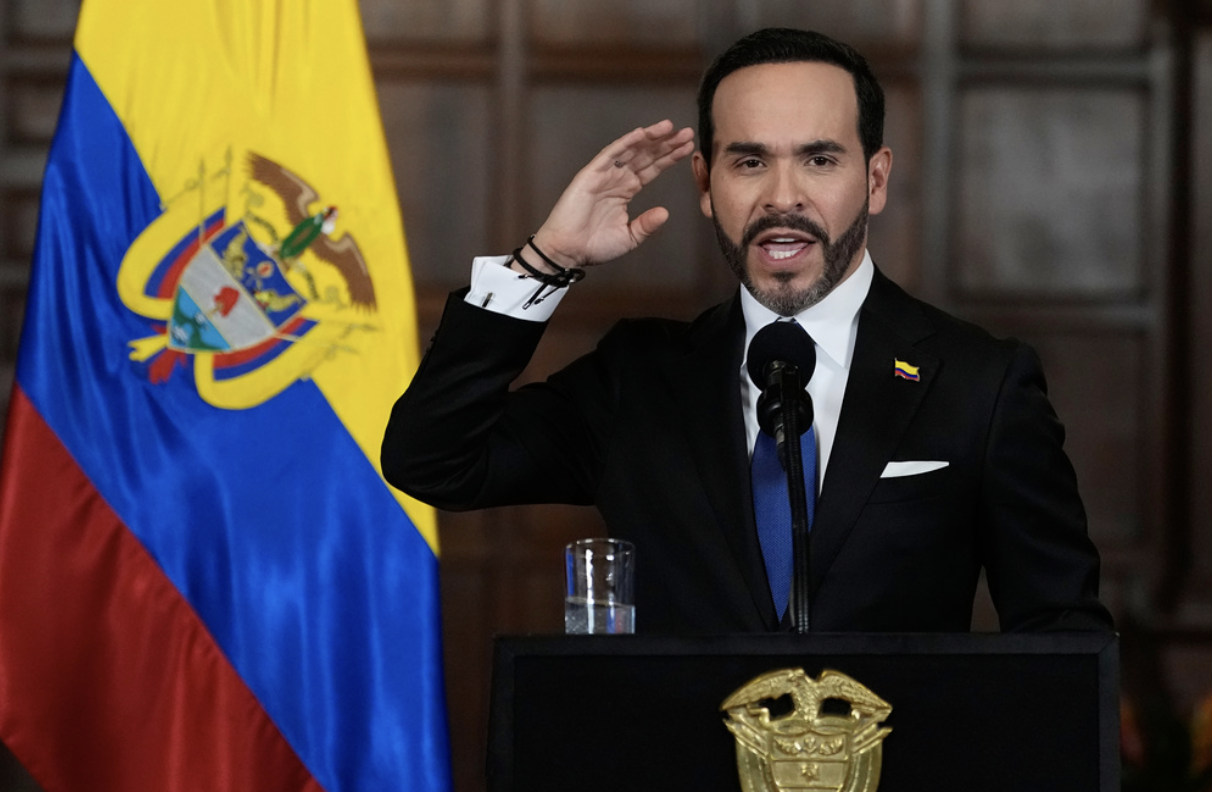
Colombia's President Abelardo De la Espriella announces a joint effort with Bogota's Mayor Carlos Fernando Galan to strengthen security in the Colombian capital through increased police presence, intelligence, technology, and urban capabilities in Bogota, Tuesday, Aug. 25, 2026. (AP Photo/Fernando Vergara)
Against the backdrop of a rightward shift in Latin America, Colombia expressed a shift in policy priority at an Oct. 12 Security Council meeting regarding the renewal of the Colombia 2016 Peace Agreement, a coordination by the UN to stabilize communities in Colombia affected by drug violence. As opposed to a full continuation of the agreement, Foreign Affairs Minister Omar Bula from Colombia expressed a greater support for overt security through military defense while the representative from the United States supported the shift, highlighting a failure in previous President Gustavo Petro’s ‘total peace’ plan, stating that the plan was but “failed negotiations.”
Bula highlighted that, in 60 days of his government being in power, Colombia conducted nearly 32,000 arrests, confiscated 135 tons of narcotics, removed 3,400 firearms from circulation, and signed over 110 extradition orders to dismantle criminal networks. Bula frames this as a success from the previous administration’s ‘total peace’ plan, noting that from the implementation of the Peace Agreement in 2016 to August 2026, more than 130,000 people were murdered, while 100,000 cases of extortion and 2,700 kidnappings were recorded.
Bula attributes these changes to the assumption of power by President Abelardo de la Espriella in August, leader of right-wing party Defenders of the Homeland, who made promises to reverse the agenda of the previous leftist President Gustavo Petro of the Historic Pact party. Perhaps the most significant change in de la Espriella’s departure from Petro’s administration is the strengthening of ties with the U.S. in order to combat left-wing guerrilla groups. Whereas before Petro’s ‘total peace’ agenda sought negotiations with armed groups to scale back their numbers, de la Espriella named Medellín as the home of the “Shield of Americas” program overseen by the U.S. He said that the city was a strategic location for the program as it is the “head of the snake of drug trafficking and organized crime.”
De la Espriella developed another joint operation with the U.S. known as Plan Patriota 2.0. The plan is an extension of Plan Patriota, is a U.S.-backed military strategy implemented by former Colombian President Alvaro Uribe from 2003 to 2006. This plan was adopted in order to shift away from Petro’s 2023 plan to reduce the size of coca crops in an attempt to cut cocaine production through agricultural methods. De la Espriella’s administration, as Bula pointed out, intended instead to reduce the focus on agriculture and increase military intervention instead. In a 2023 speech Petro, further, called the war on drugs “ill-named,” due to the “failure” of military force in the reduction of drug violence. He, instead, aimed his goals at promoting human rights.
In Oct.2025, the U.S. Department of Treasury imposed sanctions on former President Petro due to their assessment of his allowance of “drug cartels to flourish” and a refusal “to stop this activity.” Months later in March 2026, the U.S. Drug Enforcement Administration labeled Petro as a “priority target,” citing their findings of possible dealings with Mexico’s Sinaloa cartel.
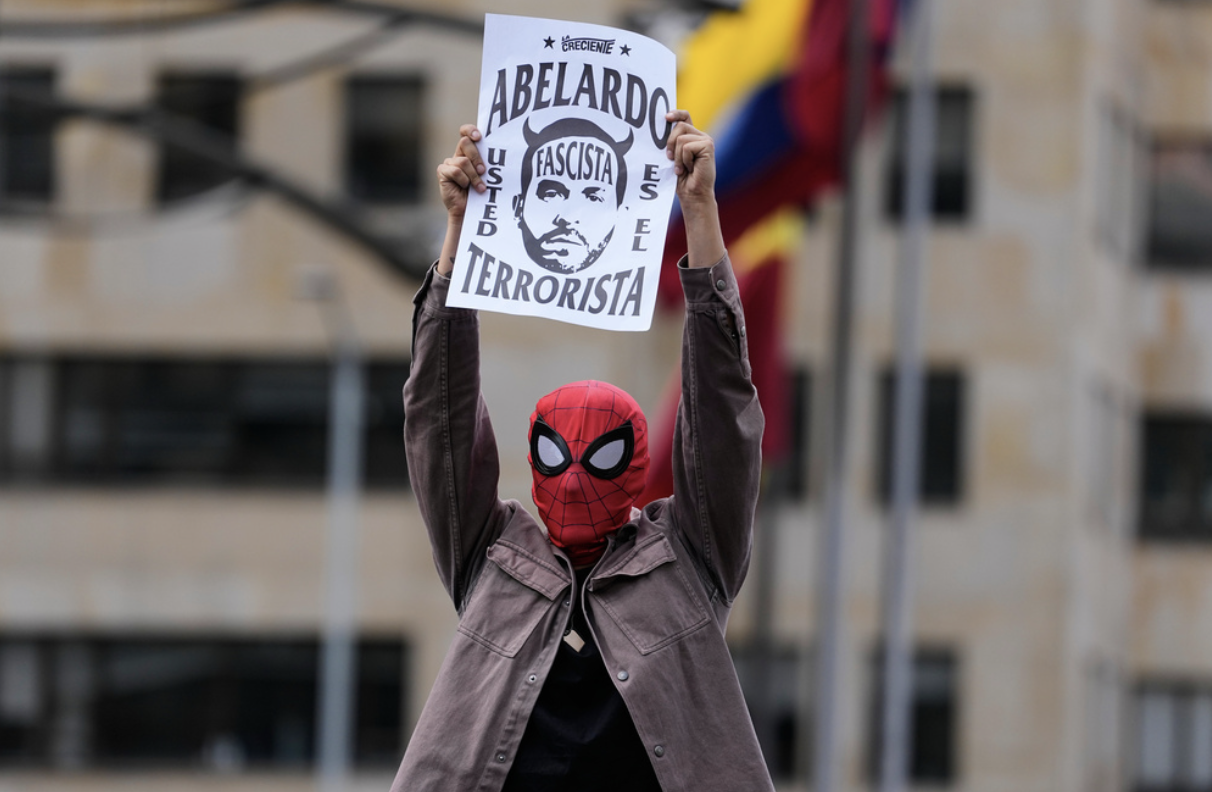
A demonstrator, donning a Spiderman mask, takes part in a protest against President Abelardo de la Espriella's order to remove exhibits about political violence from the National Museum in Bogota, Colombia, Saturday, Oct. 17, 2026. (AP Photo/Fernando Vergara)
Despite the heightened security prioritizations under the de la Espriella administration, many Colombians are expressing opposition against the possibility of human rights abuse under a priority of increased security. Trade unions, social movements, student organizations, and Petro’s Historic Pact party led demonstrations in Cali on Oct. 14 to protest legislation supported by the De la Espriella administration that could threaten human rights. Along with a series of demands for workers' rights and social protections, the demonstrations also highlighted the potential threat to human rights under the De la Espriella administration posed by the proposed ‘anti-terrorism statute.’ The statute grants the state greater powers to suppress domestic terrorism, though critics argue that the definition of terrorism is too broad and could threaten Colombians’ right to peaceful assembly.
The protesters were also concerned about the deployment of 600 American troops in the region to combat drug trafficking. The battalion has begun training in Panama and will soon be deployed in Colombia and Honduras to train with local forces and conduct raids against accused drug traffickers, according to U.S. military officials. The deployment, endorsed by President de la Espriella, is thus met with significant pushback from demonstrators. Bula’s claimed victory over drug violence at the Oct. 12 UN meeting, then, is overshadowed by the growing opposition to de la Espriella’s security focus, with opposition to the ‘anti-terrorism statute’ being perhaps the first of many in regions affected by drug violence.