
US-Venezuela Oil Deal Tests Venezuela’s Democratic Transition
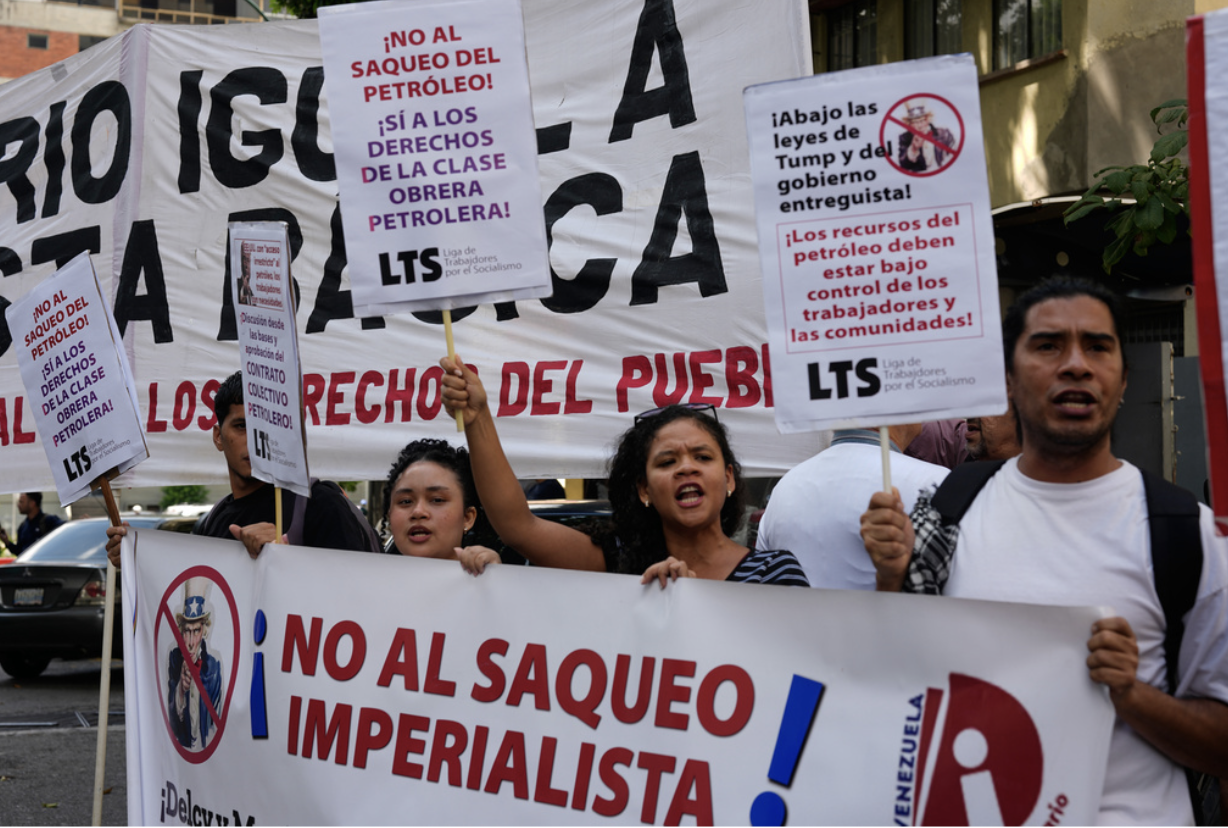
Oil workers, retirees and trade union members protest against Trump's oil policies outside Petroleos of Venezuela PDVSA headquarters in Caracas, Venezuela, Thursday, Oct. 1, 2026. (AP Photo/Ariana Cubillos)
On Sept. 23, 2026, the United Nations (UN) hosted the 81st session of the United Nations General Assembly (UNGA 81), where the interim President Delcy Rodríguez of Venezuela took the podium, pledging progress toward fair and free elections. Her government has not announced an election date.
Rodríguez, who was former President Nicolás Maduro’s vice president, has built a new diplomatic relationship with the United States through the signing of the Historic Oil Agreement. The deal was signed on Aug. 28, 2026, by President Donald Trump and Rodríguez, allowing US control over 65 billion barrels of oil reserves. The deal gives the US the right to purchase and manage Venezuela’s oil. It aims at securing US energy dominance, while also providing Venezuela the capabilities to reconstruct and develop its infrastructure.
During the UN General Assembly discussions, Trump met with Rodríguez to discuss US interests in reconstructing their diplomatic relationship by lifting economic sanctions and working on the terms of the US-Venezuela oil agreement. The development of US-Venezuelan relations is critical for the transition period in Venezuelan politics. On Jan. 3, 2026, Maduro was captured by US armed forces, ending his 13-year presidency that was built on authoritarianism. His governance was widely criticized by human rights groups for political repression.
Maduro’s rule started in 2013, where Venezuelans faced hyperinflation, political repression, and violations of their human rights. Maduro’s government relied heavily on revenue from the state oil company, Petroleos de Venezuela S.A., to finance state operations. The economic crisis was amongst the worst situations that Venezuelans had to endure. It caused the nation’s gross domestic product to drop by 80 percent, both increasing inflation and leading to approximately 7.9 million Venezuelans to flee the country since 2015.
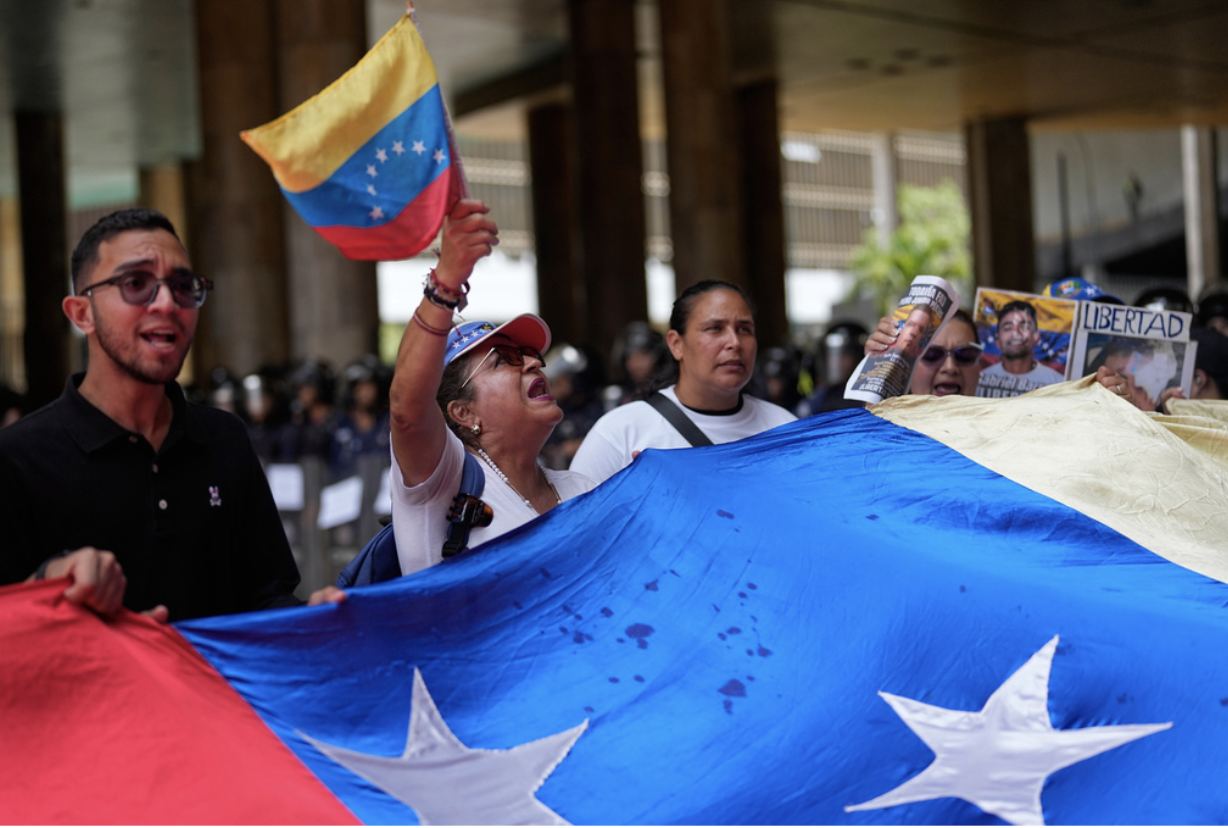
Protesters demand the resignation of National Electoral Council (CNE) president Elvis Amoroso outside CNE headquarters in Caracas, Venezuela, Thursday, Oct.1, 2026. (AP Photo/Ariana Cubillos)
During Maduro’s presidency, opposition to his government grew amid increasing political repression to overthrow the authoritarian regime. It led to more than two thousand political prisoners to be imprisoned. According to the Inter-American Commission on Human Rights (IACHR), they declared these mass imprisonments “state terrorism,” highlighting the suppression of political rights and free speech in Venezuela.
Nine months after Maduro's capture, the Rodríguez government released 39 political prisoners. Estimates suggest that between 379 to 500 detainees remain in custody. Political discontent remains fueled by the lack of fair elections. According to a survey conducted by the International Republican Institute, 74 percent of Venezuelans believe that democracy is the most sustainable form of governance and 62 percent want the government to take more measures toward reconstructing Venezuela’s political system. The deteriorating economic conditions left behind from the previous Maduro regime remain an issue, as well as the detainment of political prisoners, which challenge Venezuela’s path to democracy and political order.
During Trump’s speech at UNGA 81, he stated “‘if necessary, we will use our unmatched military might to secure the vital national interest of the United States.’” This quick shift in US priorities excluded the Venezuelan people's hopes for a democratic free election, instead replacing it with US interests.
According to an interview on Telemundo 47 with protester Oscar Correa, reporters asked him to describe his thoughts on the recent US-Venezuela relationship and pending date for elections. He stated, “Our position is that free elections and democracy for Venezuela must come first, and that without free elections, no economic interests will succeed in Venezuela.” While discussions of the oil agreement continued to carry, 50 Venezuelans gathered outside the UN during UNGA 81 to advocate for free elections. They held signs that read “No Vote No Oil” and “New Face, Same Regime.” The rallying protests represent the political opposition's demand for governmental accountability, which are being put on hold by the oil agreement.
“This pact with Trump entrenched the dictatorship that he himself declared war on. But to get rid of Maduro, he left the rest and did business with them. It disgusts me.” said Antonio Marchetti, a 45-year-old electrician.
The new diplomatic relationship remains a concern regarding what this means for the future of Venezuelan politics and democratic freedom. As no election date has been set, questions arise at whether this new interim government will be a continuation of what Maduro left behind or a clean slate for Venezuela to reconstruct.