
Hungary Asks EU to Suspend Russian Oil Sanctions as Oil Prices Surge
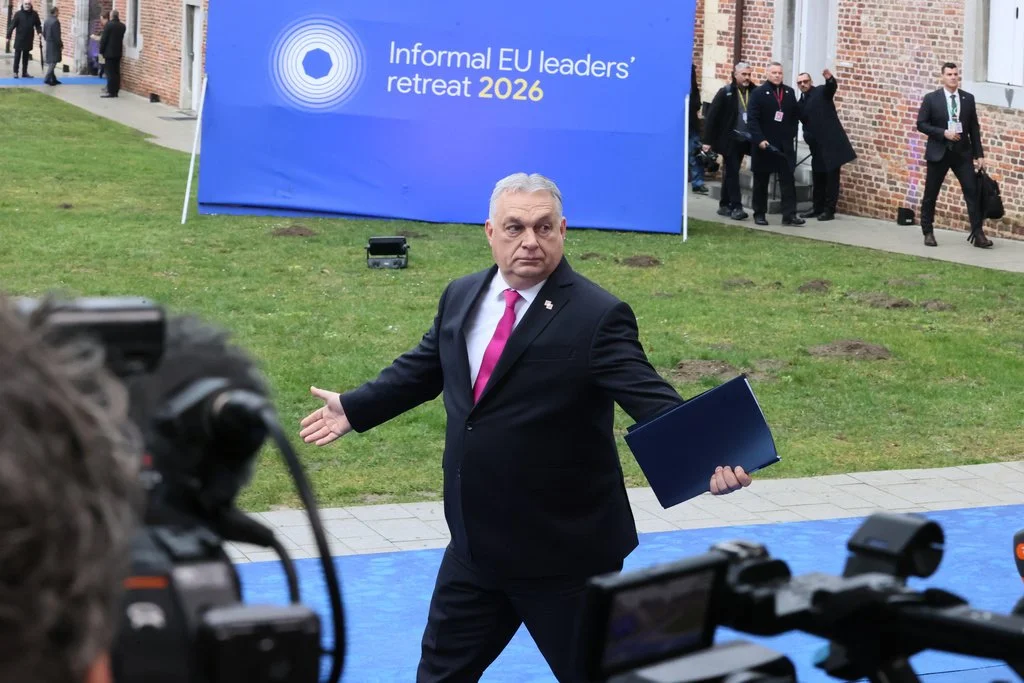
Hungary's Prime Minister Viktor Orban, center, arrives for the EU summit at Alden Biesen Castle in Bilzen-Hoeselt, Belgium, Thursday, Feb. 12, 2026. (AP Photo/Francois Walschaerts)
Hungarian Prime Minister Viktor Orbán announced in a video posted to social media on Monday, March 9, that he had sent a letter to Ursula von der Leyen, president of the European Commission, asking that Russian oil sanctions be suspended due to surging oil prices as a result of the war in Iran.
Orbán, who has served as Hungary’s right-wing populist prime minister for sixteen years, has consistently been one of the Kremlin’s closest allies within numerous supranational organizations. In 2023, Orbán’s Chief of Staff, Gergely Gulyás, told a briefing that Hungary would not arrest Russian President Vladimir Putin if he entered the country, despite his arrest warrant from the International Criminal Court, which Hungary has recognized since its establishment in 2002. Russian oil sanctions have been staunchly in place since the country invaded Ukraine in 2022, serving as one of the European Union’s strongest non-military efforts to suppress President Vladimir Putin during the conflict. The Hungarian government has long opposed EU efforts to cut Russian energy imports.
Since the invasion of Ukraine, Hungary has, alongside Slovakia, maintained and increased supplies of Russian oil and gas through the Druzhba pipeline. Both nations have been granted a temporary exemption from an EU policy prohibiting the import of Russian oil to member nations. Oil deliveries have been halted by Ukraine since Jan. 27, however, as Ukrainian President Volodymyr Zelenskyy has said that the pipeline, which runs through Ukraine, was damaged by a Russian drone strike. Orbán, who has consistently been running an anti-Ukraine media campaign in support of Putin, has accused Zelenskyy of deliberately holding up oil supplies. In retaliation, Orbán has vetoed a new round of EU sanctions against Russia and is blocking a major 90 billion euro EU loan for Ukraine until Ukraine resumes flow in the Druzhba pipeline.
As the war in Iran enters its second week, global oil prices have soared due to the conflict’s compromise and blockage of the Strait of Hormuz, critical to the global movement of oil and gas. Orbán also announced on Monday that the Hungarian government plans to introduce a price cap on gasoline and diesel at fueling stations. The price of gasoline will be capped at 595 forints ($1.75) per liter and diesel at 615 forints ($1.81) per liter, applying only to vehicles with Hungarian license plates and registration documents. Orbán’s government imposed a similar cap on fuel prices in November 2021, as prices soared amid COVID-19-related disruptions, though the effort was scrapped over a year later due to rising consumption and fuel shortages.
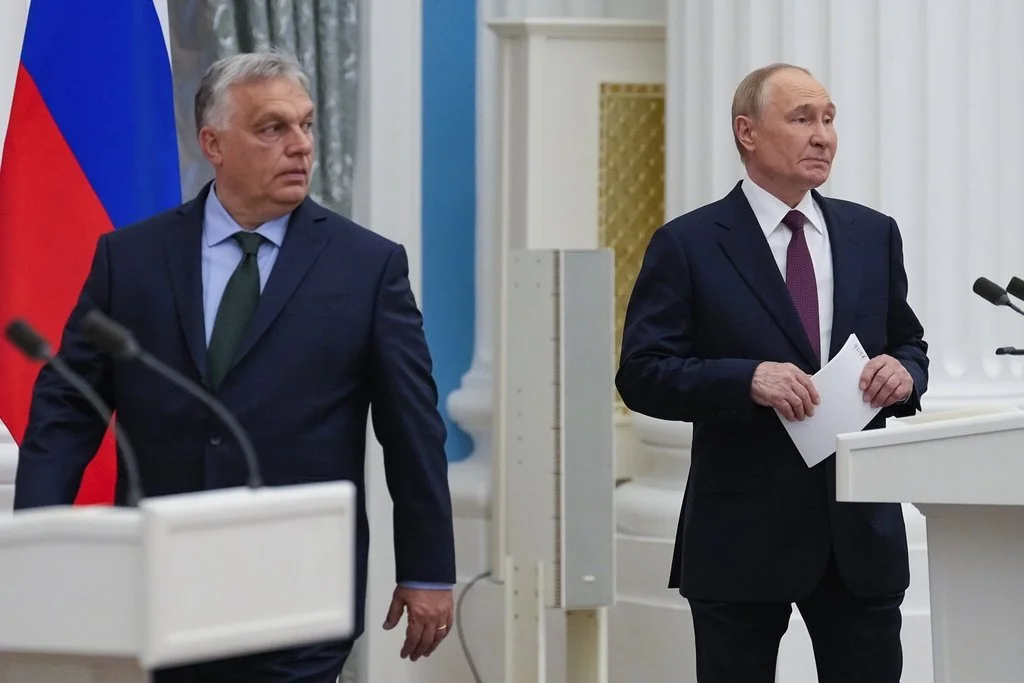
Russian President Vladimir Putin, right, and Hungarian Prime Minister Viktor Orban arrive to make press statements after their talks in the Kremlin in Moscow, Russia, Friday, July 5, 2024. Hungarian Prime Minister Viktor Orban visited Moscow on Friday for a rare meeting by a European leader with Russian President Vladimir Putin and discussed peace proposals for Ukraine, which triggered condemnation from Kyiv and some European leaders and officials. (AP Photo/Alexander Zemlianichenko)
For years, Hungary has stood out among EU member states due to Orbán’s commitment to the Kremlin as well as his populist policy decisions, as evidenced by his most recent request. For over a decade, the European Commission has accused the prime minister of dismantling democratic institutions, taking control of the media, and infringing on minority rights. In 2022, the EU’s executive branch recommended the bloc suspend around 7.5 billion euros of “cohesion funds” to Hungary, or funds given to member nations to help bring their economies and infrastructure up to EU standards, over concerns regarding democratic backsliding and improper usage of EU money.
Though in 2023 the European Commission re-released funds to Hungary after it concluded Orbán had carried out sufficient judicial reforms, this past February, Advocate General Tamara Ćapeta of the EU’s highest court urged the court to annul the decision due to the fact that Hungary had not in fact carried out the required reforms at the time the funds were released. Consequently, Hungary had been asked to make reforms ensuring judicial independence and to tackle internal corruption. Orbán has consistently stood his ground on his policies and alignment with Russia, rejecting accusations of democratic backsliding and denouncing them as interference with Hungarian sovereignty.