
Ukraine Transforms the Modern Battlefield with a Robot Army
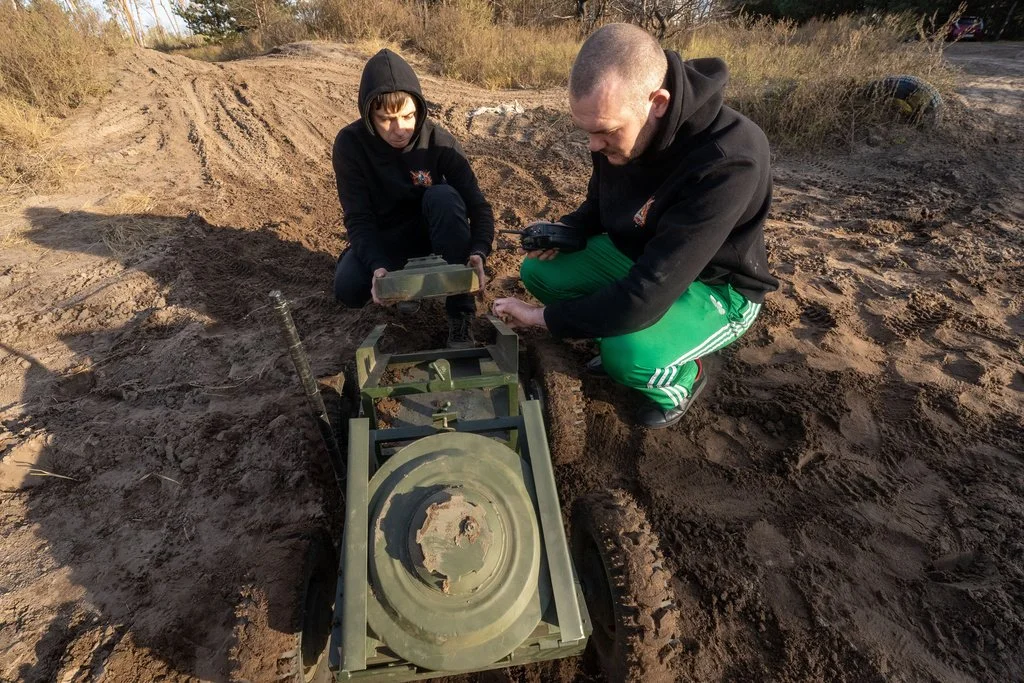
Employees of the Bender Robots company test a drone installing anti-tank mines in the Kharkiv region, Ukraine, Friday, Oct. 3, 2025. (AP Photo/Andrii Marienko)
As the war between Russia and Ukraine enters its fifth year of conflict, new technological advancements are hitting the battlefield. The Ukrainian front lines are increasingly incorporating new robotics technology, such as unmanned ground vehicles (UGVs), with their prevalence growing exponentially since spring 2024.
These new ground vehicles have become an essential part of Ukraine’s military strategy against Russia. As of early 2026, robotic military operations have grown to over 7,000 missions a month, with more than 200 Ukrainian companies involved in robotic manufacturing. According to Ukrainian Army Lieutenant Victor Pavlov, this new technology is “what modern warfare looks like”, further stating that “armies everywhere will have to robotise.”
Land robots now account for 90% of Ukrainian military logistics, and the technology does more than anyone could have previously imagined. Several different kinds of land-based robots are now in play on the battlefield, executing different functions: carrying and transporting cargo, bringing supplies for medical evacuations, laying mines, or engaging in combat with remote control machine guns and grenade launchers.
These UGVs are particularly important in "kill zones," where sending infantry can be dangerous. Instead, these unmanned vehicles are able to perform vital tasks once executed by military personnel, such as laying barbed wire, de-mining areas, or removing other machines that are out of commission. Working well across all kinds of terrains, these robots have also become important for transporting food and weapons to troops in all sorts of positions. Additionally, they can help evacuate wounded troops from the battlefield and have a carrying capacity of over 450 pounds. Dozens of these medical evacuation missions have been largely successful, exemplifying what an asset these robots can be.
According to the Modern War Institute, the primary goal of Ukraine’s operational concept is not to replace infantry but rather to keep them out of kill zones. However, according to others like Mike LeBlanc, co-founder of the robotics firm Foundation, "there's a moral imperative to put these robots into war instead of soldiers". Just recently, his company sent several humanoid robots to Ukraine, although they have yet to be seen in action on the battlefield. According to LeBlanc, he envisions a future with robots that can use any weapon a human can, suggesting a turnaround of conventional warfare into a completely new robotic-based landscape. Yuriy Poritsky, CEO of a Ukraine-based manufacturing company that makes these types of UGVs, says that "there's nothing sci-fi about the battlefield, this is our reality," despite its seemingly futuristic, fictional nature.
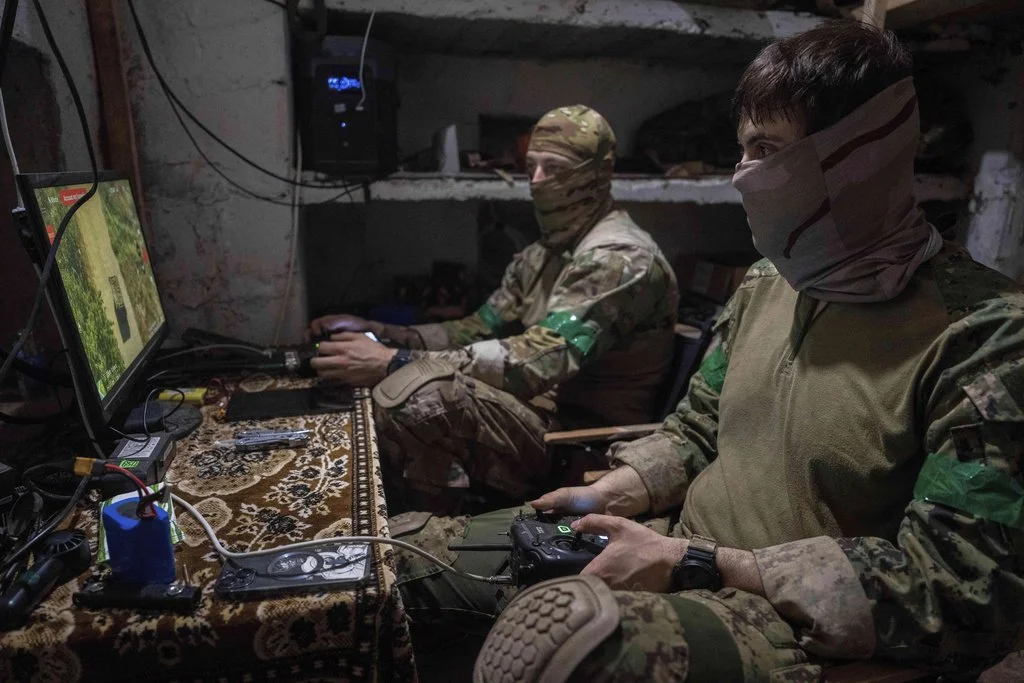
Ukrainian servicemen navigate land and aerial drones near Kostiantynivka, Ukraine, on Wednesday, Sept. 10, 2025. (AP Photo/Alex Babenko)
Ukraine’s former commander-in-chief and current ambassador to the EU, Valerii Zaluzhnyi, sees the growth of these new military robotic technologies as exponential, suggesting that the future of modern warfare could potentially be a swarm of AI-powered drones. He says that “...In the near future we'll see dozens and even hundreds of smarter and cheaper drones attack[ing] from various directions and heights, from the air, ground and sea at the same time,” according to the BBC. While robotic warfare technology keeps soldiers safe in some respects, the large growth in production of sky drones has, in large part, expanded the “kill zone” and made the battlefield more dangerous for infantry on the front lines.
The discussion surrounding robotized warfare raises concerns about how robots and artificial intelligence are going to continue to shape the future evolution of the modern battlefield. Currently, all unmanned ground vehicles are controlled remotely by humans, but will there be a time when they are controlled by AI? This brings in several new questions involving feasibility and ethics, but it’s not a future too far off from our current reality.