
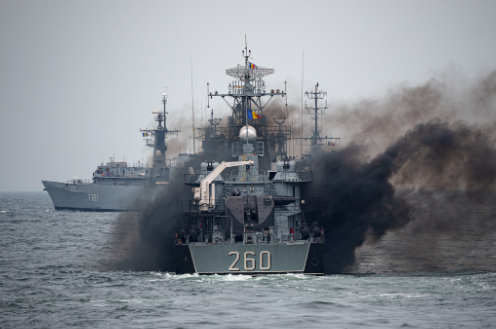
A Romanian warship sails engulfed in smoke during a Romanian Navy-led exercise outside Constanta, Romania, Tuesday, April 16, 2024. The exercise, dubbed "Sea Shield 2024," brought together U.S. and NATO troops and involved some 2,200 military personnel from 12 allied and partner states. (AP Photo/Andreea Alexandru)
On Nov. 14, drones struck three commercial vessels near Romania’s Sulina Canal, two of them inside Romanian territorial waters. Amid continued drone attacks on civilian shipping in the Black Sea, Bucharest is seeking additional military support from NATO allies.
Confirming the events on Nov. 15, Romanian Prime Minister Luca Niculescu said that Romania had scrambled F-16 fighter jets twice in response. No casualties were reported, and fires were extinguished by crew members following the attacks.
According to Romania's Defense Ministry, the Greek-flagged tanker Evia Petrol V was struck at approximately 9:10 p.m. about four nautical miles southeast of Sulina. The Saint Kitts and Nevis-flagged bulk carrier Marsol was hit roughly 35 minutes later, five nautical miles southeast of the canal. Both vessels were struck within Romania’s maritime borders. Officials also reported damage to the Saint Kitts and Nevis-flagged tanker Ali Najafov.
The attacks followed a Nov. 13 drone strike targeting the Palau-flagged cargo ship Larissa 1 near the Danube Delta. The drone damaged a cargo crane, but no injuries were reported.
Niculescu described the attacks as direct violations of international law and linked the deteriorating regional security landscape to the ongoing conflict between Russia and Ukraine. Romanian officials have not yet identified credible origins of the drones involved in the attacks.
Romanian Defense Minister Stefan-Radu Oprea announced plans to discuss closer coordination with NATO allies in Brussels, including the need for additional maritime surveillance aircraft and counter-drone equipment. Romania signed a €247 million contract for 12 radar systems from French defense contractor Thales, with the first delivery originally expected around April 2027. Following discussions with Oprea, Thales agreed to deliver the first two systems ahead of schedule, the first by several weeks and the second by several months.
The attacks occurred along one of the Black Sea’s principal commercial shipping corridors. Connecting the Danube River to the Black Sea, the Sulina Canal provides Ukraine, Romania and Moldova with export channels and international markets. Since Russia's full-scale invasion in 2022, maritime security concerns have become more significant as the war disrupted traditional Ukrainian trade routes.
Subsequent incidents have further disrupted the transport of freight, including waters near Bulgaria. On Nov. 16, the Somali-flagged cargo ship Betul 8 was struck while carrying 3,000 metric tons of wheat in Bulgaria's exclusive economic zone. All 12 crew members were rescued. Maritime security sources attribute the attack to a drone strike.
On Nov. 17, after being struck four times, the Liberian-flagged liquefied petroleum gas tanker Gas Husky was damaged and sunk off Bulgaria’s coast. All 19 crew members were rescued. According to a maritime security firm Diaplous at least 17 vessels have been attacked off the coasts of Romania and Bulgaria since mid-July.
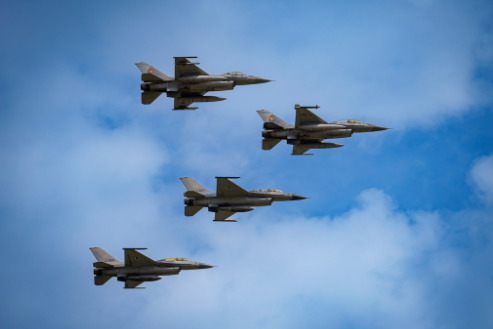
F16 fighter jets of the Romanian Air Force and the Romania-based European F-16 Training Center (EFTC) perform a fly-by at the Black Sea, Defense, Aerospace and Security (BSDA) international exhibition in Bucharest, Romania, Wednesday, May 22, 2024. (AP Photo/Vadim Ghirda, File)
The series of drone attacks prompted increased regional security measures. France has deployed an Atlantique 2 maritime patrol aircraft to Romania, while Romanian naval units conducted operations in the Black Sea to recover and examine drone debris. On Nov. 16, the Romanian Defense Ministry announced that French aircraft had identified two aerial drones adrift in the Black Sea.
Romania is working closely with the European Union to strengthen regional security cooperation channels. Romanian Foreign Minister Dan Neculaescu raised the topic of Black Sea security at EU meetings in Brussels on Nov. 16, emphasizing the need for coordinated regional security and advocating for the accelerated implementation of a joint Romanian-Bulgarian maritime security hub.
During visits to Romania and Bulgaria on Nov. 9-10, European Commission President Ursula von der Leyen committed €50 million (about $56 million) toward the establishment of the hub. The initiative is intended to improve regional information sharing, maritime security and risk detection. The EU has also announced an additional€10 million, each for Romania and Bulgaria, to enhance maritime search-and-rescue operations.
The series of incidents raised questions about NATO’s collective-defense obligations. Under Article 5, whether an incident constitutes an armed attack is reviewed on a case-by-case basis. The recent set of events did not amount to an “attack against all.”
In the aftermath of the incidents, Romania and Bulgaria have concentrated their efforts on increasing surveillance, military cooperation and maritime security capacities. With the EU-backed hub’s development underway, commercial shipping continues operating in the affected Black Sea corridor.