
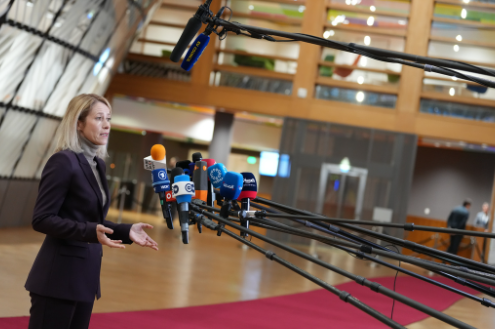
European Union foreign policy chief Kaja Kallas speaks with the media as she arrives for a meeting of EU foreign ministers at the European Council building in Brussels, Monday, Nov. 16, 2026. (AP Photo/Virginia Mayo)
On Nov. 16, the Foreign Affairs Council of the European Union convened in Brussels, where officials issued the latest round of condemnations against Russia. At the meeting, EU countries accused Moscow of delaying negotiations on ending the war in order to continue its bombing campaign. As winter approaches, Russia has been increasingly bombing power plants and other civilian infrastructure, using the threat of a powerless winter as a tactic against Ukraine as it continues what the EU called its “war of aggression against Ukraine and hybrid campaign against the EU and its member states.”
After an informal exchange of views with Ukrainian Foreign Minister Andrii Sybiha, the council turned its attention to the war. Sybiha updated the council on the U.S.-led Abu Dhabi talks, provided an overview of the ground situation in Ukraine and outlined the nation’s most urgent needs. The subsequent discussion focused on increasing Ukraine’s resilience ahead of the winter, with particular emphasis on air defense, energy, transportation, and humanitarian and financial needs. The council also adopted a decision that will soon grant Ukraine a package of nearly 8 billion euro under the Ukraine Facility, the largest single disbursement ever made by the EU to Ukraine under the facility.
At the talk in Brussels, EU foreign ministers asserted that the priority in Ukraine should firstly be to secure a stable ceasefire, and then subsequently a real peace agreement. They asserted that Russia was the one who initiated the war and must be the one to make concessions, rejecting any new demands from the Kremlin.
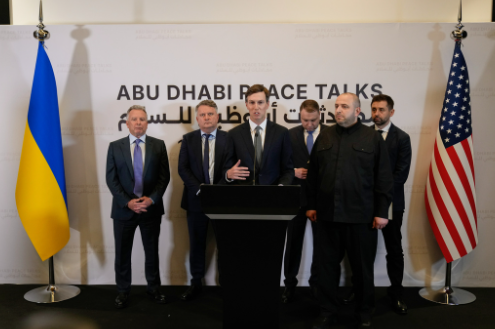
U.S. envoy Jared Kushner speaks at a briefing during U.S.-mediated talks between Russia and Ukraine, alongside U.S. envoy Steve Witkoff, left, and Rustem Umerov, head of Ukraine's Foreign Intelligence Service, second from right, in Abu Dhabi, United Arab Emirates, Wednesday, Nov. 11, 2026. (AP Photo/Altaf Qadri)
The meeting comes after the most recent round of negotiations held in Abu Dhabi last week. At those talks, the U.S. agreed for the first time to discuss Russia’s demand for a new European security framework and asked Moscow to present proposals.American negotiators Jared Kushner and Steve Witkoff have both served as mediators for the war, and have been talking to both sides for a little over a year. During this time, however, no lasting ceasefire has been established and little tangible progress has been made in peace negotiations.
Russia’s demand has been continuously rejected by the EU, which likened the framework to the draft treaty Russian President Vladimir Putin offered NATO shortly before launching his full-scale war of aggression on Ukraine in 2022. It’s seen as an attempt to weaken NATO by requiring that the alliance pull troops and equipment back to where they were in 1997, before the Czech Republic, Hungary and Poland joined in 1999.
Ukrainian President Volodymyr Zelenskyy has warned that discussions on new security arrangements could give Moscow an opportunity to weaken NATO and reshape the borders of Eastern Europe. In response to the U.S. push for discussions, European leaders have asserted that decisions about the continent’s security are to be made by the nations’ leaders themselves, warning against allowing Russia to dictate the terms of a new security order or negotiate a future for NATO.
Addressing Russia’s demands, Lithuanian Foreign Minister Kęstutis Budrys insisted that Europe is not in need of another security framework, expressing that Moscow has repeatedly violated previous agreements and thus cannot be trusted. The council also made a point to further increase pressure on the Kremlin, imposing additional restrictive measures on 12 individuals and 101 entities for their role in the economic sectors of Russia that are funding the country’s shadow fleet and war of aggression.
They also called for further tightening the screws on Russia through more sanctions, measures against the country’s circumvention of EU sanctions and tighter visa restrictions. Ministers listed 30 additional individuals and one entity responsible for the manipulation of foreign information and interference activities on behalf of the Russian Federation, as well as one entity responsible for cyberattacks on Ukrainian, American and European governing bodies, critical infrastructure and private companies.
At an informal summit in Dublin last week, EU leaders affirmed that Europe should be represented in future peace talks by a team of security advisors from Poland, France, Germany, the UK and Italy, as well as senior officials from main EU institutions. Though they cannot act as mediators given their position as Ukraine’s biggest support, they hope that their role can focus on security arrangements and reconstruction.