
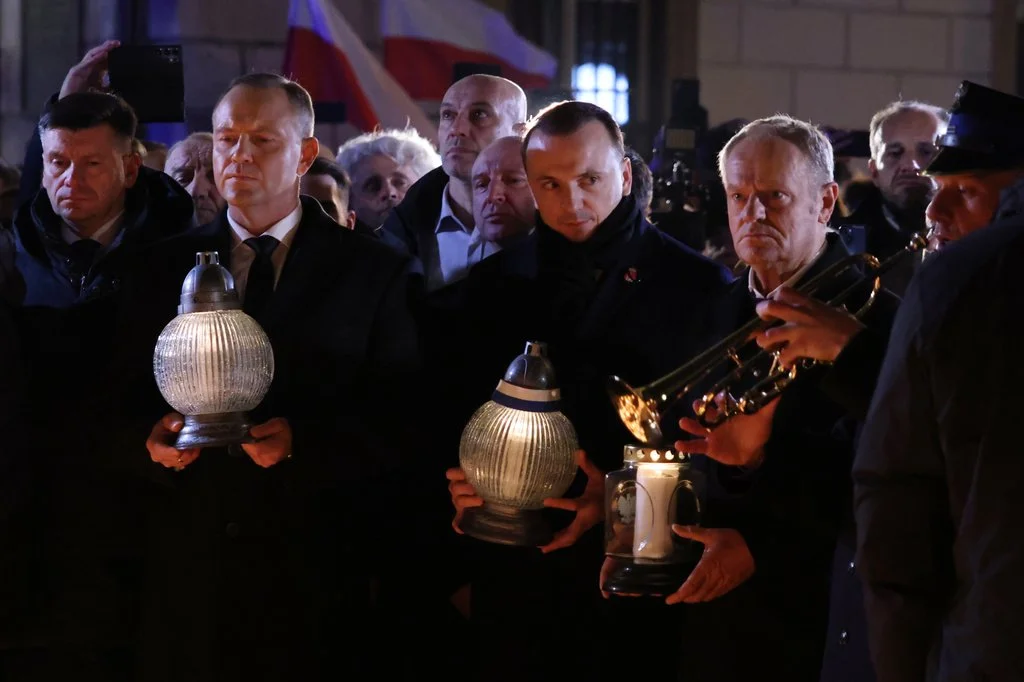
Poland's President Karol Nawrocki, second left, Mayor of Krakow Lukasz Gibala, center, and Prime Minister Donald Tusk hold candles in the main square in Krakow, Poland, Monday, Nov. 9, 2026, to commemorate the victims of a shooting attack. (AP Photo/Beata Zawrzel)
At least six people were killed and 15 were injured after a shooter fired shots in the Main Market Square of Kraków, Poland’s second-largest city. Police noted that a man wearing military-style clothing and a bullet-resistant vest drove into the square before opening fire. The suspect was shot by police and later died in the hospital from his injuries.
Kraków's Main Market Square is a bustling area popular with tourists. Foreign nationals were among both the killed and injured. A British man and an Austrian woman were among the six people killed, while injured foreign nationals included citizens of Austria, Germany, Portugal, Russia and Britain. The attack was described as an “act of terror” by the Polish defense minister and national mourning was put in place following the attack on Nov. 7.
The gunman's home in the city of Ostrowiec Świętokrzyski was later searched with support from counterterrorism police, who eventually found a Gadsden flag, an American Revolutionary-era flag that is often linked to the U.S. far right. The police also examined the suspect's computer and found evidence suggesting that he visited websites concerning Anders Breivik, the Norwegian neo-Nazi who killed 77 people in July 2011. Poland’s Justice Minister Waldemar Zurek noted that there was “a very strong indication of right-wing extremism” behind the gunman’s actions. At the family home, authorities also found the bodies of the suspect’s mother, father and sister, who they believed to have been shot.
Authorities seized 11 weapons from Oksiński, his vehicle and his residence, including two AR-15 semi-automatic rifles, according to prosecutors. Kacper Rekawek, a senior researcher at the International Center for Counter-Terrorism in The Hague, noted that the suspect’s firearms and military-style equipment resembled those used by far-right extremists in Europe and elsewhere around the world. The nationalist opposition dismissed suggestions of a far-right connection to the killings, with Law and Justice party leader Jarosław Kaczyński calling the claims a “blatant lie.”
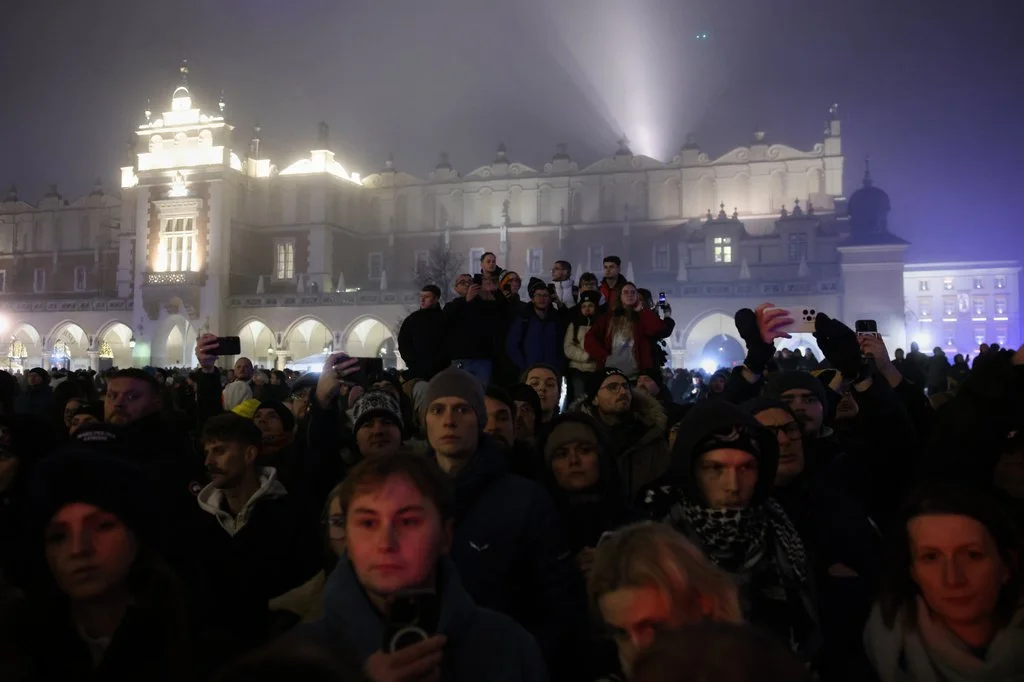
People gather in the main square in Krakow, Poland, Monday, Nov. 9, 2026, to commemorate the victims of a shooting attack. (AP Photo/Beata Zawrzel)
Thousands of people took to the streets in Kraków to march in memory of those affected by the shooting following the reopening of the square. Among the people marching were also Poland’s Prime Minister Donald Tusk and President Karol Nawrocki, who appeared to be displaying unity over the incident despite their tense relations. Mourners gathered at a flower-covered memorial at the site where the gunman opened fire from his car. “For Poland, this is always a sign of hope" said deputy prime minister Władysław Kosiniak-Kamysz, "while we may hold different views, we are still capable of cooperating and seeking out what unites us,” he added.
Although mass shootings remain relatively rare in Poland, the country experienced three separate school attacks in the central Mazovia region over a four-day period in early October. The incidents, involving knives and other sharp objects, left one person dead and several others injured, including children. Some of the attackers were reportedly drawn to far-right ideologies rooted in nihilistic worldviews and Nazism. Kacper Rekawek, a senior researcher at the International Center for Counter-Terrorism in The Hague, said the attacks could be viewed as part of a broader copycat pattern of violence. Separately, security expert Tomasz Safjański told Rzeczpospolita that Poland was failing to adequately address the radicalization of young people, warning that the focus on external threats was allowing violence and extremism to grow within schools, communities and online.