
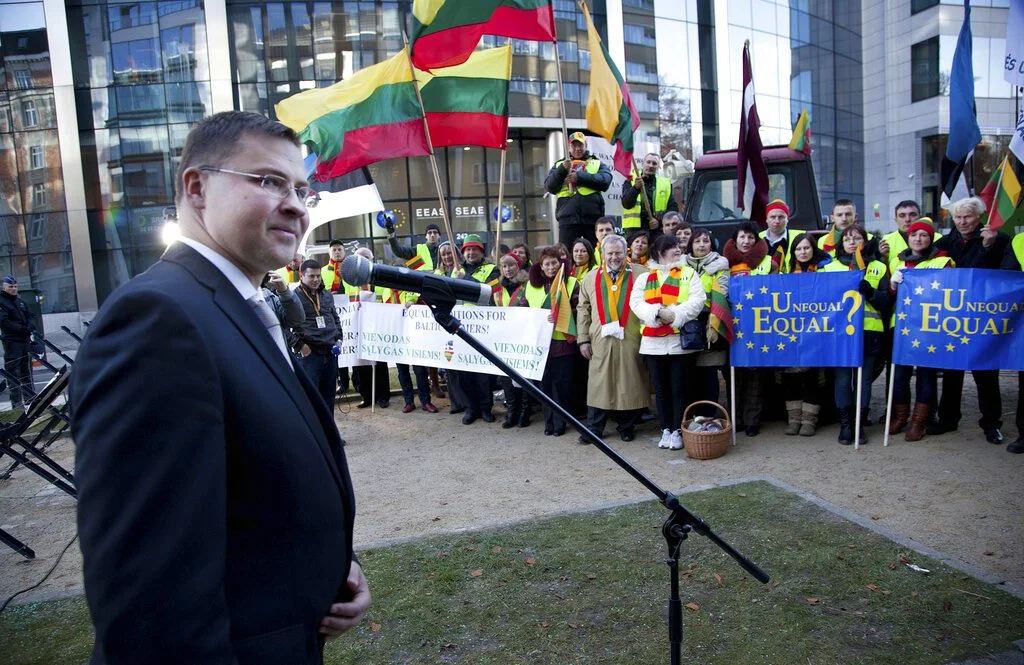
Latvian Prime Minister Valdis Dombrovskis, left, speaks with farmers and agricultural workers from the Baltic countries outside of an EU summit in Brussels on Thursday, Nov. 22, 2012. (AP Photo/Delmi Alvarez)
Hundreds of people in the eastern Latvian city of Jekabpils rallied on Nov. 7 to demand a ban on Russian grain being exported through Latvia. Prime Minister Andris Kulbergs attended the protest while simultaneously acknowledging that a complete stop is nearly impossible. There were reportedly more than 300 participants and 200 vehicles, including tractors and grain trucks, at the “No to Blood Grain” rally. The protest targeted shipments from Russia and occupied Ukrainian territories.
The protest comes at a time when Russian grain transit through Latvia has more than tripled over the first 10 months of 2026 compared to the same period last year, according to Latvia’s State Revenue Service. From January through September alone, nearly 690,000 metric tons of Russian grain passed through the country. Attacks on ships and ports in the Black Sea since July have disrupted Ukrainian and Russian grain exports, pushing Russian exporters toward Baltic Sea ports. However, terminals in Latvia and Lithuania can only handle about 10 percent of the volume that typically moves through Russia’s southern ports, according to the Kyiv Independent.
Latvia’s government says that it agrees with the principles behind the protest, but at the same time it cannot unilaterally change trade policy. On Oct. 13, Kulbergs said that Latvia could neither ban the transit outright nor raise railway fees on the cargo by 300 percent. He cited the EU’s exclusive competence over tariffs and transit, the absence of sanctions on Russian grain, and a risk of lawsuits that were estimated to cost 200 to800 million euros. He added that by the time the grain reaches Latvia, it often already belongs to non-Russian companies, such as those based in the U.S., Switzerland and Japan. The nation also has contracts covering trade that cannot be immediately voided.
However, the government of Latvia had taken action earlier this year. The Parliament, known as the Saeima in Latvian, adopted amendments on Sept. 17 to speed up a review of railway fees for Russian grain, and the government authorized the Food and Veterinary Service to sample transit shipments.. Despite these measures, farmers from the aforementioned Jekabpils area drove tractors and trucks to a railway station that month and signed a letter to the president calling for a complete and immediate ban. They said they would continue protesting if the situation did not change.
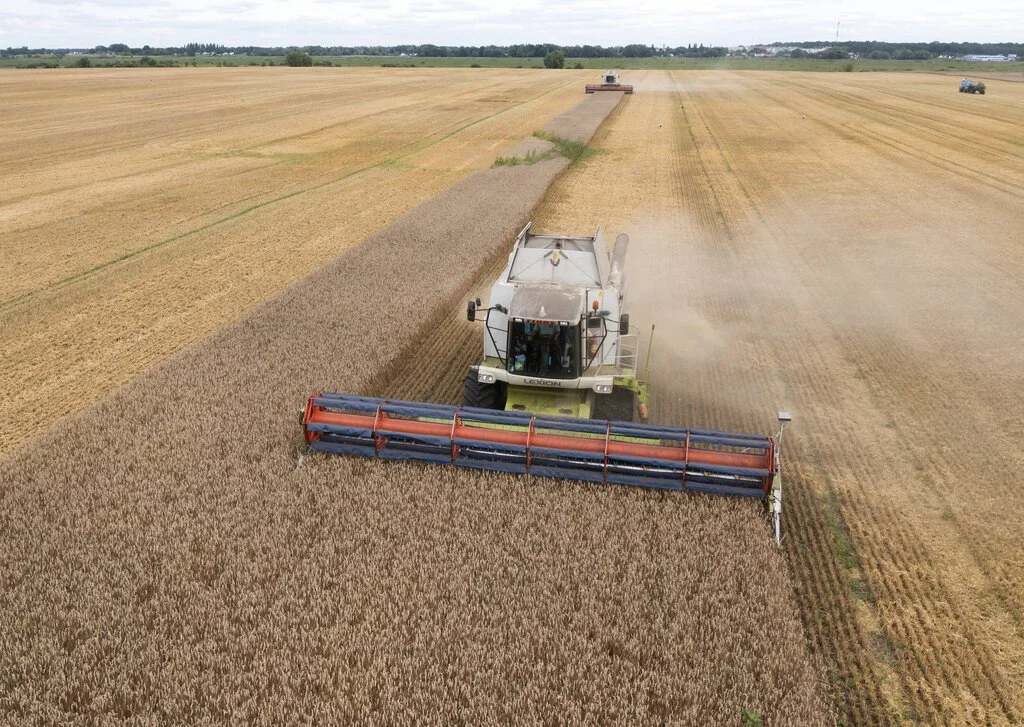
Harvesters collect wheat in the village of Zghurivka, Ukraine, Tuesday, Aug. 9, 2022. Before the war, Ukraine was seen as the world's bread basket, exporting 4.5 million tons of agricultural produce a month through its ports. (AP Photo/Efrem Lukatsky)
Meanwhile, Estonia has taken a different approach. Its government approved a national sanction on Oct. 1, prohibiting the transit of grain originating from Russia and Belarus, noting that such transit through Estonia had historically been negligible. Prime Minister Kulbergs said the situation differs because Estonia had no transit contracts in effect when it made the decision, while Latvia has such contracts at present.
At the EU level, tariffs on Russian and Belarusian grain that took effect in July 2024 do not cover cargo moving through the bloc to third countries. The European Commission made it clear when it proposed them that they would not affect such transit. Kulbergs, Estonian Prime Minister Kristen Michal and Lithuanian President Gitanas Nauseda sent a joint letter on Oct. 9 asking European Council President Antonio Costa and Commission President Ursula von der Leyen to ban the transit of Russian grain anywhere in the EU. The Baltic leaders also raised the issue publicly at the Oct. 15-16 summit on Oct. 15. Kulbergs additionally claimed he planned to travel to Brussels at some point to discuss the measure.
Notably, the letter also calls for preventing the export of Russian grain taken from occupied Ukrainian territory through the EU. Lithuania has pressed for a mechanism to verify the origin of grain so EU ports and transport infrastructure are not used to ship illicit grain.
Ultimately, this protest leaves Latvia’s government facing public pressure to ban Russian grain, without a good measure to actually do so. Kulbergs told the crowd on Nov. 7 that a bill would be submitted to parliament to stop the transit by banning new contracts, and that ministries would coordinate actions the following week. However, he warned that a ban would bring litigation and costs, maintaining that earlier contracts must remain in place. The protest therefore illustrates how the Russo-Ukrainian war has divided European public opinion and government position, as well as introduced policy complications not just Latvian, but all European governments and the EU as a whole must consider.