
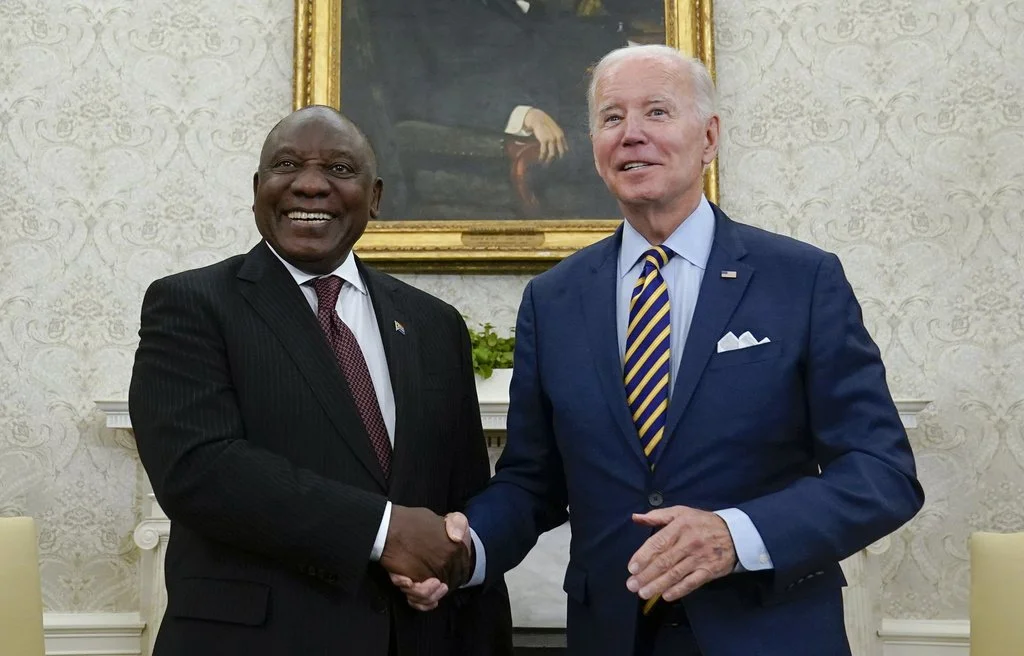
US President Joe Biden shakes hands with South African President Cyril Ramaphosa as they meet in the Oval Office of the White House, Friday, Sept. 16, 2022, in Washington. A bipartisan group of U.S. lawmakers wants the Biden Administration to punish South Africa for what they call its support for Russia’s illegal invasion of Ukraine by relocating this year’s AGOA America-Africa trade meeting to another country.(AP Photo/Alex Brandon/File)
On Monday November 2, Jamieson Greer announced that the US intends to end its duty free trade relationship with South Africa and Rwanda starting January 1st 2027. The move would hit exports including South African auto parts and wine.
AGOA was first enacted in 2000 and was reauthorized for another 10 years in 2015. The program has had broad bipartisan support and has been a centerpiece of US economic engagement with sub-Saharan Africa. In January, the House voted 340 to 54 to renew it, and Republican Congressman Jason Smith, who introduced the extension, called AGOA a key part of US economic relations with Africa. It has also been framed as a strategic tool, with the US Chamber of Commerce arguing that renewing AGOA would help diversify supply chains away from China, and Foreign Policy reported that the program’s 2025 lapse could affect more than a million jobs across the continent. Since its inception, Total goods traded with Sub-Saharan Africa under the AGOA program has more than doubled from $24 billion in 2002 to $49.9 billion in 2022, with the most amount of growth in agricultural and textile manufacturing, followed by minerals exports. The program was designed to help sub-Saharan African (SSA) nations grow and diversify their economies by providing duty-free access to the US market for thousands of products. AGOA shifted US-Africa relations away from a heavy reliance on traditional aid and emergency relief toward trade-driven economic development.
The suspension comes two months after Congress renewed the program. AGOA lapsed in September 2025 after lawmakers failed to agree on a renewal, and Trump signed a one-year extension in February 2026. In September, he signed a law extending it through December 2028. To remain eligible, countries must show progress toward a market-based economy, the rule of law, political pluralism and due process.
In his statement, Greer said the two governments are “engaging in practices that are inconsistent with AGOA’s eligibility criteria.” For South Africa, the administration cited trade barriers, corruption, and what it described as threats to US national security and foreign policy interests. Greer did not cite specific examples of these concerns. However, recently, South Africa and the US have had some tensions, with Washington objecting to South Africa’s genocide case against Israel at the International Court of Justice, among other disagreements.
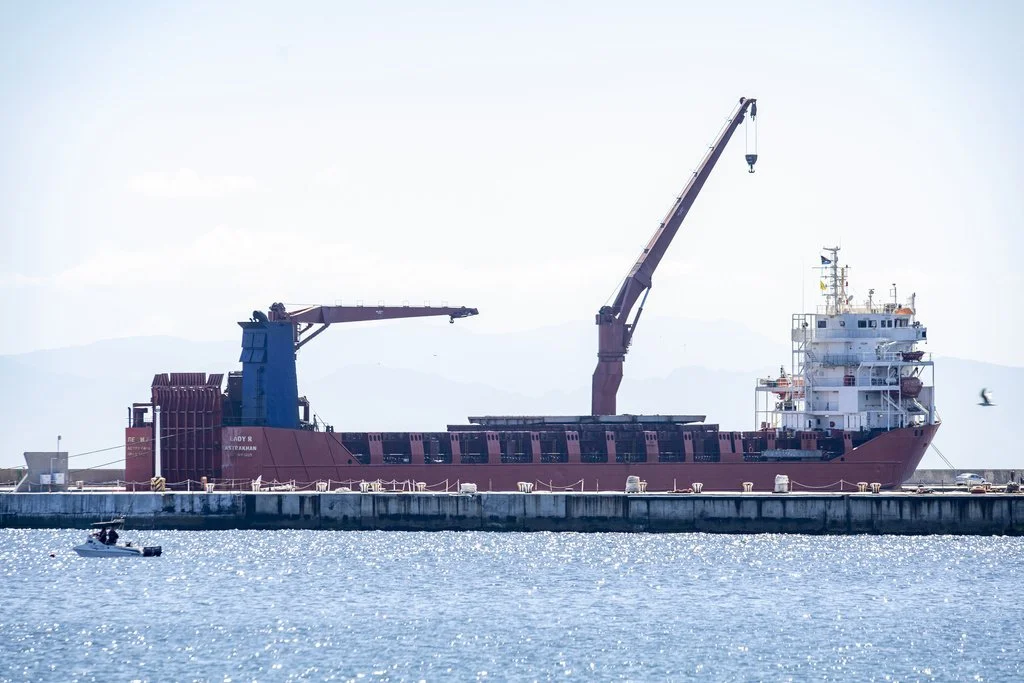
Russian vessel, Lady R, is docked at the Simon's Town Naval Base near Cape Town, South Africa, Thursday, Dec. 8, 2022. A bipartisan group of U.S. lawmakers wants the Biden Administration to punish South Africa for what they call its support for Russia's illegal invasion of Ukraine by relocating this year's AGOA America-Africa trade meeting to another country. (AP Photo, File)
South Africa has been AGOA’s largest beneficiary; it exported around $1.7 billion in goods to the US under the program in 2025. South Africa’s trade ministry said AGOA exports make up only about 10% of its total exports to the US and 1% of its global exports. South Africa’s trade minister, Parks Tau, said the country has 60 days to address US concerns, and that the government recognizes that the decision may create uncertainty for workers and exporters. South Africa’s President Cyril Ramaphosa has said they should prepare by seeking new markets and trade deals, including with China.
Rwanda’s suspension follows months of US pressure over its alleged support for the M23 rebel group in the Democratic Republic of Congo. Rwanda’s apparel exports have already been excluded from AGOA since 2018 over import tariffs the US considers a trade barrier. Rwanda exported about $42 million to $43 million in goods to the US in 2025, with critical minerals the largest share, followed by coffee at about 16% and tea at roughly 10%. Rwanda did not immediately respond to the decision.
Both suspensions are set to take effect on Jan. 1, 2027. In a statement, South Africa’s trade ministry said that AGOA remains important but “does not constitute the totality of the economic relationship” with the US.
Overall, analysts say that South Africa faces potential losses in agriculture, automotive exports and related jobs, while the impact on Rwanda is likely to be less severe given its limited reliance on AGOA. Other experts warn that the higher cost may be more of a strategic one. The US Chamber of Commerce argued last year that renewing AGOA would help diversify supply chains away from China, and Carlos Lopes, a professor at the University of Cape Town, said the program’s uncertainty “creates fertile ground” for Beijing to expand its reach in Africa. Trade economist Eckart Naumann noted earlier this year that Washington felt real urgency to secure a critical minerals deal with countries including South Africa. Rwanda’s minerals and South Africa’s trade are now set to lose AGOA eligibility, and South Africa is already seeking new partners such as China. These suspensions test how Washington balances political pressure against its push for African minerals.