
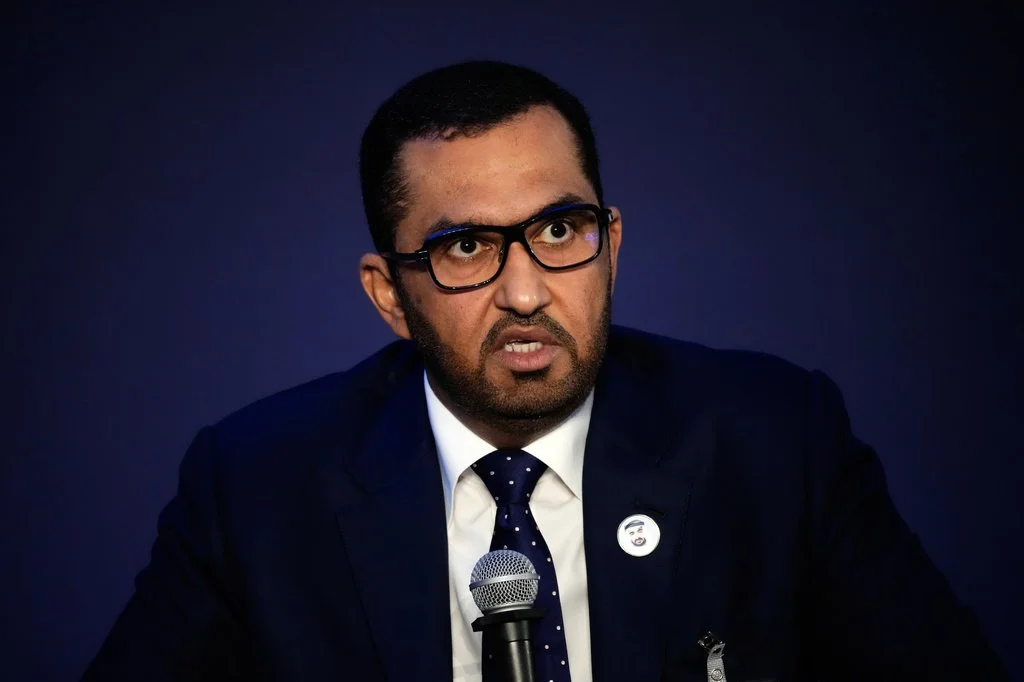
ADNOC Group CEO Sultan A. Al Jaber speaks at the headquarters of the Organisation for Economic Co-operation and Development in Paris on Oct. 1, 2026. (AP Photo/Teresa Suarez)
Abu Dhabi National Oil Company (ADNOC) announced a long-term partnership with OpenAI and Emirati tech firm G42 on Nov. 2 to boost its use of AI. The deal will see ADNOC become the first energy firm to deploy OpenAI’s Frontier platform, which enables coordination of AI agents.
The deal comes as OpenAI CEO Sam Altman visited the UAE and met Abu Dhabi Crown Prince Sheikh Khaled bin Mohamed bin Zayed Al Nahyan. According to Reuters, Altman said OpenAI’s advanced models would help address ADNOC’s most difficult and valuable problems. He also identified energy and physical infrastructure as constraints on AI’s expansion.
ADNOC noted that the partnership will begin by deploying AI to optimize oil field development and pre-extraction oil valuation. This will be achieved by bringing together data on reservoirs, wells, facilities, and costs to optimize oil field development planning to take place in hours instead of months.
The second area will be using AI agents to predict oil supply, demand, pricing, and margins. This will enable informed decisions to be made on production, processing, refining, logistics, and sales. Human experts will retain oversight of decisions with major implications, while the AI systems will run on “computing infrastructure based in the UAE”.
This follows ADNOC’s previous investment in AI. In March 2025, energy tech firm AIQ announced a $340 million deal with ADNOC to deploy its ENERGYai solution and supporting systems across upstream operations.
ENERGYai has been developed using 70 years of data and industrial expertise from ADNOC. The system will be used to analyse seismic data, create geological models, and monitor operations. It will also allow engineers to utilize natural language to query company data.
The partnership signed on Nov. 2 is part of four agreements between OpenAI and Abu Dhabi entities covering energy, government, investment, and wider AI adoption.
Within the government sector, Abu Dhabi and OpenAI have launched an initiative to translate a defined set of policies and regulations into a format that can be understood by AI. This will allow government officials to perform standard compliance checks such as permits and certificates. Decisions will still be made by the government.

Open AI CEO Sam Altman speaks at the company’s DevDay conference in San Francisco on Sept. 29, 2026 (AP Photo/Jeff Chiu)
Within investment, Mubadala, Inception42 and OpenAI have committed to using AI to inform investment decisions. A separate five-year agreement between Inception42 and OpenAI aims to expand AI adoption across government, businesses and education.
Overall, the deals demonstrate the breadth of sectors that Abu Dhabi is looking to utilize AI within.
G42 has had a number of partnerships with American tech firms over recent years. In April 2024, “Microsoft announced a $1.5 billion investment in the firm.”
As part of the deal, Brad Smith, Vice Chair and President of Microsoft, will have a seat on G42’s board. G42 will also utilize Microsoft’s Azure platform to host its AI apps and services. The two companies will work together to provide technology to governments and large businesses.
They plan to expand beyond the UAE, with the partnership including plans to expand into the Middle East, Central Asia, and Africa. Microsoft noted that the partnership includes security commitments with both the American and Emirati governments.
OpenAI has also moved closer to the UAE with its infrastructure. In May 2025, the company launched Stargate UAE. This is a planned one-gigawatt computing cluster in Abu Dhabi, working with G42, Oracle, Nvidia, Cisco, and SoftBank.
When announcing the project in May 2025, OpenAI said it expected the first 200 megawatts of capacity to come online in 2026.
This is the first international rollout of OpenAI’s Stargate infrastructure initiative. It is also the first OpenAI for Countries deal. It has been developed in conjunction with the U.S. Government. This investment in infrastructure has been announced to expand the use of AI within sectors such as energy, healthcare, education, and transport.
There is increasing demand for electricity within these projects. In its 2026 report, the International Energy Agency projected that global data center electricity demand would roughly double from 485 terawatt-hours in 2025 to 950 terawatt-hours in 2030.
While AI systems have become more efficient at performing specific tasks, new applications such as complex reasoning and AI agents can use significantly more energy than basic text generation.
However, tech firms require more energy infrastructure to grow their offerings. The latest deal in Abu Dhabi brings these together as part of a wider initiative to work with Emirati institutions and American technology providers.