
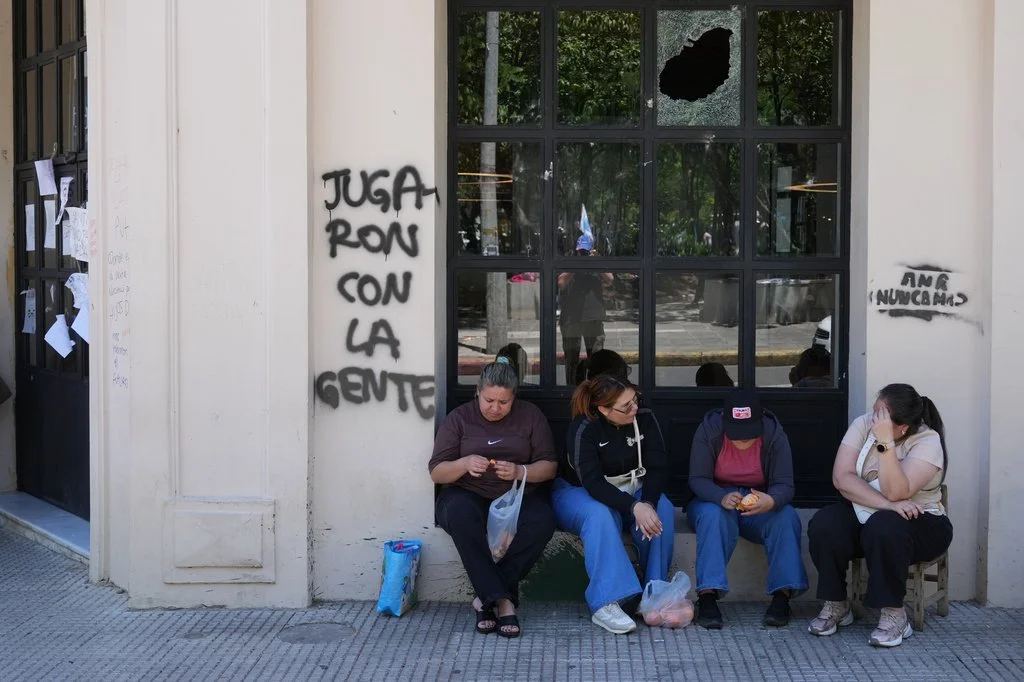
Women sit outside a closed Ueno Bank's office, which Paraguay’s central bank seized amid a solvency crisis, in Asuncion, Paraguay, Monday, Nov. 9 , 2026. (AP Photo/Jorge Saenz)
International capital is an important resource for emerging economies seeking to build infrastructure and support development, but its practical value ultimately depends on the domestic institutions that hold and deploy it. If these institutions fail, financial and economic implications ultimately impact the entire nation, especially when development and infrastructure are directly impacted. Paraguay’s Ueno Bank crisis demonstrates this vulnerability, where financial resilience is not merely a question of the domestic bank surviving, but whether the government can continue delivering development when a financial intermediary fails.
The rise of Ueno Bank initially signaled a significant breakthrough for financial technology and digital inclusion in Paraguay. It exponentially expanded its customer base since its launch in 2023, with a significant portion of growth being charged by state money, as public sector deposits jumped from $80.2 million in 2023 to $834.8 million in September 2026. This growth signaled an acceleration in the digitization of Paraguay’s economy, with expanding access to financial services. Following its June 2024 merger with Visión Banco, its customer base and operations significantly broadened while simultaneously attracting new users through its digital services. By June 2026, Ueno reported 2.94 million customers and a 28% share of transactions through Paraguay’s SPI instant-payment system.
Ueno’s role in the economy extended beyond retail banking. According to Reuters, the bank held approximately $850 million in public funds as of June 2026, including substantial pension and health-fund investments. This combination of consumer reach, payment activity, and public-sector exposure signaled Ueno’s growing role in Paraguay’s financial system, becoming a shared intermediary for households and state institutions. However, this growing reach also increased the consequences of its failure. With a growing integration of the bank into public obligations, its failures became harder to contain within the relationship between the bank and its individual depositors. The vulnerabilities of its deeply established role in Paraguay’s economy was brought to light by the Central Bank intervention in November 2026.
On Nov. 3 2026, Ueno Bank was seized by Paraguay’s Central Bank following the collapse of the bank’s solvency ratio to below half the legal minimum. This decision involved the closure of all physical branches and the freezing of all digital transactions, transfers, and cash withdrawals. This move locked out nearly three million customers, roughly 60% of the country’s adult population, from their accounts. Ueno’s public-sector deposits as of September, included around $380 million invested by the Instituto de Previsión Social, Paraguay's state pension and health fund, which were frozen as well. The effects of the freeze thus extended beyond private savings, exposing resources allocated for healthcare and pensions to the failure of a single private bank.
Ueno’s reach, however, was not simply limited to its customers. Its institutional reach extended into the financing of Paraguay’s public infrastructure. Paraguay’s state-owned electricity utility, Administración Nacional de Electricidad (ANDE), was unable to access approximately $21 million in loans from Taiwan and the Inter-American Development Bank (IDB) intended for public works. Payments associated with foreign suppliers were also affected, with an additional $46.9 million in irrevocable letters of credit tied up. These funds were connected to a broader $260 million IDB financing program alongside a $30 million contribution from Taiwan, intended to expand Paraguay’s high-voltage electricity transmission infrastructure. This exposure connected the bank’s failure to an international financing structure whose purpose extended beyond banking services to infrastructure delivery.
These exposures demonstrate the extent to which public infrastructure financing had become dependent on the stability of a private financial intermediary. These implications demonstrate how digital banking risks can spill into the public sector and threaten national development. The state’s dependency on the institution makes the consequences of failure difficult to contain within the bank itself. The funds frozen at Ueno were part of an international financing structure, intended to support public infrastructure. However, this exposed the vulnerability of public development projects to fundamental weaknesses, as access to these funds depends on the institutional reliability of the domestic banking system. ANDE’s report of approximately $21 million in internationally financed funds trapped at Ueno illustrates a gap between financial commitment and ability to deploy it. This distinction is important as development depends on implementation, not simply financing.
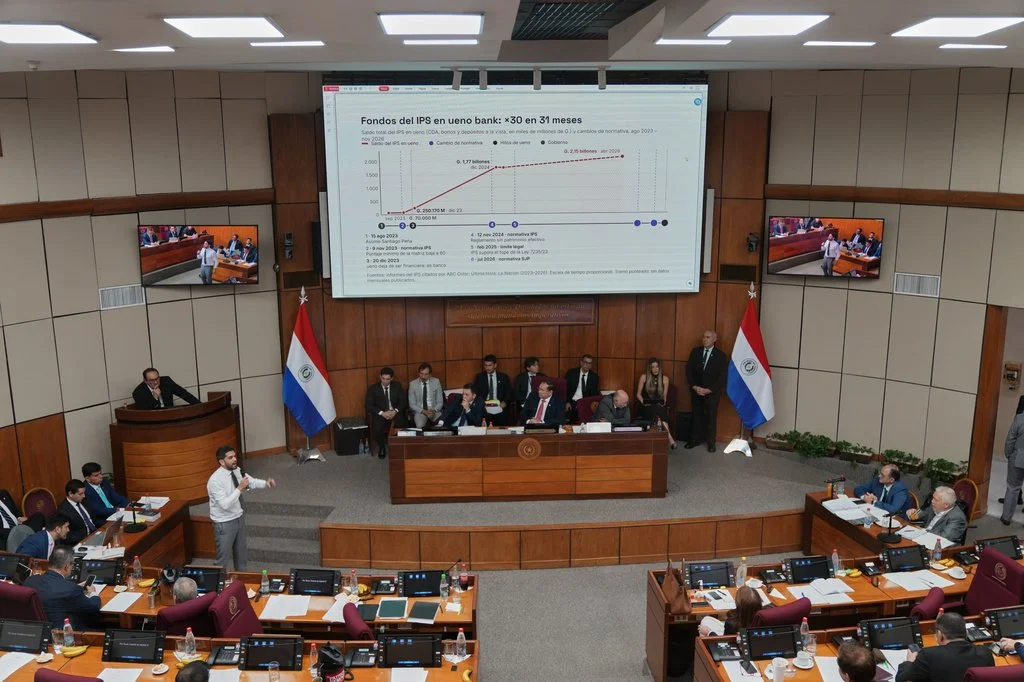
Senators debate the impeachment of President Santiago Pena over accusations linked to the collapse of Ueno Bank at the Senate in Asuncion, Paraguay, Friday, Nov. 6, 2026. (AP Photo/Jorge Saenz)
This is how Ueno’s collapse exposed a structural vulnerability in how emerging economies finance and execute development. While international loans and grants provide the necessary capital to build infrastructure, the capital must pass through domestic financial institutions before it can be deployed. When governments rely on private financial platforms to hold public resources and deliver development financing, the platform’s resilience extends beyond commercial concern and becomes a public responsibility.
The 2023 collapse of Silicon Valley Bank demonstrates how the failure of a financial intermediary disrupts services beyond its direct consumers. According to the US Government Accountability Office, several payroll companies used SVB to process paychecks. Thus, businesses that did not themselves bank with SVB experienced payroll delays, while other companies struggled to pay employees as their deposits were inaccessible. The significance of this incident was how a bank failure directly affected the people whose routine economic activities were dependent on it. This is yet another demonstration of why financial resilience is a public responsibility, as consequences of failure extend beyond the contractual relationship between a bank and its depositors. Regulators need to assess not only an institution’s financial condition, but also the essential functions that would be disrupted by its failure.
For Paraguay, this responsibility also extends into the implementation of international development partnerships. International financing and domestic institutional reliability are not separate conditions for development, but the latter determines when the former can be put to use. This distinction shifts the attention from securing capital to ensuring it can be deployed when required. ANDE’s subsequent discussions with the IDB about continuing the disbursements for electricity infrastructure demonstrate the importance of that continuity. The development implication for Paraguay is concrete: access to international financing does not remove the need for reliable domestic financial institutions. When the dependency on a domestic institution is concentrated on a single private bank, its failure can constrain the government’s ability to act despite the securement of the capital, directly affecting domestic development. The bank’s resilience is relevant not only to depositors but also to the public commitments financed through it. The exposure raises a policy question of whose responsibility it is to ensure that development financing remains accessible when a participating institution enters the equation. This question concerns the recipient governments and development partners, as while a financing agreement establishes commitments, the public agencies still need reliable arrangements for holding and deploying the resources.
ANDE’s exposure reveals the gap between securing development financing and retaining access to it. Upon identifying this vulnerability, the policy response should focus on continuity. ANDE and its leaders could agree to a backup plan in advance, through which future disbursements and supplier payments can be routed in case of disruptions with the primary intermediary. The purpose of such an arrangement would not be to recover the funds trapped in a failed bank but to prevent the failure of one institution from blocking subsequent financing and payments, especially in the case of public obligation. Potential backup mechanisms would need to comply with lenders’ and legal requirements; however, establishing them before a crisis would allow for alternatives to negotiate new arrangements under pressure. Treating resilience as a public responsibility does not mean guaranteeing the survival of every domestic bank, but rather ensuring that public obligations and development do not become unnecessarily dependent on the continued operation of a singular institution.
A significant part of Paraguay’s development strategy relies in part on its relationships with international financial institutions and foreign partners willing to finance long-term infrastructure and development projects. The consequences of the Ueno Bank crisis are already extending into the international assessments of Paraguay’s economic position. Fitch Ratings placed the country’s BB+ sovereign credit rating on negative watch on November 11, following the resulting political unrest from the crisis. Its significance is that the risks associated with Ueno are no longer being assessed solely at the level of an individual bank, but as a reflection of the state’s overall financial position. This warning could lead to investors demanding higher returns on Paraguayan government debt as compensation for the perceived increase in the risk of lending to Paraguay, increasing borrowing costs and leaving less fiscal room for infrastructure and other developmental priorities. The negative watch itself is not a downgrade, but the heightened uncertainty could also make private investors more cautious about committing capital to the country.
Customer recovery is also important. By November 12, EFE reported that all Ueno customers eligible for the state guarantee had received an advance repayment. While this progress should be acknowledged, it reinforces the distinction between recovery and continuity, as restoring partial access after failure does not remove the need to prepare for interruption in advance.
Emerging markets increasingly view digital finance as a tool for economic modernization; however, this does not change the fact that institutional reliability is the foundation. As private financial platforms are increasingly integrated into public infrastructure and international development financing, the resilience of these platforms becomes a question of national economic security. Paraguay’s lesson is not to retreat from innovation or external financing, but to ensure that modernization strengthens the state’s capacity to deliver development rather than having the entire capacity dependent on a singular institution without an alternative.