

Spain's Prime Minister and Socialist candidate Pedro Sanchez applauds during an electoral rally in Alcorcon, outside of Madrid, Spain, Sunday, Nov. 15, 2026. (AP Photo/Manu Fernandez)
Spanish Prime Minister Pedro Sanchez called for snap elections on Nov. 29 ahead of the elections that were planned for next year, following a succession of crises that have hit Spain. Sanchez called for the elections after the far right and conservative parties voted against measures that would have helped alleviate the growing housing crisis. Sanchez’s goal in calling for the election is to win more seats and get a stronger mandate in order to pass housing legislation. It is the country's sixth general election in 11 years.
The two main parties are Sanchez’s party, the Spanish Socialist Workers’ Party (PSOE), and the People’s Party (PP), the main opposition party. There are also a number of small parties which play important roles in coalition building. Most notably, the Vox party, which does not represent a credible threat on its own, may join the PP to form a more far right coalition. To succeed in these elections a coalition of parties will need to secure 176 seats in parliament. It is important to note that in the 2023 General Elections, the PSOE received fewer votes than the PP, but was able to organize a winning coalition and thus gain power.
PP is currently favored in polls from Nov 8 with 29.8%, which would be roughly 126 seats next to PSOE’s 25.9%, or 106, seats. Regional elections in the past year, which are particularly indicative in Spain’s federation with autonomous regions and separatist parties, point towards a shift to the right. If PP is able to form a right-wing coalition it would buck a global trend towards leftist politicians this year as seen in the Brazilian Presidential election, US Midterms, and in the Israeli Elections.
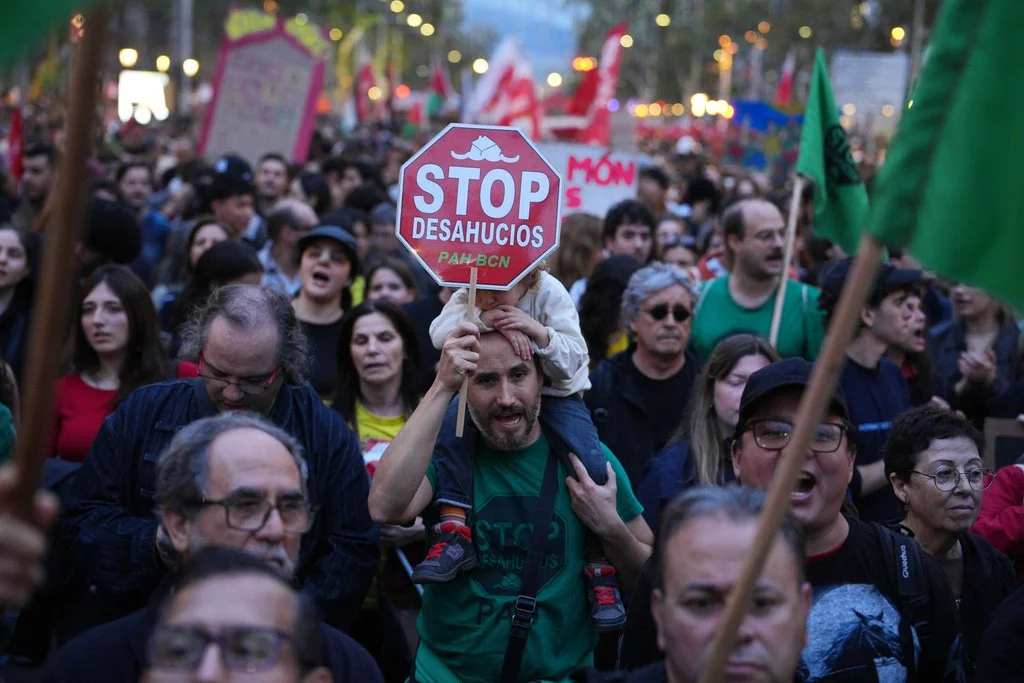
A protester carrying a child holds a sign with the words "Stop evictions" during a nationwide general strike in Barcelona, Spain, Wednesday, Nov. 11, 2026. (AP Photo/Emilio Morenatti)
The main reason for the snap elections is the ongoing cost of living and housing crisis. Protests sprang up across Spain following the eviction of 87 year old Maricarmen Abascal from her home of more than 70 years after an exorbitant rent increase. This prompted the first general workers strike in 14 years in Spain, which took place on Nov. 11, bringing out more than 3 million people. Although, more recently on Nov. 12, the parliament adopted measures to restrict evictions and increase affordable housing. Right wing parties have promised to overturn these measures if they win the elections at the end of November.
Coupled with the cost of living crisis is a migration surge in Ceuta, a Spanish territory off of Morocco where over the summer tens of thousands of migrants crossed the border causing at least 141 deaths. Additionally, On Nov. 16, nearly 2,200 migrants reached the Canary Islands. This has particularly incited the far right party Vox, who has proposed “remigration” and deporting 8 million people of foreign origin.
There is also distrust among Spanish people of the Sanchez administration, which has been in power since 2018. Members of the socialist party and Sanchez’s inner circle have been accused of corruption. In June, José Luis Ábalos, who was a top official in Sanchez’s socialist party, was sentenced to 24 years in prison for bribery and corruption. Sanchez’s wife has been accused of corruption, and his brother was banned from holding public office on the accusation that he received a patronage job. Additionally, there were two deadly train crashes this year, causing the death of a total of 115 people. There is a broad sentiment that this government is not providing what people need. Maria Torrena Perez, a 40-year-old primary school teacher was quoted in Reuters saying “We need decent housing. We need a quality public education system. We need a decent healthcare system. Ultimately, they're not investing in what they should be investing in."