
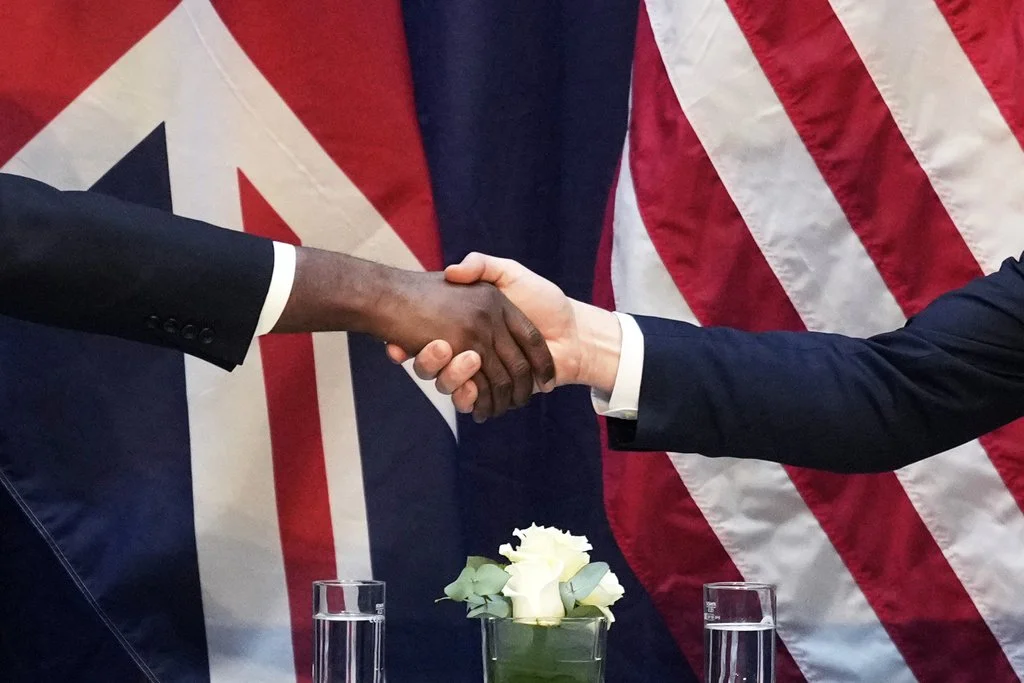
United States Vice-President JD Vance and Britain's Foreign Secretary David Lammy shake hands during a bilateral meeting on the sidelines of the Munich Security Conference in Munich, Germany, in February 2025. (AP Photo/Matthias Schrader)
In the English seaside town of Bournemouth, across the road from an abortion clinic, on a patch of grass beside a footbridge to the town centre, Livia Tossici-Bolt, a retired medical scientist in her sixties, held up a sign: “Here to talk, if you want.” An officer asked her to leave the area—but Tossici-Bolt refused. The officer asked her again. Tossici-Bolt remained. The next day, the scene repeated itself. In June 2023, she received two £100 fixed-penalty notices, one for each day she had refused to leave the buffer zone. Tossici-Bolt refused to pay them and challenged the order in the High Court, arguing that it violated her rights as a Christian. She lost the challenge, and the matter proceeded as a criminal case.
In March 2025, while Tossici-Bolt was awaiting the verdict, Samuel Samson took an interest in her case. Samson, a 28-year-old senior State Department official (and former director of strategic partnerships at the conservative organization American Moment) met with her during a visit to the UK. In this case, Samson became the visible link between the American administration and the activist, and the State Department announced that it was “monitoring” the case.
What’s unsettling is not only that this exposes an ambition to make the alliance between US and Europe conditional on a particular Christian-conservative vision. It is also that, under the Trump administration, the boundary between diplomacy and political advocacy has been blurred. Through transnational networks, highly mobilized ideological forces are gaining access to institutions that anchor Europe’s liberal democracies.
Tossici-Bolt’s case would prove to be one of several involving European conservative activists that the Trump administration, drawing on cases promoted by American legal and advocacy organizations with ties to the White House, has used as symbolic evidence of Christian persecution in Europe.
Vice President JD Vance had already cast the conviction of Adam Smith-Connor, who was found guilty after silently praying inside an abortion-clinic buffer zone, as evidence that “the backslide away from conscience rights has placed the basic liberties of religious Britons, in particular, in the crosshairs.” In an article published on the U.S. State Department’s Substack, Samson placed Tossici-Bolt’s case within what he called “an aggressive campaign against Western civilization itself.”
It is this self-appointed mission—to “save” Europe—that has made Samuel Samson one of the Trump administration’s most active envoys to Europe. The New York Times mapped his European activities in 2025 and early 2026: in Britain, he met anti-abortion activists and leader of Reform UK Nigel Farage; in France, he questioned officials about Marine Le Pen’s criminal conviction and met representatives of the National Rally; in Germany, he met AfD lawmakers; and, in Hungary, he engaged with Viktor Orbán’s political orbit. Samson has described these encounters as an effort to work with “like-minded allies.”
But like many of the Trump administration’s Christian missionaries, Samson is not merely a doer; he is also a thinker. In December 2025, at the Institute for International Affairs in Budapest, Samson articulated his political philosophy during a panel titled “The Western Commitment to Natural Rights: The Key to Transatlantic Renewal.” America and Europe, he said, “are not merely political partners,” but “partners in civilization.” He described Western civilization as grounded in Christianity, natural law and a conception of human rights rooted “in nature and in God.” He presented the United States as “one of the crowning jewels of this tradition.”
ADF UK, the British operation of Alliance Defending Freedom, a US-based Christian legal and advocacy organization, has supported the cases of several anti-abortion activists. When Samuel Samson met with Livia Tossici-Bolt, he was part of a State Department delegation that also met representatives of ADF UK. With nearly $120 million in annual revenue, ADF is a major Christian legal and advocacy organization, not a small activist group. The organization’s filings show that ADF UK received more than £4 million from its American parent between 2018 and 2025.
ADF now has a formal channel into the Trump administration. ADF president Kristen Waggoner sits on the Religious Liberty Commission’s Advisory Board of Legal Experts, while Ryan Tucker, another senior ADF lawyer, sits on its Advisory Board of Lay Leaders. The commission itself includes Kelly Shackelford, president of First Liberty Institute, another major Christian legal organization. The White House Faith Office was created in 2025 to give faith-based organizations a place in the administration’s policymaking. While there is no public evidence that American taxpayers funded any of Tossici-Bolt’s defense, American officials intervened to give the campaign diplomatic legitimacy.
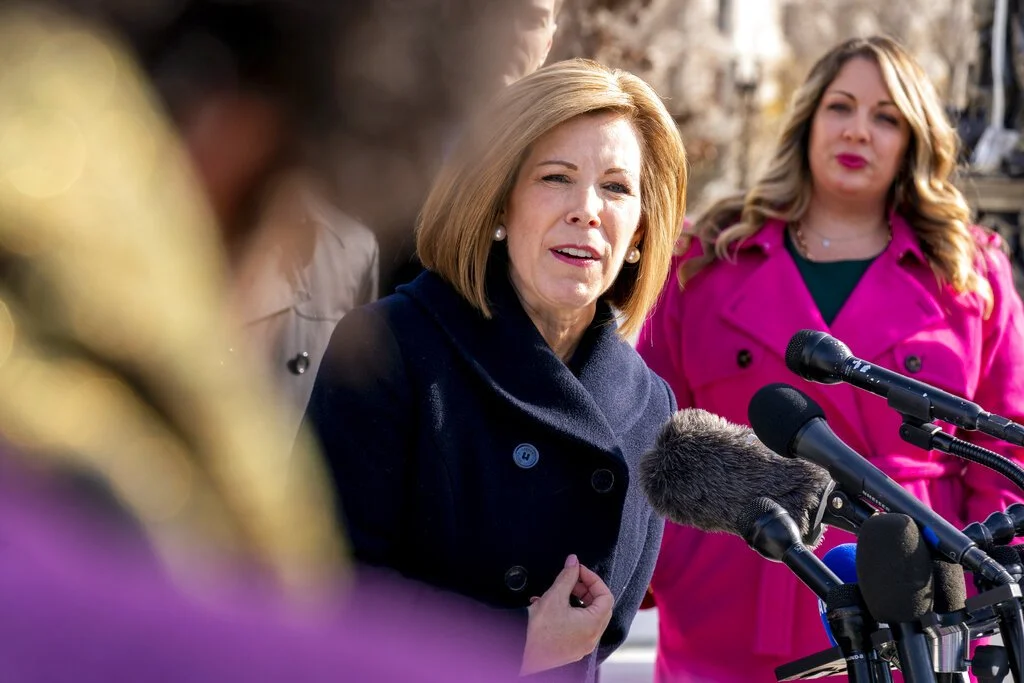
Lawyer Kristen Waggoner, president of the Alliance Defending Freedom (ADF). (AP Photo/Andrew Harnik)
Speaking to BBC Radio 4’s Today programme after her conviction, Tossici-Bolt said she had not been standing outside the abortion clinic to express her views, but to offer conversation. Later in the interview, she described freedom of expression in Britain as being “in a state of crisis” and said that her case had “serious implications for the entire Western world.” By the time her case reached the Trump administration, her anti-abortion activism had been translated into free-speech advocacy and, ultimately, into a story about the defense of Western civilization.
The language of universal rights through which this Christian civilizational project presents itself is striking. Over the past two years of reporting on American Christian organizations and their expanding activities in Europe, there has been an observed pattern: organizations like ADF repeatedly take on cases that allow Christian-conservative claims to be recast as questions of free speech, religious liberty and parental rights.
In the UK, ADF turned prosecutions of several anti-abortion activists, including Livia Tossici-Bolt, into evidence of a free-speech crisis. In Sweden, ADF framed the removal of the Samson family’s daughters by child-protection authorities as religious discrimination. The American Home School Legal Defense Association (HSLDA), a Christian homeschooling organization, used a similar frame in Finland, presenting the Karf family’s dispute over child-welfare oversight as an assault on parental rights. HSLDA and ADF International have supported several European homeschooling cases before the European Court of Human Rights. The connection is also personal: Michael Farris, HSLDA’s founder and longtime board chairman, served as ADF’s president and CEO from 2017 to 2022.
It is clear why this model is effective: case by case, an aligned ideological campaign presents itself as a series of isolated disputes. Against this backdrop, the Trump administration’s moral map of Europe takes shape. Western Europe: liberal, censorious and hostile to Christian values. National-conservative governments and movements: “like-minded,” “civilizational” allies.
At the Munich Security Conference in February 2025, JD Vance presented Europe’s security problem as an internal ideological struggle. The threat he said he worried about most was not Russia or China, but “the threat from within”: Europe’s retreat from values supposedly shared with the United States. He pointed to Sweden, where he said a Christian activist had been convicted after participating in Quran burnings; Britain, and its abortion-clinic buffer zones; and Scotland, where he claimed residents whose homes lay inside “safe access zones” had been warned that even private prayer at home could breach the law (the letter sent out to residents in safe zones, however, never mentioned prayer.) Vance did not simply ask what Europe needed to defend itself from. He asked what, exactly, Europe was defending itself for—and who would be allowed to belong to the “shared society” that the alliance was meant to protect.
Some months later, at the NATO summit in The Hague in June 2025, Trump celebrated the allies’ new defence-spending commitment as “a big win for Europe and, actually, for Western civilization.” The US is formally committed to defending Europe. But once the alliance is described in civilizational terms, the question is no longer only what Europe is defending itself from, or what it is defending itself for—but also, which Europe counts?