

Protesters opposing data centers march carrying signs during a protest in Dublin city centre, Ireland, Saturday, Nov. 7, 2026. (AP Photo/Peter Morrison)
Protesters in Amsterdam stormed the construction site of a Microsoft data center on November 6 in an attempt to stop the project from moving forward. Dutch police said they had arrested 150 to 200 people that evening, as anger swelled over the increasing investment from governments into AI and the buildings that power them.
These protests were part of a larger continent wide movement, “Stop Dirty Data Centers,” in which more than 100 groups across 15 European countries joined to call for a moratorium on these large projects. Crowds ranged from a few dozen gathering in front of the Polish parliament to a few hundred marching through cities like Dublin and Milan.
As AI becomes ever more important in today’s world, and the geopolitical race to be competitive in the field heats up, Europe is seeing an increasing number of these large warehouses full of computer equipment take root in the continent. But many are not happy with this. At the heart of concerns from the protesters sits the environmental and social costs that these data centers bring, as well as the AI that they power. So where does the EU stand on the matter?
On one side of this policy problem, there are European governments eager to invest in the field and build up AI infrastructure to attract foreign investment from U.S. tech giants. But on the other side, citizens are having to deal with the costs that data centers bring on.
Last year, European Commission President Ursula von der Leyen published the EU’s AI Continent Action Plan, a policy strategy that aims to triple the amount of data centers in the bloc over the next five to seven years. Europe currently hosts around 3,400 data centers across 45 different countries in and out of the EU, 45% of them concentrated in the FLAP-D areas (Frankfurt, London, Amsterdam, Paris and Dublin).
The intention is clear. The EU as a whole wants to be able to compete in AI, but nationally speaking, the degree of investment into the area varies. In September, two-thirds of EU governments pledged money to back a plan to create seven large AI computing hubs. These 18 countries raised 3 billion euros in total.
However, nine countries refrained from contributing. The Dutch government, for example, is constrained by their budget to be able to make room for AI. And other governments would rather focus on smaller AI-driven projects than the prospect of big and expensive warehouses.
Overall, even if the degree of investment varies, most, if not all, EU countries have pledged some amount of money towards AI, data centers, and various AI-driven initiatives in whatever regional or domestic forms they may take. And thus, anger showed out against this.
So, what is the EU doing in response to the demands from protesters? Different national governments have had varying approaches to the question.
In the Netherlands, the government imposed a one-year moratorium on their construction in 2019, and has barred new data centers or expansions in Amsterdam from 2025 to 2030. Denmark has new legislation that puts them lower on the priority list for electricity grid connection in response to power grid strains. And Portugal’s Environment and Energy Minister, Maria da Graca Carvalho, said the country is preparing rules for data centers to be powered by renewable energy, and to use cooling systems that do not compete with household and business water supplies.
But EU-wide policies to regulate data centers are harder to find. The bloc has created new laws and rules to improve the transparency of the energy use of these data centers, in an attempt to curb their energy and water use. However, compliance remains incomplete.
AI data centers are the fastest growing consumers of electricity. If they were a country, their level of energy use would make them the 11th largest electricity consumer in the world. These are big structures that have servers, routers and internet connected devices running 24/7, while cooling systems operate continuously to keep it all from overheating.
The EU’s official stance is that they want more data centers, but they want them to be clean and sustainable. They hope that the transparency on energy and water use, in the form of a rating scheme, would promote the use of renewables and low carbon emission energy. But opponents say simple transparency is not enough to stop the projects from polluting and hurting local communities if there is no hard regulation.
Data centers can have serious strains on the energy grids of the cities they inhabit. In Frankfurt, 41% of the city’s electricity consumption comes from AI data centers. According to the International Energy Agency, electricity consumption of data centers is expected to double by 2030 to 945 terawatt-hours, around what Japan consumes annually.
It is a hard problem to solve. Many on the left back an EU-wide moratorium on large-scale builds due to the environmental reasons many protesters brought up, while those on the right strongly oppose it, arguing that it will hurt the EU’s chance to keep up with the global race in AI.
An investigation published earlier this year by The Guardian and Investigate Europe, an independent journalism cooperative, found that U.S. tech firms had successfully lobbied the EU to hide the environmental toll of data centers. They convinced the European Commission to add a secrecy provision to the EU’s Energy Efficiency Directive, a law governing data center sustainability reporting. This meant certain green metrics were hidden from public view, leaving researchers with only national-level summaries of energy footprint.
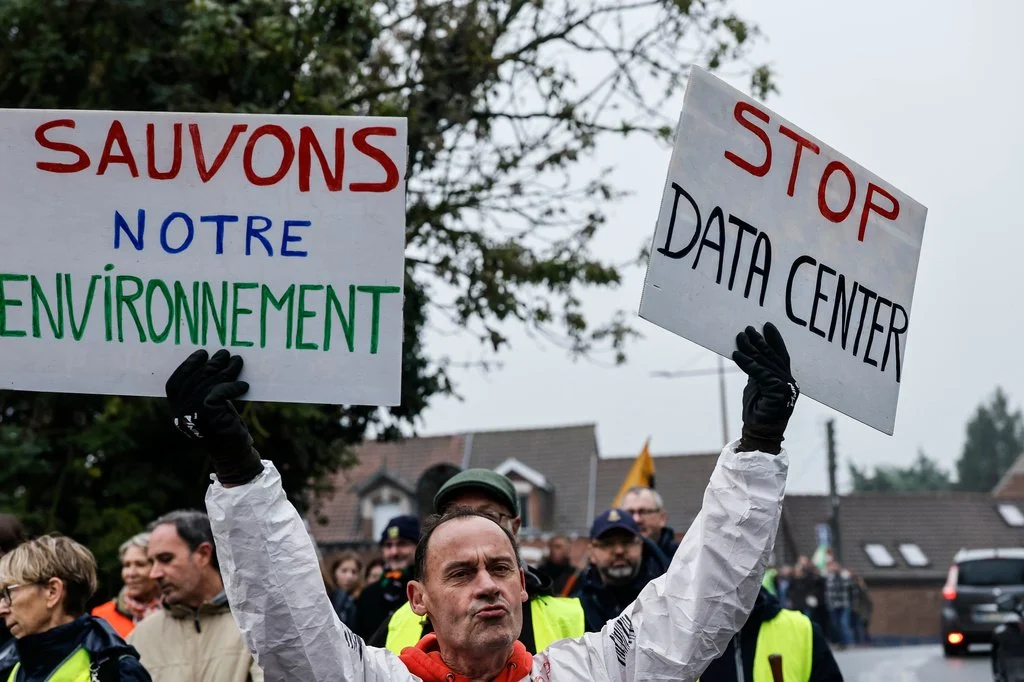
Protester hold a sign reading, "Save our environment" as they march to call for freeze on energy hungry data centers, in Corbehem, France, Saturday, Nov. 7, 2026. (AP Photo/Jean-Francois Badias)
Aragon is a sparsely populated and autonomous community in the northeast of Spain. Its often flat landscape, abundant renewable energy, and land, as well as its agile local permit laws has made it a hub in data center installations. Amazon operates three presently, and Microsoft plans to build three more, as, over the next decade, the region is said to see more than €60 billion of investment in data centers and digital infrastructure. During the continent wide protests, 2,000 people marched through the streets of its capital city, Zaragoza, over the environmental costs these projects are bringing to a region already regularly affected by drought.
Local communities that live alongside data centers are often the ones bearing the costs. Behind the 2.5 billion questions ChatGPT receives a day, there is a real physical toll and footprint to using AI models.
The regional government of Aragon is welcoming tech companies with hopes that the data centers they would host will bring jobs and economic prosperity to the region. But, Amazon’s current data centers, smaller than the ones planned for the future, used 68 million liters of water in 2025, 48% more than what the company had originally told officials.
Additionally, cities might get hotter with data centers around. According to one study, a single large data center can increase land surface temperature by nine degrees Celsius and air temperature by two degrees Celsius.
While protesters took to the streets across Europe to demand regulations on data centers, the EU lags behind in responding to them. European governments have a tight rope to walk between wanting to attract their construction in hopes of competing in AI, and making sure local communities and the environment do not suffer for the economic opportunities they bring.
The European Commission is currently preparing a legislative proposal for 2027 on minimum performance standards for data centers, that would take a first big step in regulating the buildings that are driving AI’s prevalence. But, it remains to be seen whether more legislation will follow after that.