
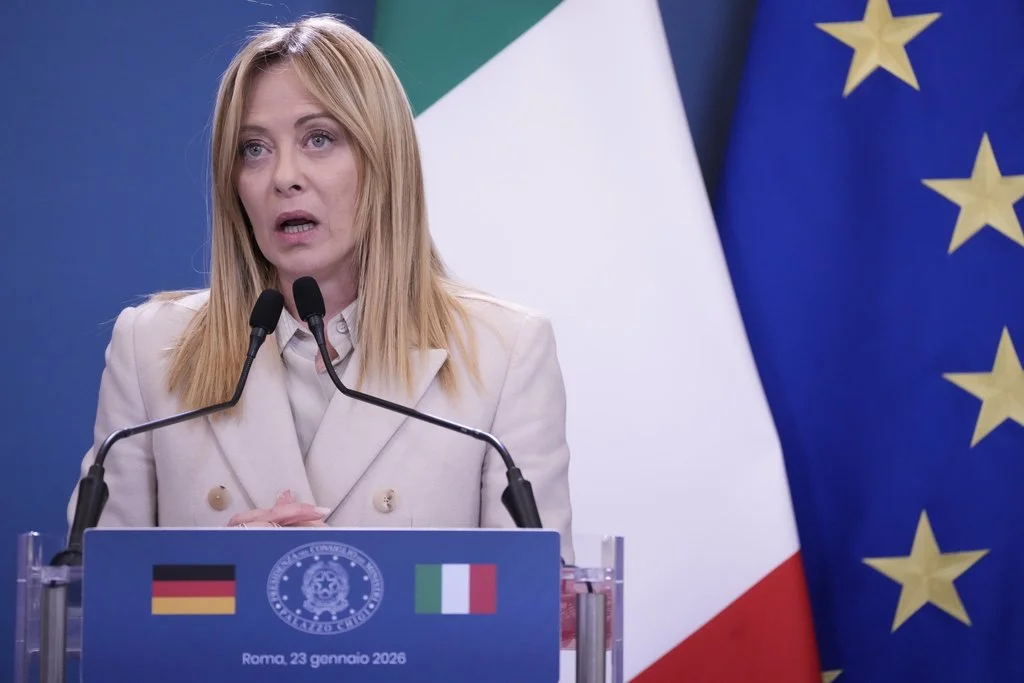
Italian Premier Giorgia Meloni speaks during a news conference at the end of an intergovernmental summit at Villa Doria Pamphilj in Rome, Jan. 23, 2026, to discuss political and economic cooperation. (AP Photo/Gregorio Borgia, File)
With Italy’s general elections creeping up in 2027, the current center-right ruling coalition is under scrutiny for proposing a new bill that could keep Prime Minister Giorgia Meloni in power.
The bill, if enacted, would eliminate all of the first-past-the-post seats available, accounting for a third of Italy’s parliamentary seats. Italy’s current model, a first-past-the-post system in which the “winner-takes-all” through a simple majority, would shift to a proportional system in which the allocation of parliamentary seats is based on a certain percentage of votes that each party receives. In this new system, any coalition that wins more than 40 percent of the vote will be given seat bonuses, designed to put them in a stable majority.
The proposed reform to the electoral system comes as a shock to the opposition parties, having been notified of this discourse only after the deal was struck. Those in favor of the bill say that it would ensure a stable government after the next general elections in 2027, while those against say that it would offer an unfair advantage to Meloni’s administration, leaving the left behind.
The conservative coalition between the right-wing groups “Lega per Salvini Premier,” “Forza Italia,” and Meloni’s own “Fratteli d’Italia,” dominated Italy’s 2022 general election. The democratic opposition had struggled to form a coalition ready to challenge the far-right, ultimately leading to their defeat. Offering a stark change to Italian administrations of the previous 10 years, Meloni’s campaign became favorable amid post-COVID-19 challenges and a turbulent economic outlook. Her promises to manage the post-pandemic funds allocated to Italy through the EU’s National Recovery and Resilience Plan, or the NRRP, also gained support.
Meloni was the first woman to hold the position of Prime Minister and to carry post-Fascist roots, with connection to the far-right party Fratelli d’Italia, whose symbol of a tricolor flag can be traced back to Benito Mussolini’s own party. Since being elected in 2022, she has stepped away from her immediate involvement with the party, but hasn’t effectively denied the ties of the party to its dictatorial past.
Her administration has been described as the most conservative in Italy since World War II. Her politics have been characterized by her criticisms of immigration, anti-LGBTQ policies, and long standing Euroskepticism, where she has talked about removing Italy from the European Union and switching away from the common currency, the euro.
While Meloni has been praised for her ability to maintain a stable economy, there has been little done to incentivize any investment, with a GDP growth of about 0.5 percent, and a projected growth of 0.8 percent in 2026. Compared to Spain, with a growth of 2.9 percent in 2025 and a forecasted growth of 2.0 percent in 2026, Italy’s economic situation is teetering on deficiency. Worlfgango Piccoli, a Teneo political risk consultant, has denoted Meloni’s wary attitude towards public spending and absence of structural change as a lack of ambition.
The NRRP funds, valued at 194 billion euros, were a large support system designed to keep Italy out of a recession. With the NPPR funds set to run out in 2026, the economy is expected to decline rapidly.
Though the left-wing opposition’s votes were fragmented in 2022, a new coalition is expected to form in the next year, giving the bloc a better angle in the 2027 general election under the current system. However, under a completely proportional system, 57 percent of the seats in both houses of parliament would go to the right-wing coalition. Meloni’s Fratelli d’Italia, and the rest of the conservative bloc, would obtain the entire seat bonus presented by the bill.

Italy's Prime Minister Giorgia Meloni, center, speaks with French President Emmanuel Macron, right, during the EU summit at Alden Biesen Castle in Bilzen-Hoeselt, Belgium, Thursday, Feb. 12, 2026. (AP Photo/Omar Havana)
The prospects of the new electoral bill raise other concerns as well. Salvini, of the Lega per Salivini Premier party within Meloni’s government, has long admired Russian President Vladimir Putin whose government is widely considered authoritarian. Salvini has also condemned the sanctions that the EU has implemented against Russia after its invasion of Ukraine, a coordinated response meant to defend international law and democratic sovereignty. Despite her colleague’s views, Meloni has remained supportive of Ukraine during the war against Russia.
The proposed changes to Italy’s electoral system could possibly hinder democracy and incite wider concerns about democratic backsliding. This reflects poorly on Italy, as a key player in the EU and in NATO, affecting the EU’s credibility as a democratic institution.
Democratic backsliding is already a concern in other European countries such as Hungary, under the nearly 20-year rule of Viktor Orbán. His government has been criticized for obstructing media freedom and the rule of law, triggering the Article 7 procedure of the Treaty on European Union.
Italy’s electoral bill reform isn’t an isolated incident within Europe, but one that risks influencing other countries within the EU and beyond.