
US-Iran Standoff in Strait of Hormuz Threatens Economic Crisis for Starmer

Britain's Prime Minister Keir Starmer takes part in a Q&A session on youth employment and cost of living with apprentices in Downing Street, in London, Monday, Nov. 17, 2025. (AP Photo/Frank Augstein, Pool)
Prime Minister Keir Starmer's decision to back U.S. defensive strikes in the Strait of Hormuz is triggering a massive cost-of-living panic in the United Kingdom. The resulting disruption to the global oil trade is surging domestic inflation and is turning Labour voters against the conflict. Now, Starmer's cabinet is scrambling for financial solutions before the upcoming local elections in May.
The current crisis escalated rapidly on March 20, when Starmer allowed the U.S. to use U.K. bases to bomb Iranian missile sites, targeting shipping in the Strait of Hormuz. President Trump issued an ultimatum to Iran, asking the government to reopen the strait by threatening to target its power plants. Iran retaliated by threatening a total blockade. Although negotiations have paused U.S. strikes until April 6, the Pentagon just deployed 2,000 airborne soldiers, fueling speculation of a ground invasion.
Starmer actively refuses to let the U.S. use U.K. bases for offensive strikes against Iran, classifying the March 20 attack on the strait as “collective self defense.” However, bases such as Diego Garcia are launching defensive operations to combat retaliation without encouraging escalation. British officials are considering deploying a Royal Navy "mothership" for mine-clearing drones to reopen the strait, while HMS Dragon heads to the eastern Mediterranean to bolster regional security. Frustrated by this limited involvement, President Trump dismissed British warships as “toys” and claimed he did not need Starmer’s assistance.
This foreign policy tactic carries devastating implications for households across the globe. The Strait of Hormuz is one of the world's most critical energy routes. Approximately 20 million barrels of crude oil pass through it daily, representing roughly 25% of the world’s seaborne oil trade. Furthermore, a report from the International Energy Agency (IEA) states that "except for deliveries to Kuwait, the entirety of LNG (liquefied natural gas) exports from Qatar and the UAE transit the Strait of Hormuz." With Qatar exporting over 112 billion cubic meters of gas annually, Iran's threat has jeopardized global markets.
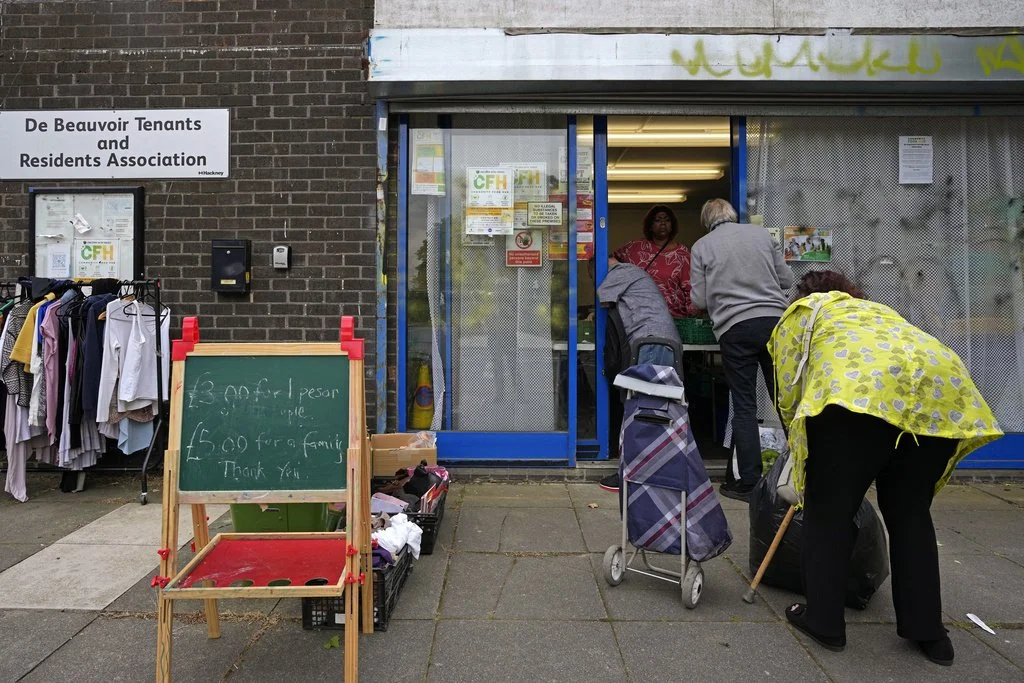
People line up at the Community Food Hub in Hackney, London, Thursday, June 13, 2024. Since calling a general election, British Prime Minister Rishi Sunak has been at pains to repeat a key message on the campaign trail: The economy is turning a corner, inflation is down, and things are looking up. That’s not the reality for millions across the U.K. still feeling the squeeze from high food, energy and housing prices. (AP Photo/Kin Cheung)
In the UK, petrol prices spiked by 10% and diesel increased by a staggering 20% between late February and late March. However, the conflict impacts more than just fuel. The National Farmers’ Union warns that surging fertilizer costs will inevitably drive up food prices, while household gas bills will rise rapidly. Additionally, the crisis has even derailed the U.K.'s broader economic recovery. On March 19, the Bank of England warned that inflation will climb between 3% and 3.5% through mid-2026, rather than falling as economists had previously hoped.
To address the situation, Starmer convened an emergency Cabinet Office Briefing Rooms (COBR) meeting with Chancellor Rachel Reeves and Energy Secretary Ed Miliband. They aim to explore “every lever that’s available” to ease the cost of living. However, Downing Street rejected immediate financial bailouts, choosing to focus on preventing fuel shortages and pressing regulators to “stamp out profiteering.” According to YouGov, British opposition to the conflict surged from 49% to 59% in just one week.
The strikes are also deeply unpopular within Starmer’s own base. Initial polling shows that 64% of Labour voters oppose the action, while right-wing Reform UK voters generally support it. With local elections rapidly approaching, this crisis arrives at a crucial time. It is unclear how the fallout will affect the elections, but the incumbent Labour Party will likely suffer the consequences of the backlash. In May, British voters will decide if Starmer's foreign policy decisions are worth the price of their skyrocketing household bills.