
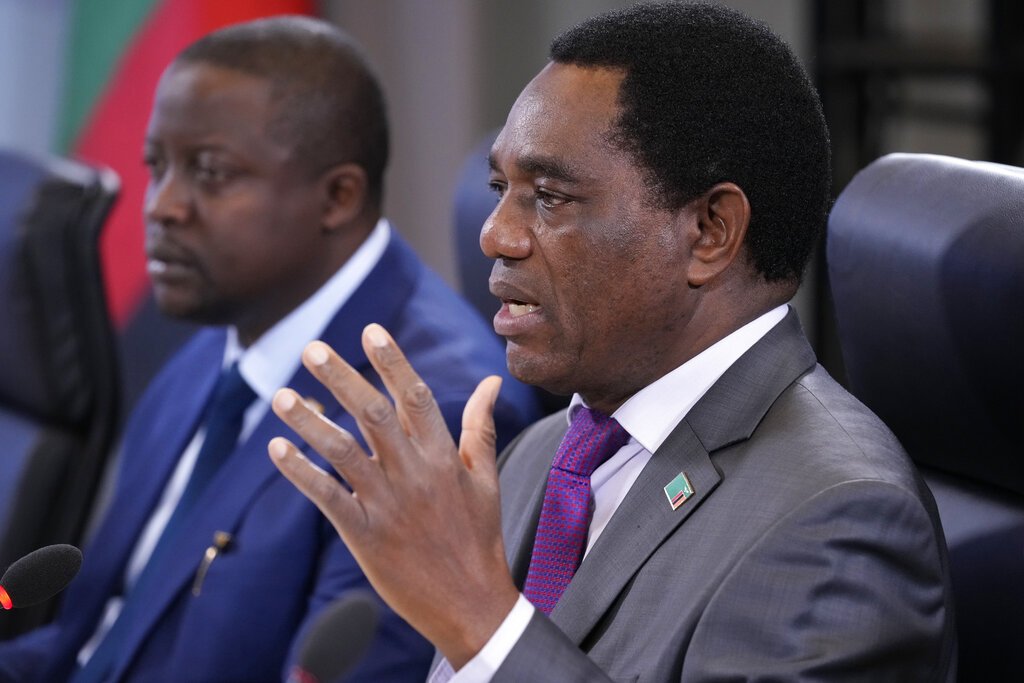
Zambia's President Hakainde Hichilema speaks during a meeting with Treasury Secretary Janet Yellen during the U.S. Africa Leaders Summit at the Walter E. Washington Convention Center in Washington, Thursday, Dec. 15, 2022. (AP Photo/Andrew Harnik)
On Oct. 10, the Republic of Zambia and the United States (U.S.) signed a five-year, $2.5 billion health-financing Memorandum of Understanding (MOU). The deal is part of the Trump administration’s new America First Global Health Strategy (AFGHS), which follows the dismantling of the United States Agency for International Development (USAID). AFGHS focuses on strengthening bilateral relations and entering into multiyear bilateral agreements contingent on co-investment from recipient governments. Under this deal, the U.S. government plans to commit $1.52 billion in health assistance, and Zambia is committing to invest $975 million in its health system. The MOU stresses the transition to Zambia’s increased responsibility for its health system. The deal aims to support Zambia’s more than 1.3 million HIV-positive citizens, as well as an estimated 7.3 million malaria cases and 60,000 tuberculosis cases each year.
Although the deal was successfully signed, progress required overcoming hurdles. A 10-month delay in signing the agreement stemmed from the U.S. seeking provisions that would grant broader control over the country’s rare earth and copper deposits, a move Zambian government officials did not favor. Mulambo Haimbe, Zambia’s Minister of Foreign Affairs and International Cooperation, publicly criticized Washington’s decision to tie the health deal to “preferential access of U.S. companies over Zambia’s critical minerals.” Haimbe emphasized that Zambians will dictate how their critical minerals are used, and Zambia will not give one country special treatment.
For Haimbe, the activists, and the Zambian people, the U.S.-Zambian health-financing deal was a resounding success. The Zambian government was able to convince the U.S. government to backtrack on its earlier provisions and decouple the health-financing MOU from critical minerals negotiations. In doing so, Zambia also secured an additional $504 million investment from the U.S. and carved out an opportunity for a separate critical minerals deal.
Under Zambia’s National Critical Minerals Strategy, the country officially classifies 11 critical minerals, with copper as the most important, accounting for 70% of export earnings. Zambia ranks as the world’s eighth-largest producer of mined copper and the second-largest in Africa. With such high copper output and copper’s foundational role in the green energy transition, the artificial intelligence buildout, and national defense infrastructure, President Hichilema has leveraged his country’s key natural resources as a strategic wedge between the world’s two major superpowers—the U.S. and China—which are jockeying for position over Zambia’s copper reserves and rare earth minerals.
As Zambia signed its landmark deal with the U.S. this week and kept the critical minerals deal on the table, it also announced a deal with China—beginning next year, Chinese buyers of its copper exports will pay in renminbi. This decision follows the country’s acceptance of mining royalties and taxes in renminbi, making Zambia a trailblazer among African states that are increasingly shifting away from reliance on the dollar.
Experts have weighed in on renminbi settlement and found that although the U.S. dollar remains the dominant currency for pricing global commodities, settling in renminbi can reduce exchange-rate risk and let countries transact directly with Chinese suppliers. Moreover, as trade between China and many African nations increases, settling in renminbi has let those countries eliminate currency conversion steps, lowering exchange-rate risk and transaction costs.
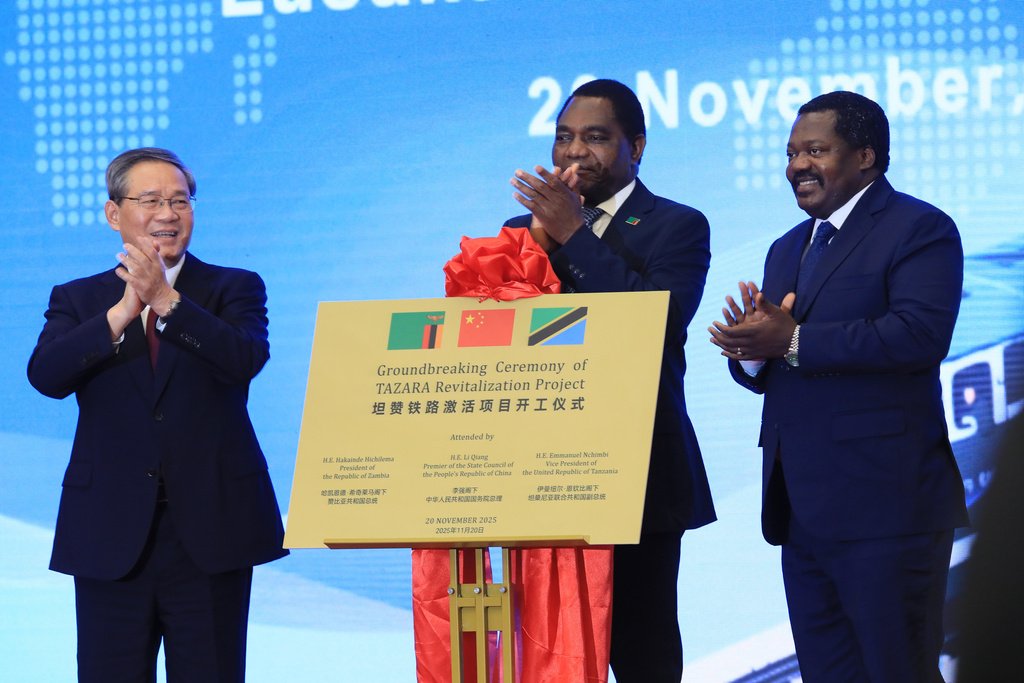
From left: Chinese Premier Li Qiang, Zambian President Hakainde Hichilema, and Tanzanian Vice President Emmanuel Nchimbi applaud during the launch of the TAZARA (Tanzania–Zambia Railway) revitalisation project in Lusaka, Zambia, Thursday, Nov. 20, 2025. (AP Photo)
The AFGHS stands on three pillars: Making America Safer, Making America Stronger, and Making America More Prosperous. Under the Making America Stronger pillar, Leveraging U.S. Global Health Leadership to Compete With China is a key component of the strategy. The strategy emphasizes using U.S. foreign health assistance to counter China’s influence in Africa and highlights Africa’s critical mineral supply as inputs for advanced military and commercial technologies. Hichilema’s recent deals with both China and the U.S. aren’t a strategic maneuver but a prominent leader using his state to command leverage rather than succumb to either superpower. With China holding dominant influence over mineral operations in Zambia, the U.S. lacks the competitive advantage it aimed to establish in AFGHS. Looking past this week's announcements, we should expect a U.S.-Zambia rare earth minerals deal. It remains to be seen how China’s influence over the country and Hichilema’s relationship with China will affect this deal and the future of U.S.-Zambian relations.