
The Shakeup of Mali’s Junta
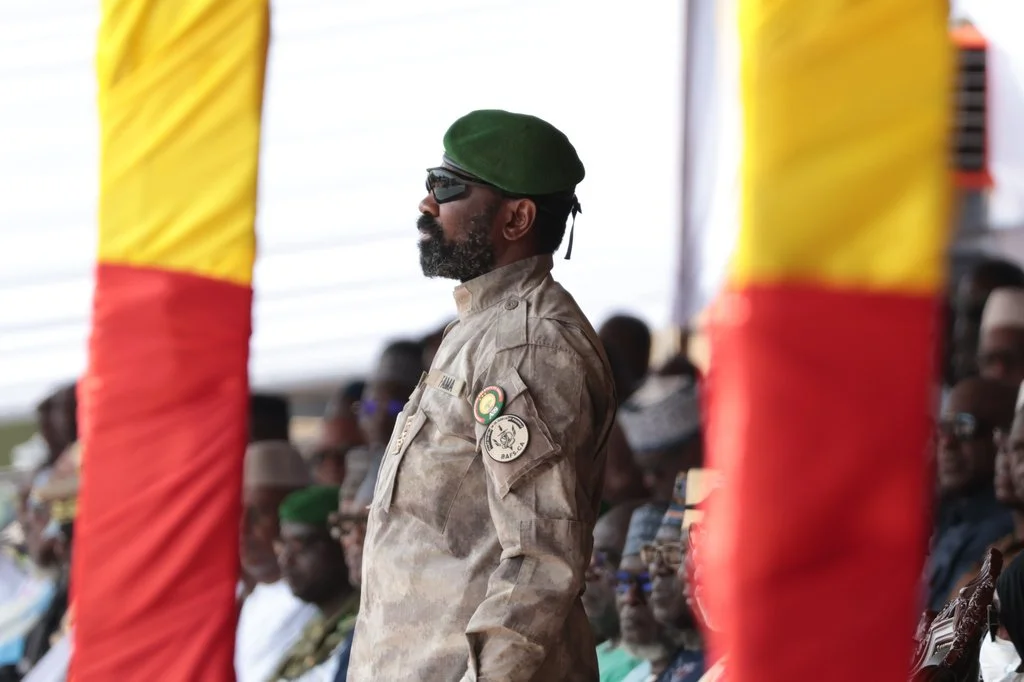
Mali's junta leader Gen. Assimi Goita attends the funeral of former defense minister Sadio Camara at the Military Engineering Parade Ground in Bamako, Mali, Thursday, April 30, 2026. (AP Photo/Boubacary Bocoum)
On April 25th in Mali, rebel militants and separatist groups launched a coordinated series of attacks against Mali’s (military) junta government—the largest in over a decade. The Azawad Liberation Front (FLA), Tuareg separatists, and the Al Qaeda-linked ‘Jama'at Nusrat ul-Islam wal-Muslimin’ (JNIM) coordinated a joint offensive against Mali’s junta and their Russian paramilitary partners, The Africa Corps, formerly The Wagner Group. In these coordinated attacks, the militants targeted multiple sites across the country: Kati, Gao, Kidal, Mopti-Sévaré, and the capital Bamako.
In a confirmed statement from JNIM, the group declared responsibility for the attacks on Assimi Goïta, Mali’s President, and the assassination of Sadio Camara, Mali’s Defense Minister. JNIM also claimed that the group had obtained complete control of the cities of Mopti and Kidal.
Kati, a town twelve miles from Bamako, was the site of General Sadio Camara’s assassination. Mali’s Minister of Territorial Administration, General Issa Ousame Coulibaly, confirmed that Camara’s residence was targeted by a suicide car bomber in coordination with other attackers.
In Camara’s prior capacity as Colonel, he served as one of the key leaders in the August 18th, 2020 coup, led by now President Assimi Goïta. Goïta established a junta-led government, the National Committee for the Salvation of the People (CNSP), forcing then-President Ibrahim Boubacar Keïta’s arrest, resignation, and the dissolution of the former government.
In reaction to Goïta’s coup, leaders from the Economic Community of West African States (ECOWAS)—tasked with increasing economic cooperation amongst its members to raise living standards—exerted pressure on the CNSP and Goïta to return power to civilians. A declaration from ECOWAS on August 28th, 2020, “[called] on the CNSP leadership to immediately begin the process for a civilian transition in consultation with [Mali’s] Constitutional Court.”
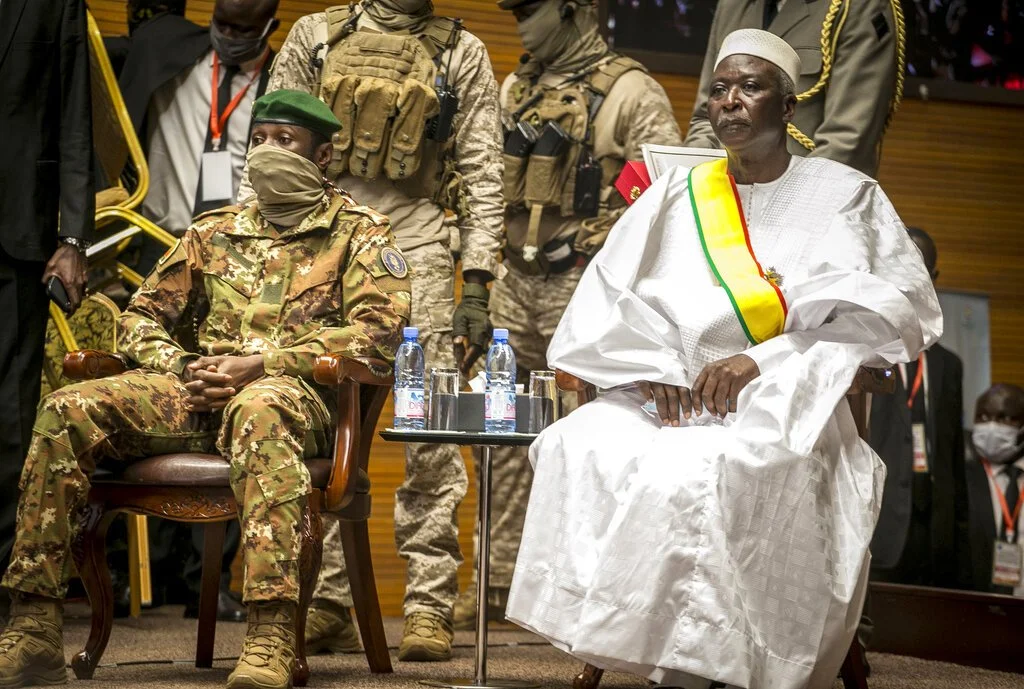
Former Defense Minister and retired Col. Maj. Bah N'Daw, right, is sworn into the office of transitional president, and Col. Assimi Goita, left, head of the junta that staged the Aug. 18 coup, is sworn into the office of transitional vice president, at a ceremony in the capital Bamako, Mali, Friday, Sept. 25, 2020. Mali's transitional president and vice president were sworn into office Friday, more than a month after a coup in the West African nation, as Mali remains under sanctions by the 15-nation West African regional bloc ECOWAS, and amid uncertainty about details of the transition period. (AP Photo)
Goïta stepped down as president on September 25th, 2020, after serving 38 days in office. A group of 17 electors appointed Bah Ndaw as president and Goïta as vice president. The electors tasked Ndaw, Goïta, and Prime Minister Moctar Ouane with leading an 18-month transitional government with the commitment to hold elections at the end of the period.
Weeks later, in October 2020, Ndaw announced a 25-member transitional cabinet, with three members from CNSP leadership. Camara, one of the three, was appointed defense minister. On May 14th, 2021, a cabinet reshuffle led by Ndaw and Ouane removed Camara from his position. Ten days later, the public announcement of the new cabinet, excluding Camara without consulting Goïta, who oversaw Mali's defense and security ministries, prompted a second coup. This resulted in Ndaw's arrest and Goïta's reclamation of the presidency. Amid the second coup, Camara was reinstated as defense minister.
Under Camara’s leadership as defense minister, Mali pivoted toward Russia and away from France. French troops had been deployed to Mali in 2013 as part of a counterinsurgency effort—Operation ‘Serval’. Originally a success, Serval prevented Tuareg separatists from advancing towards the capital of Bamako. In 2014, this operation expanded into Operation ‘Barkhane’, focused on expanding the French troop presence to counter militant Islamist groups beyond Mali into Niger, Burkina Faso, Chad, and Mauritania.
Relations between France and Mali broke down in 2022, under Goïta and Camara’s leadership, leading to the full withdrawal of French troops in August of that year. As the French were withdrawing, Russian paramilitary soldiers began deploying to Mali. An estimated 2,000 Russian soldiers are currently deployed in the country.
In the recent April 2026 rebel attacks across Mali, Russian African Corps fighters who were stationed in Kidal chose to withdraw from the town due to the threats they were facing from the FLA and JNIM. The FLA seized control of Kidal following the withdrawal of Russian and Malian forces.
Following the attacks on Goïta and the killing of Defense Minister Camara, Goïta maintained a low profile. In his first public appearance, three days after the attacks, he met with the Russian Ambassador to Mali, Igor Gromyko. Later that day, he made his first public address to the country.
Questions mount from the international community about the ability of Russian paramilitary forces to counter rebel groups in Mali, and whether Mali's alignment with Russia over France was a wise decision.